The JRB presents an excerpt from Chris Hani: A Life of Courage and Compassion, the new authorised biography by Zakes Mda.
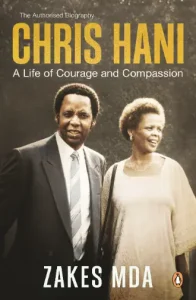
Chris Hani: A Life of Courage and Compassion
Zakes Mda
Penguin Random House South Africa, 2026
~~~
A Soldier’s Soldier
In 1987, an argument about Paul Simon’s Graceland revealed something of Hani’s reluctance simply to repeat the official line. His former comrades remembered the same openness in the way he dealt with the guerrillas under his command.
In 1987 Graceland became an issue. The previous year Paul Simon had released this album, recorded with such South African musicians as Joseph Shabalala and his group Ladysmith Black Mambazo, Ray Phiri and his group Stimela, Bakithi Kumalo, General M.D. Shirinda and the Gaza Sisters, Lulu Masilela, Tau ea Matšekha, Boyoyo Boys, and Morris Goldberg. The album received significant critical and commercial success, winning the Grammy for Album of the Year and achieving sales figures of over sixteen million copies worldwide.
When Hani arrived at his home in Lusaka one afternoon, three of the guerrillas who lived with him were arguing about Graceland. One was admonishing his comrades for listening to ‘that rubbish’. The reason was that Paul Simon had broken the cultural boycott that the Anti-Apartheid Movement (AAM) worldwide had declared against South Africa – part of the campaign to boycott apartheid South Africa in all spheres of life.
Paul Simon had found a bootleg tape of music from South Africa, was enthralled by it, and planned to go to the country to meet those groups and maybe cut an album with them. He was warned that there was a cultural boycott against South Africa and his going there would be breaking it. The AAM under the leadership of Father Trevor Huddleston and Oliver Tambo were very strict on the boycott.
Paul Simon defied the boycott, went to South Africa, met the groups and cut an album with them. The result was Graceland, which became so successful that Simon organised a US and a British tour. The Graceland Tour, as it was named, opened in Rotterdam in the Netherlands on 1 February and on April 7 it had six sold-out concerts at the Royal Albert Hall in London. The tour was picketed everywhere it went. The pickets were worse in London where Huddleston could lead them personally with the help of such ANC activists as Jonas Gwangwa and John Matshikiza. By this time Paul Simon had invited Hugh Masekela onto the tour, who in turn invited Miriam Makeba. This pitted the two boys of the Huddleston Band, Hugh and Jonas, against each other.
Masekela adopted a very defiant mien, even against Tambo. His argument was that the cultural boycott was meant to punish apartheid South Africa. Why should it punish Black South African artists who had been given such a great opportunity by an international star of the stature of Paul Simon to showcase their talent to the world? For many of them this was a great opportunity to establish themselves to international audiences and feed their families.
Huddleston and Gwangwa were toeing Oliver Tambo’s line that the boycott must be applied strictly. They felt that Masekela’s argument was mercenary. South African artists should be prepared to sacrifice international stardom in the same way that soccer players were sacrificing playing in the FIFA games, rugby players were sacrificing playing against top rugby nations, and sports people of all kinds were sacrificing competing at the Olympics and the Commonwealth Games. They were losing a lot but were prepared to go through the temporary suffering in order to bring about permanent change in South Africa.
The guerrilla who was loving Graceland was using Masekela’s argument, while his two comrades were of the view that Tambo had spoken and his word was sacrosanct. They wanted to know what Hani thought. He surprised them when he didn’t immediately take the Tambo–Huddleston–Gwangwa position in a knee-jerk manner, but, while admitting that Paul Simon shouldn’t have gone to South Africa in the first place, insisted that something good could still come out of the musicians who had seen some limelight through him. Yes, the apartheid system would point at them and say, ‘Look how happy our Blacks are! How talented! How sophisticated! Do these look like oppressed people?’
Miriam Makeba and Hugh Masekela had set the record straight to the world community about the viciousness of apartheid before. Who could forget Makeba’s speech at the United Nations and her participation in various international campaigns for the liberation movement in general, not just the ANC? Under her influence the rest of the musicians, after their profiles had been raised thanks to Graceland, could create critical awareness about the need for the liberation of South Africa too.
They could be an asset to the liberation struggle if only the ANC won them over to their side instead of treating them like polecats.
This showed the tolerant and patient side of Hani’s that every former guerrilla that I interviewed praised.
Mac Maharaj talked movingly about this quality of Hani’s to me.
‘Chris was a soldier’s soldier’, he says. ‘He related to his soldiers not as a person who wielded power over them. He was very easy in his relationship with his cadres. That’s why I call him a soldier’s soldier rather than an officer. He had the Mandela quality where even if he met you one time, he would relate to you. He meets you once and two years later when he meets you again he remembers you, he knows your name, and where you came from. The combatants in the camps related to him and took their problems to him. He related to them like a caregiver.’
They cried to him when they felt there was an injustice at the camps. But there was this one time when he cried to them. He was frustrated by the right-wing element within the ANC, and he cried tears.
‘They do not like your ilk, or me for that matter’, he is reported by Mabandla to have said.
Mabandla writes of a dinner that was held for him and the rest of the cadres who had just arrived in Zambia from Lesotho after the great Lekhanya deportation, and to everyone’s amazement Hani went to town praising his ‘presumed rival’ Thabo Mbeki, calling him the best political strategist in the movement, with Joe Slovo coming a close second. Mbeki was a man of sheer talent with a computer-like brain.
Mabandla continues: ‘With tears in his eyes, Hani also offered concern and a warning. “I am worried about what you may see here in Lusaka. It is a difficult place. A number of people here have given up on the fight against apartheid. They have grown comfortable and fat in exile. [He named names.] This may deflate you who have been engaged in a daily existential battle with the enemy in Lesotho – indeed, permanently engaged in manoeuvres with the enemy for strategic advantage. What you may glean here about your movement may drive some of you away. It may discourage you.”’
Mabandla does not say what names Hani named, which is a pity. Every ex-combatant I spoke with said Hani would never speak behind your back. If he wanted to keep those names secret he would not have named them. I would speculate that one of those names was Joe Modise. You may remember that Hani and his comrades did name him quite openly in their famous Memorandum. There was no love lost between the two, in the same way that there was no love lost between Hani and Mbeki – besides moments of mutual admiration.
Hani was so frustrated that he considered giving up leading the armed struggle and going back to school to improve his education. He had always wanted to be a lawyer, but the call for the liberation struggle was too strong.
Despite his frustrations, he continued. He and Tambo met delegations from various organisations from South Africa that were either reaching out to the ANC after seeing the writing on the wall or were invited by the ANC itself for a tête-à-tête. They included Bantu Holomisa in 1988, who came with his delegation that included T.T. Matanzima and Derrick Mgwebi to confer with Hani and his fellow military leaders; COSATU, whose meeting with Hani and Tambo, according to Mabandla, was a bit testy; and KaNgwane leader Enos Mabuza and his Inyandza Party. Mabandla says Mabuza even advocated that Inyandza youths be part of MK.
While Hani was having his tête-à-tête with various internal players on the military side of the struggle, Mbeki was having his détente on the diplomatic side – holding what he called exploratory dialogue between the ANC and influential members of the Afrikaner community in Dakar, Senegal – known as the Dakar Conference. The whole debate of doves versus hawks, and military versus diplomats, came up again when Hani voiced his opposition to Mbeki’s diplomatic efforts.
On 27 October 1987, at a ceremony to mark his birthday, Oliver Tambo announced that Chris Hani would become the new MK chief of staff, replacing Joe Slovo, who became the general secretary of the South African Communist Party. Steve Tshwete replaced Hani as the political commissar of MK. Joe Modise continued in his old position as the commander of uMkhonto we Sizwe. The commander-in-chief, of course, was Oliver Tambo.
~~~
- Zakes Mda is an acclaimed novelist, playwright, poet and painter. He was born in the Eastern Cape, but spent his early childhood in Soweto, finishing his school education in Lesotho. His books include Ways of Dying, The Heart of Redness, Little Suns and The Zulus of New York, and his work has been translated into more than twenty languages. The recipient of South Africa’s Order of Ikhamanga in Silver, Mda divides his time between South Africa and the United States.
~~~
Publisher information
Chris Hani is remembered as the fearless guerrilla commander, communist leader and revolutionary whose assassination changed the course of South African history. But behind the public icon was a son, husband, father, intellectual, mentor and friend whose life has never before been explored with such depth and intimacy.
Drawing on years of research and extensive interviews with family members, comrades-in-arms and political contemporaries, acclaimed writer Zakes Mda offers the most complete portrait yet of one of South Africa’s most admired – and contested – freedom fighters. Tracing Hani’s childhood in rural Cofimvaba, his political awakening, his battlefield experience in the Wankie Campaign, his challenge to the ANC leadership, his work directing underground operations from Lesotho and elsewhere, and the turbulent final years of apartheid, the biography tells the story of an extraordinary individual and of a nation fighting for freedom.
Mda moves beyond myth to reveal the contradictions, sacrifices and relationships that shaped Hani’s life, exploring his unwavering commitment to justice alongside his deep devotion to family and comrades.
Richly researched and compellingly written, Chris Hani: A Life of Courage and Compassion reveals why, more than three decades after his death, Hani remains one of South Africa’s most admired, compelling and consequential political figures.