The JRB presents an excerpt from Lilian Ngoyi: A Life, the new biography by Martha Evans.
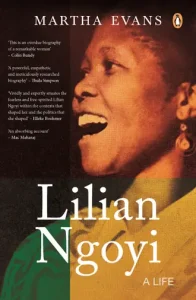
Lilian Ngoyi: A Life
Martha Evans
Penguin Random House South Africa, 2026
~~~
The Jazz Pianist
As soon as he saw me, I was the one for him. And it was the same with me.
– Lilian Ngoyi, on meeting her future husband
Very little is known about the man whose surname Lilian Ngoyi would bear for the rest of her life. The scant information about him comes from a 1924 court case, the details on their marriage certificate and what Lilian wrote in her short autobiography. These records suggest that while John Gerald Ngoyi was an appealing prospect to the teenage Lilian Matabane, he was likely a cause of concern to her parents. Although he came from a respectable Johannesburg family and was highly educated, he also had a penchant for fast cars, women, liquor and jazz.
The first official mention of Lilian’s future husband appears in the pages of the Rand Daily Mail in 1924, some five years before they met. A ‘John Ngoi’, in all likelihood the same person as John Ngoyi, appeared in the Witwatersrand Criminal Sessions in connection with a ‘curious’ case of automobile theft. A few months earlier, police had found him, together with a ‘lady friend’, driving a missing motor vehicle ‘recklessly’ some twenty miles from its registered owner, who reported that the car had vanished from outside the New Club in Loveday Street on a Saturday evening.
John Ngoyi’s defence, although somewhat muddled, remained untested. He claimed he was picked up by two white men, who were driving the car around Johannesburg on Sunday morning. The trio proceeded to embark on a joy ride of sorts. The Europeans plied their new friend with liquor and then drove to Krugersdorp, where the two men gave up the game and caught a train home, instructing the hapless John to drive the car back to Johannesburg. At his trial, John’s requests to locate witnesses, and for a barrister to represent him, were ignored, and he was summarily found guilty and sentenced to fifteen months’ hard labour. The affair, not something to highlight on a suitor’s résumé, must have put paid to any further desire to fraternise with whites on the young man’s part, but it did not extinguish his lifelong love of automobiles.
Like Lilian, John had grown up in an urban setting and, by the late 1920s, the Ngoyis were entrenched in Johannesburg. Their settlement in the city mirrors the trajectory of the Matabane family, although the Ngoyis would have hailed from the Eastern Cape. Like Lilian’s parent’s, John’s parents were both literate and religious. The couple, William Wellington Ngoyi and Eva Lulu, married in 1899 and settled in the city around the turn of the century. In the post-war years, Wellington became an active member of the Johannesburg Presbyterian Native Church, often leading the church in song. In 1903, they started a family and went on to produce four children, two girls and two boys. John, born in 1904, was their first son.
Wellington found employment at City Deep Mine as a dressing station attendant (seeing to mine-related injuries), and many immediate and extended family members were linked with the mine and its hospital. It is here, according to some sources, that Lilian and John met.
Lilian later described their meeting as a case of love at first sight. Standing outside a house, she’d been singing ‘Johnny’, a popular song with lyrics along the lines of ‘I’ve met men, but never anyone like you, Johnny’. Overhearing her, a young man came outside, took one look at her and announced, ‘I’m Johnny!’
‘As soon as he saw me’, Ngoyi said, ‘I was the one for him. And it was the same with me.’
This meeting changed the course of her life: before she was able to finish her nursing training, Lilian fell pregnant, an event to which most biographical accounts pay little attention. Ngoyi herself glosses over it, possibly to deflect attention away from the fact that she was unmarried. For a teenage girl to fall pregnant out of wedlock, away from home, and on the eve of promising professional prospects, must have been both frightening and disappointing; her Methodist upbringing, and the nursing profession’s puritanical views, would have added an element of shame to the incident.
Lilian’s fate was the crystallisation of parents’ deepest fears for their daughters in the city. There was both a real and perceived fear that naïve young daughters would fall prey to the seductions of men with bad intentions, and find themselves pregnant, abandoned, unemployed and unmarriageable.
Lilian’s case was slightly different, given that she was familiar with town life and had not arrived in Egoli fresh from the countryside. But in many ways she had more to lose. She later claimed that she worked as a trainee nurse for three years and left because her mother ‘really did not approve’ of the profession, advising her to take up dressmaking instead. There is likely some truth in this; dressmaking would have given Lilian more flexibility to raise her child. But given the strict standards of the nursing programme – no married women, widows or mothers were admitted as trainees – it also seems probable that she was dismissed when her pregnancy was discovered.
And so, in 1930, at the age of nineteen and with just one year of her training remaining, Lilian Matabane gave birth to a daughter, Edith. Undeterred by the challenge this presented, she gave her child the African name Mahlatse, which means ‘luck’ in Sepedi. And for some time, Lilian’s daughter did indeed bring her luck.
A few years after Edith’s birth, Lilian and John wed. The wedding – a low-key affair, the formalisation of an existing arrangement – was held on a Thursday in November 1934 and conducted by the Johannesburg marriage officer for coloured persons rather than a church minister.
The marriage and early years of motherhood were by all accounts happy and carefree. Records suggest that John was a sociable person with a jolly disposition. A qualified teacher, he’d left the profession because of the notoriously low salaries paid to black colleagues. (In 1921, the inspector of Native Education remarked that the ‘vast majority of native teachers are paid less than they can earn as manual labourers’, adding that it was ‘small wonder that the best teachers leave the profession to become clerks, interpreters and motor-drivers’.) John – who was Lovedale-educated – therefore sought alternative, better-paying employment. He appears to have worked in various capacities, his early love of automobiles prevailing. Keenly interested in motor mechanics, he worked for a while as a van driver at a time when ‘Driver Wanted’ advertisements populated the newspaper columns.
Lilian wrote that after her marriage ‘a burden from my mother’s shoulders was eased’. Presumably, this was not only because of her improved financial position, but also because John, seven years her senior, embraced his responsibilities as a father and husband. In this respect, one might say Lilian was fortunate. Increasingly, the city harboured what the missionaries termed ‘fallen women’ – desperate women who turned to illicit beer-brewing, prostitution and/or casual living arrangements, perceived as immoral. Many had been deserted by their husbands or lovers; some were pregnant or had been abandoned with children to raise alone. This had been such a concern to the missionaries that in the 1910s they set up hostels to shelter naïve young women upon their arrival in the city so that they would not, as the editor of Bantu World put it, ‘drift into temptations’. The blame could not, of course, be placed solely on the young women, or even on opportunistic men. The migrant labour system had much to answer for in this regard. Its devastating effect on family life is apparent in the number of illegitimate births in Johannesburg; in 1932, for instance, of the 809 registered native births, 380 were listed as illegitimate.
But John and Lilian’s upbringings gave them the ability to steer through urban challenges with a sound moral compass, and John’s relatively well-paying employment also gave them a wider array of options.
The young couple resided in the native married quarters of City Deep Mine. Accommodation here was highly prized – partly because of the presence of women, many of whom brewed liquor, and partly because the rooms were less cramped. Despite the name, only about a third of the women living in the compounds were the bona fide wives of their living partners. Legally, women were unable to rent rooms themselves in Johannesburg, so many moved in with lovers, brothers, sons or other male relatives living in married quarters. Some women agreed to play the role of wife for mine employees eager to secure lodging in the sought-after compounds, exchanging favours, sexual and/or domestic, in return for shelter. This was a mutually beneficial arrangement and the practice of ‘acquiring’ a wife to gain access to accommodation also became widespread in site-and-service schemes.
Because of this, the married compounds had a poor reputation and were seen as dens of depravity. Originally reserved for more skilled mine employees, the arrangement became looser over time. By the 1930s, the compounds began to resemble the mine locations they had been intended to replace; extended family members, men and women, seeking to gain a foothold in the city, began to move in, and soon rooms were leased and sub-leased to all and sundry. Nelson and Evelyn Mandela, for instance, moved into City Deep’s married quarters with Evelyn’s sister and her husband in 1944, and Lilian and John lived there for some time before their union was solemnised.
Freed from the draconian constraints of the nursing probationer’s programme, the couple dabbled in some of the pleasures of urban life. Interestingly, on their marriage certificate, John had initially listed ‘jazz pianist’ as his occupation, but then for some reason thought better of it, scratched it out, and replaced it with the less glamorous and more respectable ‘bookkeeper’. Perhaps Lilian or the marriage officer advised him against it, or perhaps he had his own concerns about how this description might be perceived. Either way, his about-turn reflected many of contemporary tensions associated with the urban subculture.
Together with ballroom dancing and vaudeville, jazz played an important role in Johannesburg in the first half of the century. It encapsulated the ambitions of the repressed elite (mission-educated, upwardly aspirant urban Africans), and many successful bands enjoyed the admiration of both black and white society. Some hoped that culture would succeed where politics had failed in the Union. ‘These European night clubs are serving a factor to a better South Africa’, wrote the arts columnist for Bantu World in 1941. ‘They are breaking slowly but surely the segregation barrier set up by dirty politics’. Inspired by American counterparts such as Paul Robeson, Duke Ellington and Fats Waller, black Johannesburgers’ embrace of jazz was an expression of racial pride, evident in the names of bands and troupes, including De Pitch Black Follies, the Bantu Revue Follies and the Merry Blackbirds. Despite the restrictive pass laws and night-time curfews, popular ‘Concert and Dance’ events – variety performances held until the early hours of the morning – helped to ‘make life sweet and brilliant’.
John was musical, possibly even talented enough to play for one of the rising jazz ensembles himself. For her part, Lilian enjoyed dancing and spent many an evening participating in the new craze sweeping through the city’s dance halls. In the heady pre-war years, ballroom dancing also grew in popularity, and standard ragtime dances – the Charleston, foxtrot and quickstep – were the order of the day. Live bands played music inspired by tunes heard on the radio, gramophone records or in international films. These events, held weekly, also allowed budding musicians to showcase their skills, the most popular bands being the Empire Follies, the Darktown Strutters and the Merry Blackbirds.
The dress code was smart; at the more formal events, women’s lacey low-backed dresses swept across the floor, and feathery fans provided splashes of colour. Men wore stylish suits, bow ties and tails. The venues were transformed into magical arenas. ‘Flopping hangings, half-dark illuminations, glittering adornments, dazzled one’s eyes’, wrote Bantu World of a 1933 event held at the New Inchcape Palais de Dance (dubbed the Ritz). Keen participants formed clubs, and sometimes events were held as fundraisers. Lilian was so enthusiastic that she danced competitively. In a Drum profile – written two decades later – Ezekiel Mphahlele referred to her ‘short interlude of ballroom dancing in the competition ranks’.
In the early days, jazz and ballroom dancing were frowned upon, and newspapers frequently published letters from disapproving readers. ‘The modern manner of mixed dancing that is carried on these days by the people who profess to be the true followers of Christ, is the cause of untold sin and wretchedness’, opined an E.J. Tilo in 1936. But the night-time frolics quickly gained a better reputation. According to an article in New Nation, together with soccer, ballroom dancing was forming a ‘respectable’ new culture. Indeed, the names of the various clubs – the Oxford Sailors, British Central, Rainbow and Parktown – reflected the aspirations of the dancers.
Through her marriage, Lilian would have acquired a new family, including, for the first time, sisters. The extended Ngoyi family features prominently in the social columns of Umteteli wa Bantu – there is a mention of a Miss F. Ngoyi (presumably Flora, Lilian’s sister-in-law), and a Joseph Veli Ngoyi – a possible cousin and keen cricketer who scored several centuries for City Deep in matches against neighbouring mines. Lilian’s brother-in-law, Paul Gladstone Ngoyi, was a high flyer who attended and hosting many of the social events. Mentions of Lilian are sparse and vague; in 1938 the newspaper notes that a Mrs L. Ngoyi (presumably Lilian) formed part of a farewell party for a couple departing for Grahamstown for the holidays the preceding year. Other than this, she is absent from the society pages.
Sadly, this carefree time was indeed merely an ‘interlude’ for Lilian. John’s passion for motor vehicles eventually caught up with him. In the first half of the century, a combination of poor infrastructure, reckless driving and confusing road signs resulted in congested and dangerous Johannesburg streets. In 1933, the president of the Automobile Association complained that lax laws were turning South Africa into a utopia for the ‘road hog’, and fatalities increased year on year. The authorities posited numerous solutions: harsher penalties, wider roads, compulsory eye tests, a reduction in tram stops. Eventually, these combined measures led to improved road safety, but not before John Ngoyi became a casualty of the city’s inability to keep up with its rise in traffic.
In April 1937, a mere three years into their marriage, John was injured in an automobile accident. After a two-week battle for his life, Lilian’s husband, just thirty-three, succumbed to his injuries. The short obituary in Bantu World hints at the sadness that accompanied the abrupt end to his fleeting life.
His many friends will be shocked to hear of the untimely death of Mr John Gerald Ngoyi, son of Mr and Mrs Wellington Ngoyi of City Deep. The late Mr Ngoyi was of a very cheerful and lovable disposition, and was blessed with many friends. He was an able pianist and a keen motor car mechanic. He was laid to rest on Tuesday morning. Heartfelt sympathy is extended to his bereaved wife and child and parents.
‘I was now back where I started’, Lilian later wrote of the tragedy. An unemployed widow, with a seven-year-old daughter to raise alone, she was in fact worse off.
~~~
- Martha Evans is an associate professor at the Centre for Film and Media Studies at the University of Cape Town. She is the author of Broadcasting the End of Apartheid: Live Television and the Birth of the New South Africa (2014), Speeches that Shaped South Africa: From Malan to Malema (2017) and Lilian Ngoyi: A Life (2026).
~~~
Publisher information
‘Vividly and expertly situates the fearless and free-spirited Lilian Ngoyi within the contexts that shaped her and the politics that she shaped’
—Elleke Boehmer
Lilian Ngoyi was a trailblazing figure in South Africa’s liberation struggle – an electrifying orator, a key architect of the 1956 Women’s March, and the first woman elected to the ANC’s National Executive Committee. Yet her life story has never been fully told.
In this authoritative and deeply researched biography, Martha Evans brings MaNgoyi vividly to life. Born in a Pretoria location, widowed young and raising her family in poverty, Ngoyi truly represented the people she spoke for and was the most senior ANC woman leader not married to a high-profile man, forging her own path through her political instinct, charisma and formidable courage.
From the Garment Workers’ Union to the Federation of South African Women and the ANC Women’s League, she rose to national prominence, travelling abroad as a representative of the liberation movement, standing alongside the giants of her era, and organising one of the largest protest marches South Africa had seen. Then came arrest, the Treason Trial, solitary confinement and years of banning – in an attempt to silence her voice and remove her from the public stage.
Drawing on letters, speeches and rich archival sources, this compelling biography restores Ngoyi to her rightful place in history and reveals the complex, deeply human woman behind the icon.