Fifi Bat-hef reviews Cape Fever by Nadia Davids, a slow-burning gothic tale of a young Cape Malay woman in service in a colonial-era house.
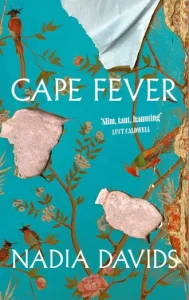
Cape Fever
Nadia Davids
Scribner UK, 2026
Nadia Davids opens Cape Fever with a brief, disarming note to the reader in which she quotes the famous line from Henry James’s short story ‘The Middle Years’—‘We work in the dark, we do what we can, we give what we have’. For Davids, writing Cape Fever felt much the same as she too had to step into darkness and wait for her characters to materialize. In an exchange with her, she shared that while the outline of the novel came to her in a dream-like state seventeen years ago, it was only in 2023 that she was finally able to put it to paper. That sense of delayed emergence is visible in the writing itself, which is deliberately low-lit and moves in slow accruals.
Cape Fever is a short gothic story that works almost entirely through implication and withheld revelation, even in its setting. The colonial outpost is not named but is heavily alluded to. From the looming mountains that frame every view and the busy harbor below, to the calls to prayer drifting from the vibrant Muslim Quarter and the daily boom of the time-indicating gun. Anyone familiar with the landscape recognises it at once. Unmistakably Cape Town.
Soraya Matas, nineteen, lands a job with an elderly English widow, Mrs Alice Hattingh. On the surface it looks fairly simple: live-in maid, decent wages, no male presence and one Sunday off a fortnight. In reality though, it is a slow suffocation. 23 Heron Place becomes a microcosm of the racial and class hierarchies Davids knows intimately, drawn from the lives of the women who came before her.
Davids’s grandmother, who was born in the same year Cape Fever is set, worked as a personal maid to the wife of a foreign diplomat. Cape Fever is dedicated to her and Davids’s great-grandmother, who likely held a similar job. Davids makes no attempt to capture the full spectrum of Black and Coloured experiences under segregation—one that weighed far more heavily on Black South Africans. She zooms in, instead, on the Cape Malay community, descendants of enslaved Muslims brought to the Cape by Dutch colonisers. Cape Malays occupied a less brutal spot in that racial hierarchy, but still remained subject to insidious controls. Davids’s choice to stay inside the walls of Heron Place and the Muslim Quarter manages to transform domestic service into a haunted chamber where everyday erosions of voice, space and dignity take on gothic weight.
Within this confined space, the Gothic elements are spare and patient. One can flip to many pages and find only domestic work, a market list, a letter dictation, description of calligraphy—nothing overtly ‘spooky’. Yet such an atmosphere builds slowly. Heron Place creaks with age, its windows gap-toothed and stuffed with newspapers to mask poverty: its once-grand silverware pared down to a few tarnished fish knives; a hallway that boasted many art pieces now empty, save for one portrait that stirs. A spectral Gray Woman follows Soraya, leaving a trail of ash in her wake.
Soraya’s days at Heron Place are filled with relentless toil. She dusts daily, changes linen, scrubs the yellowwood floors, washes the tall windows which flood the house with ‘wonderful light’ that betray every speck of dirt. Everything must be kept ‘just so neat, tidy, precise’. Time blurs into a monotonous rhythm familiar to anyone who has read accounts of domestic labour under colonial and apartheid regimes.
‘good morning, wake, tea, tray, jam, curtains, wipe, move, cook, thank you, sweep, thank you, tidy, polish, scrub, I’m coming, weed the garden, tea, good afternoon, scrub, polish, sweep, wash, dry, fire, fire, fire, please, I’m sorry, I’m coming’.
Woven into this drudgery is the psychological sparring between madam and maid. Intent on chipping away at Mrs Hattingh’s fragile facade, Soraya makes her knowledge of the household’s decline felt. On cue, she arranges her face in feigned surprise at the state of disrepair, or ‘accidentally’ leaves out the few unsold silverware pieces after polishing. Sometimes her gestures are not so subtle, like tying a bright red scarf high on her head to claim a few extra inches of stature in a space designed to make her feel small. Meanwhile, Mrs Hattingh’s casual racism threads through their daily exchanges: habitual references to ‘your people’; praise for supposed industriousness and cleverness that shades effortlessly into condescension. Most telling is her assertion that ‘like us, your kind made this colony what it is’—a claim of kinship that quietly reinforces the racial hierarchy sustaining even this crumbling household.
Once a week the grind comes to a halt for a strange hourly ritual. Soraya is invited to sit in the study and dictate letters to her fiancé, Nour. Mrs Hattingh, unaware Soraya can read, offers her pen with the serene certainty of the benevolent patron. From the start she has judged Soraya’s speech ‘too simple to be interesting’, promising to capture only the ‘essence’, rendered more poetically in her own hand. Soraya’s words are transformed. A simple harvest of loquats is inflated into a metaphor for abundance, and her plain, honest affections are dressed in the widow’s own propriety.
The entitlement peaks in these moments with Mrs Hattingh having an unshakeable belief that her improvements are a gift. What begin as seemingly harmless poetic flourishes soon turn into something far more sinister. When Soraya finally pushes back, the favour is withdrawn as a form of emotional punishment and manipulation, the feigning a headache that comes only during ‘moments of great strain’.
The taking over of Soraya’s voice, or as Mrs Hattingh calls it, ‘rephrasing’ her speech ‘from the banal to the lyrical’ feels like a move we’ve seen before in stories of empire: that old, arrogant belief that a marginalised voice is a ‘broken’ thing, needing correction before it can be heard. One thinks inevitably of J.M. Coetzee’s Foe, where Daniel Foe claims and reshapes Susan Barton’s story with similar smug assurance. The parallel is far from exact—Coetzee’s novel is metafictional and philosophical in scope, Davids is much more intimate and domestic. In this narrow angle of voice appropriation, however, the unease overlaps. Soraya perceives it with devastating clarity: ‘by my voice I am me; by her hand, she is too’.
Davids layers this asymmetry further through the physical act of writing itself. She pits two elegant handwritings against each other—Arabic calligraphy versus the English cursive. Both are elegant with their graceful loops and disciplined lines. Davids’s craft, however, lies in lifting that veneer of shared polish to reveal the asymmetry beneath.
Soraya’s father writes rakams on rice paper, Quran verses flowing right to left in devotion. They functioned as talismans of faith and protection, and more importantly, they were a way for the Cape Malay community to hold onto their identity when colonial bans on literacy and apartheid pressures tried to strip them away. Then you have Mrs Hattingh’s English hand that claims the page as it goes, flowing in the same direction as their conquering empire. It presumes the right to correct, to improve, to own what it touches. Right-to-left versus left-to-right. Spiritual inheritance against imperial progress and domination. It is a brilliant little detail that Davids chooses to simply let sit there, heaving against the direction of the pen strokes.
Throughout the novel, the act of withholding works in different ways to heighten that suffocating atmosphere of partial knowledge. Mrs Hattingh uses silence and selective disclosure as a power play, manipulating Soraya’s time, movements, and understanding to keep her tethered to Heron Place. She denies her even the space to grieve profound personal losses. She also carefully curates stories of her absent son, whom she describes as thriving in London after the war. A successful lawyer far from the colony’s provincial decay. These tales shield her from deeper grief and shame, preserving an image of unbroken privilege.
In contrast, Soraya’s silences are acts of preservation rooted in maternal wisdom. ‘Always keep something back’, her mother had cautioned, ‘one face for them, another for us’. Soraya guards the sacred history, beauty, and spiritual depth of her community, most vividly when she refuses to share the significance of the Noorul Mubeen shrine or its living rituals with her employer, declaring that those who ‘hold sway over our outsides’ have ‘no right to know, to touch, what is in our insides’. One form of withholding suffocates and controls; the other shields from the same devastating hands that have already claimed so much.
At times the prose seems to break free and breathe more easily. There are random passages where Davids slips into long, rhythmic catalogues that flow in comma-linked abundance. The layered scents of the Muslim Quarter, ‘…the reek of chopped onions, pressed garlic, scattered methi, diced chilies, dried bay leaves; of spices—whole, roasted, ground, cast in hot oil, and of meat braising, bones boiling, fat spitting, broth cooking, sugar burning, rose water steaming…’ The dawn tumult of the District market, ‘…fruit and fish, copper and women, fabric and cures, salt for meat, salt for curses, salt for cures…’ In a novel otherwise marked by restraint and suffocation, these musical eruptions spill across the page with exuberance, asserting a richness that mirrors the oral traditions of preservation explored earlier: life, smell, sound, and memory refusing to be ‘just so neat, tidy, precise’.
The Gray Woman, visible only to Soraya’s gifted sight, offers her counsel and comfort during her strained servitude at Heron Place. Here, Davids explores psychic intrusions not as ghostly apparitions, but as manifestations of historical injustices. These women—there are many of them in the colony—are not described as ghosts, no, but as ‘score settlers, debt collectors, anger gatherers’. In her LitHub essay on apartheid’s haunted history, Davids writes that these spectral intrusions are more like ‘unfinished political business’ in a land marked by enslavement and segregation. The convergence of the Gray Woman and painted figure mirrors the chorus of women wronged by empire, their stories ‘grayed’ out, buried or rewritten. The cry that breaks through, ‘Amok! Amok!’, the historic slaves’ call to run free, to set fire to oppression’s edifices, refuses the silence once imposed.
Cape Fever does not merely lean on the Gothic tropes of decaying house and spectral figures. Davids uses the genre’s old obsession with buried secrets to insist on the visibility of historical wounds that society prefers to keep interred. The haunted house becomes the colony in miniature. The Gray Woman reflects a collector of colonial debts. The withheld word becomes a site of both oppression and resistance. The dictation, the clashing scripts, the prose’s eruptions, the dual silences all reveal how even in suffocation, the act of speaking, refusing, withholding becomes a reckoning with empire’s enduring reach. That Davids achieves this through such disciplined restraint is no small achievement.
~~~
- Fifi Bat-hef is a Kenyan book reviewer with a particular interest in post-colonial African and Arab narratives. Her reviews have appeared on ArabLit, Lolwe and Red Pepper. A version of this review originally appeared in Red Pepper Media.