Percy Zvomuya visits his former teacher, the critic Anthony Chennells, at Arrupe Jesuit University in Harare, to talk about the Rhodesian novel, the writers he taught—Dambudzo Marechera among them—and his friend Doris Lessing.
Editor’s note: Anthony Chennells died on 2 July 2026, aged 88. Percy Zvomuya interviewed him in May 2024 and March 2026, and wrote this profile while Chennells was still alive. We have kept the present tense in which it was written.
~~~
i
Anthony Chennells just loves fiction. A measure of his enduring love for literature is that a couple of times during our talk, he’d reach across his untidy desk to retrieve a well-thumbed copy of a novel to read a passage. When making a point about the presence of visual artists and musicians in Zimbabwean fiction, he instead read from Things Fall Apart, the classic novel by the Nigerian Chinua Achebe: ‘He was very good on his flute, and his happiest moments were the two or three moons after the harvest when the village musicians brought down their instruments, hung above the fireplace. Unoka would play with them, his face beaming with blessedness and peace.’ Unoka is the father of the novel’s main protagonist, Okonkwo—I thought I saw joy on Chennells’s face and a twinkle in his eyes as he read. How was it possible to feel this way from a passage that he must have already read thousands of times in a career spanning more than half a century?
I was in Chennells’s office at the Arrupe Jesuit University, in the Harare uptown suburb of Mount Pleasant, to interview him about Zimbabwean fiction and his illustrious roster of students: they include the Unisa-based professor Maurice Vambe; the retired university professor and poet Musaemura Zimunya; the England-based novelist Stanley Nyamfukudza; the poet and now retired teachers’ college lecturer Kizito Muchemwa and, perhaps most famously of all, Dambudzo Marechera. But Chennells was at times elusive, using my line of questioning to discuss some of the great African novelists he loves, including the Ghanaian Ayi Kwei Armah and the Cameroonian Mongo Beti. His transnational references might have been his way of saying, there was nothing unique about the Zimbabwean experience: that a figure like Marechera makes sense only in the company of the Congolese writer Sony Labou Tansi or even the great Malian Yambo Ouologuem. I didn’t press him on this, but he might have been saying that Charles Mungoshi’s classic novel, Waiting for the Rain, should be read together with Achebe’s Arrow of God.
Chennells has had the gift of a long life; although he has visibly aged from when I took his classes at university in the late 1990s, the man, now in his late 80s, is still in good shape and mentally alert. He retired from his professor position at the University of Zimbabwe in 2002, and instead of closing that episode, he took up another teaching challenge at the then fledgling Arrupe Jesuit University, where he still works. Before he joined the then University College of Rhodesia (now University of Zimbabwe), he was at Cyrene Mission, near Bulawayo. There is some symmetry that his extended career at the University of Zimbabwe is ring-fenced by stints at church-affiliated institutions.
Chennells’s career began in the early 1960s at Cyrene Mission, founded by the Scotland-born teacher and Anglican priest, Edward Canon Paterson. The school, which used to attract students from across Southern Africa, was once a big deal. In 1959 a now defunct local publication, The Bantu World, described the institution as a ‘world famous centre’. Although when the school is spoken about now the tendency is to mention some of its famous alumni, especially the noted visual artist Kingsley Sambo, its role in training physically disabled students from across the region is its real legacy. ‘Many people from different parts of the world have visited Cyrene Mission just to marvel at the beautiful paintings on paper and on the walls…’ says the report in The Bantu World. It was amid this riot of colour at Cyrene that Chennells first taught after studying for his Bachelor of Arts at the old Natal University.
Chennells has taught thousands of students, some of them people of renown. He has edited numerous volumes, including Emerging Perspectives on Dambudzo Marechera, a book he co-edited with Flora Veit-Wild. Many interlocutors seek him out for his erudite opinions and court his company for his skills as a raconteur. For instance, when the British writer Patrick French visited Zimbabwe for his work on a biography of Lessing, Chennells took the biographer to the farming district memorably captured in The Grass Is Singing; the British writer, David Caute, interviewed him for his semi-biographical book, Marechera and the Colonel: A Zimbabwean Writer & the Claims of the State. Given this career, will his time at a now much diminished Cyrene Mission be considered a small footnote? Those pushing a multi-disciplinary approach will point to his formative years at Cyrene as important in shaping his worldview.
Sometimes he would return to the visual arts, as he did in 1996 in a piece titled ‘Empire’s Offspring’, on the Zimbabwean painters Helen Lieros and Berry Bickle. ‘The Australians used to use the phrase Culture Cringe to describe their relationship with Europe’, Chennells began his critique. ‘Culture cringe implied that Australians were raw and unformed, their culture an imperfect replica of Europe’s, and that the only way in which they could stand tall was by more perfectly imitating the metropolitan model’. Postcolonialism’s sway in Cultural Studies ‘has helped to free us from a belief that the cultural productions of the UK constitute an ideal and that all else is an imperfect copy’, he argued. Having situated the critique in the larger critical debates of the day, he then turns to the particular. Of Bickle’s triptych, Pro Amore, Chennells wrote, ‘An unreadable script scrawls across a panel vital with the brilliance of a Matabeleland sunset illuminating the harshness of the Matebeleland bush. Stuck to the panels are objects which signify previous attempts to inhabit that landscape: an opened fan, the wooden snake of thousands of tourist exchanges, a diary page, a framed photograph of a Victorian “explorer” in collar and cravat, a tourist photograph of the [Victoria] Falls’. If the identification with the southern landscape of Matebeleland wilderness stands out and seems visceral, it might be because those forests are Chennells’s home turf, where his family, until the land reform of the early 2000s, owned land.
The connection of the wilderness of Matebeleland and its predominantly Ndebele-speaking inhabitants, however, to his doctoral thesis, ‘Settler Myths and the Southern Rhodesian novel’, isn’t immediately obvious. The work on his dissertation began with queries on how the image of the Ndebele had first been created in the settler imagination. After working out that the whites viewed the Ndebele as an admixture of ‘violent savage’ and ‘noble warrior’, Chennells investigated how these images translated in the form of what’s called the Rhodesian novel in a thesis submitted at the University of Zimbabwe in 1982 and supervised by the renowned Zimbabwean historian, Ray Roberts, and the literary scholar and novelist, Tim McLoughlin. In the late 1970s he and a couple of others compiled a bibliography of every single article or story or novel written by a white person from 1890 to 1975. Reading these stories and novels, Chennells became aware of a crucial running theme: ‘Rhodesia remains a wilderness; the settlers always seem to live on the edge of civilization; beyond the order they have imposed on the land lies a savage confusion that threatens to overwhelm them if their vigilance should lapse for a moment’. (This is a quote from Chennells’s essay, ‘The White Rhodesian Novel’.) In trying to understand the never-ending cycles of violence in post-colonial Zimbabwe, perhaps Chennells’s study hints at some important clues.
ii
After Cyrene, the next logical step was the recently established University College of Rhodesia and Nyasaland (now University of Zimbabwe). When in 1965 he moved to the colonial capital, Salisbury (now Harare), to take up a lecturer position, the Rhodesian leader Ian Smith had incarcerated most of the political leaders of the nationalist movement. But outside of the jails and penal colonies in which the activists were incarcerated, a cultural movement was about to be born. About five years into Chennells’s decades-long tenure at the university, a cohort of students that shaped Zimbabwean fiction and poetry in English enrolled. Between 1971 and 1973, Chennells and his future supervisor, Timothy McLoughlin, ran a racially-mixed Creative Writers club at the university. African students who attended the club include a certain Dambudzo Marechera, then still known as Charles William, along with Stanley Nyamfukudza, Thomson K. Tsodzo, and Edmund Chipamaunga, and the poets Musaemura Zimunya and Kizito Muchemwa.
Some of the poems written for those sessions were later published in Zimbabwean Poetry in English, an anthology edited by Muchemwa and published in 1978. In an interview Nyamfukudza told me that the sessions were attended by white women from the suburb of Mount Pleasant. He recalled that the bias of the workshops was towards poetry. ‘I found it a very useful sounding board for my own poetic attempts. Under Prof. Chennells’s leading, the discussion was always positive and I came to feel afterwards—not critical enough. The result was an overconfidence which was quickly punctured when one sought publication or was exposed to a tougher and more rigorous scrutiny. I think Anthony’s aim was to encourage by focusing on the strengths, if any. Anyone who came in contact with him could not but fall under the spell of his tremendous enthusiasm and enjoyment of all things literary. The aim, with hindsight, was to nurture, to encourage any writing that was going on, whereas a “class” would have been more evaluative. We had a wonderful time and our creative egos were sufficiently boosted to survive the harsher, much more critical world beyond.’
Over the course of two interviews—the first one in May 2024 and then another in March 2026—at his offices at Arrupe, in the Harare suburb of Mount Pleasant, Chennells recalled the young Marechera: ‘I remember him as an enthusiastic student, with a terrible stutter. When you could make out what he was saying, it quickly became clear that he was someone who read very widely. Rather boastful, being aware that there wouldn’t have been many students coming in that year, in his first year, that had read as much as he had; that, I think, was extraordinary. One [got] a sense of who he was. What had produced him? Had he been produced by the big St Augustine Mission, where he got a scholarship and went to school, or was he produced by his mother in a location/township in Rusape? He would have seen [where he lived] as a location, a place pushed to the periphery of Rusape’. Marechera would also have contemplated the fate of his family: ‘Was his father killed in an accident, or was he drunk, in which case, he was responsible for his own death. At the same time, he was a product of his very violent family life. How was he emerging out of that? What would he emerge as?’
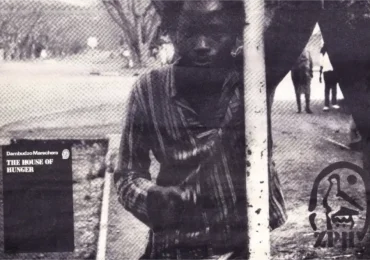
Marechera, Zimunya, Nyamfukudza, and many other students were expelled for participating in the 1973 demonstrations. Marechera applied for, and was offered, a place at New College, Oxford, and Chennells, together with two other lecturers, wrote in support: ‘Mr Marechera is by far the best African student I have taught in my eight years at the university. He is a sensitive critic whose sensitivity towards literature is controlled by rigorous powers of evaluation’, Chennells wrote. ‘He has read a great deal more than most students black or white and is also a poet of considerable promise’. He also said that if Marechera is removed from the particular tensions of life in Rhodesia, or the proverbial ‘house of hunger’, he should ‘come into his own as a truly brilliant student of English’. But Marechera was more than just a brilliant student of English, and so it proved with the publication of The House of Hunger, winner of the Guardian Fiction Prize in 1979, followed by Black Sunlight in 1980.
The latter was immediately banned in Zimbabwe by Robert Mugabe’s Rhodesian-styled Censorship Board, on the grounds of obscenity. Chennells, the writer (and rainmaker) Aaron Hodza and Zimunya appealed the decision. In his submission, Chennells pointed out that Black Sunlight was ‘an important contribution to the literature of Africa in general and Zimbabwe in particular. It demonstrates new possibilities in the way in which the contemporary African experience can be explored in fictional terms. It is, as the Board’s reader says, “a most difficult book to follow” precisely because Marechera is attempting to explore and convey some of the complexities of modern Africa.’
After Marechera’s return, Chennells and Zimunya, then back from his exile in England and a staff member in the English department, invited Marechera to give occasional lectures to their first-year students who were studying The House of Hunger.
A key figure of the 1970s literary movement is Charles Mungoshi. He was not part of the creative classes conducted by Chennells and McLoughlin because he never got the chance to go to university. After writing his Ordinary Levels at St Augustine’s, where he was Marechera’s peer, he found a job. In his spare time Mungoshi was busy writing, both in Shona and English, sending out his short stories to magazines and manuscripts to writing competitions run by local publishing houses. The autodidact writer’s best book is easily the 1975 novel, Waiting for the Rain, which in Chennells’s estimation is one of three great African novels (the other two being Ngugi wa Thiong’o’s A Grain of Wheat and Chinua Achebe’s classic, Arrow of God).
To my question when he first became aware of Mungoshi, Chennells said he must have heard of the writer in the early 1970s. ‘It was not hard to read him and realise there was considerable narrative talent’, he said simply. Part of the novel’s fascination for Chennells is how it seamlessly operates across several consciousnesses: the ancestral (the metaphysical), the psychological, the everyday, and the historical. Its anti-hero is Lucifer, a self-hating African visual artist who, armed with a scholarship, is about to head to England. His brother Garabha, a boheme and a drunk, and who through his expert playing of the drum can conjure the ancestral realm and its protagonists, is very close to their grandfather, the Old Man. The latter fought in the first uprisings against white settler rule in 1896–7 and is a living progenitor of the now much mythologised Chimurenga. The family is plagued by several ngozi, avenging spirits of the wronged dead, and until the appropriate rituals are done to appease the spirits of the dead, the family will continue to be touched by ill-fortune.
iii
A source told me that after independence, there was a pall over the Department of English at the University of Zimbabwe because of bickering and ideological divisions among the staff. Black and white lecturers banded into race-based factions and cannonaded at one another over the content of the curriculum. The debates, roughly sketched, were about how much of the so-called English canon ought to be retained, and what, and how much, of ‘Third World’ literatures of ‘writing back to the centre’ should be part of the new post-colonial syllabus. My informant told me that Chennells, who abhors conflict, remained outside the fray, observant but detached. I am surprised at his refusal to be caught up in the conflict. Chennells is skeptical about the post-colony: ‘The power of the colonial state was transferred to the new independent state. Was there really a break between the independent state and the colonial state? It would be odd if it didn’t [seep into the new state] because economically there was little that you could say was a new independent economy…’ he told me.
As for the Rhodesian novel, no one alive now, and perhaps even then, knows the Rhodesian novel better than he does. Given his encyclopedic knowledge of the Rhodesian novel and his skepticism of the post-colony, you would think he would have fought to ensure that at least some of the representative novels of that period remained on the curriculum. But by the time I was a student in that department, there was no trace of either Gertrude Page, a luminary of the Rhodesian novel, who sold 2,5m novels before her death in 1923, or the progressive Anglican missionary and poet, Arthur Shearly Cripps. If we accept that the socio-economic and political meltdown of the 2000s over which Robert Mugabe presided had its direct roots in those 90 years of British settler colonial rule, it surely behooved us to have studied the novels of the era so as to better understand the Rhodesian psyche and anticipate the pitfalls that attend a post-colony. Page set down colonial thinking in novels such as Great Splendor, Where the Strange Roads Go Down, and The Rhodesian. These texts, wrote Chennells, portrayed Rhodesia ‘as a place where Englishmen released from the distortingly genteel conventions of life at home could discover in themselves those qualities of their own nationalism which had made England great and with which they could create a British nationalism out of the wilderness’. Whenever I find these novels by Page and other Rhodesian writers, such as Sheila MacDonald, I snap them up and sit down to read them. I believe it is possible, from reading some of this literature, to understand the thinking of the white farming community, how they selfishly held on to their vast landholdings without compunction, until the moment Mugabe, who had for long been their benefactor and patron, turned against them.
Cripps—who was born in 1869 and mostly lived in Rhodesia in the first half of the 1900s before his death in 1952—is not widely known in Zimbabwe except, perhaps, in Maronda Mashanu, Chivhu, where he is regarded as a hero. It was in that district where the priest conducted his missionary work and from where he championed the rights of Africans. Cripps was opposed to settler policies, including hut tax, and to reducing land holdings on which Africans could live. He even bought a farm where he invited Africans to live without being bothered by the colonial administration. Until I interviewed his great-grandnephew, the Welsh writer Owen Sheers, author of The Dust Diaries: Seeking the African Legacy of Arthur Cripps, I had never heard of what we would now call a ‘woke’ priest. He eschewed mechanized transport and insisted on walking the more than 100km from Enkeldoorn (now Chivhu) to Salisbury.
I met Sheers when he was in Johannesburg on a 2006 publicity tour for his book, virtually unknown in Zimbabwe,but named the Welsh Book of the Year in 2005. Long before his descendant tried to search for his ancestor, Chennells had gone there. In an introduction to his 1976 anthology, Arthur Shearly Cripps: A Selection of his Prose and Poetry, Chennells examined some of the founding myths of the newfound country which exercised Cripps: ‘The Rhodesian frontier tested men and restored to them their lost manhood by providing them with a challenge and corresponding purpose. This myth about Rhodesia still lingers on in the white Rhodesian psyche and Cripps (in his first novels at least) examines its validity in a way no other Rhodesian has done. He establishes alternative images: Rhodesia is bay tree country where the wicked flourish like the green bay tree of scripture; Rhodesia is a brooding earth waiting to avenge itself on those who have exploited her…’
It’s a pity that Chaminuka: The Man Whom God Taught, a book published in 1928 in which Cripps rewrote a famous legend on Chaminuka, the most famous spirit in the Shona pantheon, wasn’t on our curriculum. Chennells saw in Cripps’s asking of Chaminuka, ‘When will he come again?’ an incipient African nationalism over thirty years before its first shoots. ‘His passionate belief in Africa’s need for Christianity did not desert him, but no longer do these novels suggest that it could be granted only in association with an imperial presence. That some of the most authoritative theology of the early church had come out of Africa gave him hope for a Christianity in Mashonaland that would be entirely self-sustaining, no longer having to rely on missionaries from abroad’, Chennells wrote.
White Rhodesian sentiment was dismissive of African spirituality. In fact, since the passage in 1899 of the Witchcraft Suppression Act—the law that criminalised African spirituality—the throwing of bones, soothsaying, consulting spirit mediums and ‘witchdoctors’ were collectively regarded ‘as a pretence and a sham, something which in actual fact has no real existence at all’. This did not deter Cripps, who began to seriously engage with such phenomena. One such example is Lion Man, a novel by Cripps published in 1928, in which an English intellectual is possessed by the spirit of a lion, mhondoro. The concept of the mhondoro involves a spirit, perhaps of a hunter or royal, temporarily dwelling in a human receptacle until a suitable host is found. ‘The mystic in Cripps invariably took seriously—though in his early ministry he usually disapproved of—the spiritual life of Africa and this book suggests that he was profoundly disturbed by Western man’s attempt to excise both from himself and his Christianity all mystical elements. Africa could teach Europe—however bizarre the lesson—that valuable experiences operated on levels beyond the analysable or merely rational’, Chennells argued.
If Cripps had lived long enough, it’s possible he could have set his efforts on reimagining the spirit of Nehanda, another celebrated figure in the pantheon of spirits. Cripps would have found a kindred spirit in Yvonne Vera, the prize-winning writer whose works include Nehanda, Why Don’t You Carve Other Animals, Without a Name and Under the Tongue. Vera wasn’t taken seriously in the English department, recalled a former student from the late 1990s, Irikidzayi Manase, now a professor of literature at the University of Pretoria. ‘Vera was being dismissed in the department as a not serious writer because of her reimagining of the nationalist heroine, Nehanda’, Manase told me. Chennells is also not a big fan, but for stylistic reasons. He gave me his qualified praise of the late writer: ‘I think one has to [rate] her highly, not just because of my judgment. Because she has been received with such enthusiasm by very good critics. I find her difficult to read. I don’t particularly like her style. She seems to unnecessarily complicate sentences, and I am not very good with that but then again the opening chapter of Waiting for the Rain which I must have read a hundred times and is unintelligible now as when I first read it’. He is humble enough to say—even though I may not be a fan, there are many other people who like her, so I should defer to the wisdom of the crowds.
Manase said Chennells was ‘the only one who went beyond the Marxist approach prevalent in the department. He introduced us to postcolonial theory at honours at a time when our theory module was steeped in Afrocentrism and Marxism. His African literature module was wide in terms of coverage and rich in exposure to concepts—that’s where he introduced us to postcolonial theory.’ Manase recalled an eccentric man, who would lie on his couch looking up and puffing some smoke as his student went through his chapters. He would make periodic interventions, correcting his writing here or proposing a suggestion there.
iv
In the last decade I have become obsessed with Doris Lessing, the person, but especially her fiction and nonfiction writing; when Chennells told me that Lessing used to stay with him on her visits to Zimbabwe and that he boarded at her apartment whenever he was in England, I thought I could extract from him some anecdotes about her. His decades-long interaction with Lessing means he should be a treasure house of Lessing gossip, but he wasn’t obliging. It can’t be that he didn’t have anything to share. Perhaps his default setting is to transmit ideas rather than anecdotes. You get the sense that when he recounts a story about a particular writer, it is in the service of a larger point. I later wondered whether he ever took a moment to put down the professor’s cross. Maybe it was his fate to carry it to Golgotha and beyond.
Declaring Lessing to be Zimbabwe’s best novelist, I provocatively framed this part of our talk. Chennells considered my statement for a while and then took out its sting by saying Lessing wouldn’t have called herself a Zimbabwean writer. ‘She wrote a lot about not being a Zimbabwean writer’, Chennells countered. In The Grass Is Singing, for instance, Rhodesia is mentioned only once, although she talks about Southern Africa a lot. Later rummaging through the archives, it turned out that this wasn’t just Chennells shying away from conflict but expressing a long-held view. ‘Claiming Lessing for Rhodesia may seem absurd. She has written of “the bile” she felt for the “white” society in Southern Rhodesia “as I knew and hated it”’, Chennells argued in ‘Doris Lessing: Rhodesian Novelist’, a paper from 1985. There is a note in The Four-Gated City implying distance between her writing and the people among whom she grew up. Indeed, in the novel Children of Violence she concocted a geopolitical entity called Zambesia, which is not Southern Rhodesia at all, but rather ‘a composite of various white-dominated parts of Africa’.
Lessing left Southern Rhodesia for England in 1949 and for that reason disavowed her Rhodesian credentials. She thought those she left behind deserved to be Rhodesian much more than she did. She suggested that to be part of the community you had to share the opinions of the other whites. ‘I don’t think that was particularly true and I don’t think she would have particularly believed that’, Chennells told me.
Before his death from cancer, the biographer Patrick French—author of The World Is What It Is, a biography of V.S. Naipaul—visited Zimbabwe. I asked Chennells whether French had interviewed him; yes, he had, although, with typical self-deprecation, he said his chief value for the writer was in telling their driver how to find Lessing’s family farm. ‘She was a very generous person to other young writers’, he told me. Indeed, when The House of Hunger was published, Lessing wrote of the book as ‘an explosion’ and that ‘writer and book are both of the nature of miracles’. Similarly, Chennells is known to be generous with his time and intellect. His vast knowledge of Catholic arcana was of use to Lessing for her novel The Sweetest Dream—she acknowledged his help: ‘With gratitude to … Anthony Chennells, for help with the Roman Catholic parts of the book’.
Chennells is useful for more than the obscure facts he knows about the Roman Catholic church, though. Generous polymaths like him don’t come often and, when they do, many people benefit—as several generations of Zimbabweans can attest.
~~~
- Anthony Chennells (1937—2026) was a Zimbabwean literary scholar. He taught English at the University of Zimbabwe, retiring as associate professor in 2002, and was Extraordinary Professor of English at the University of Pretoria and Professor of Literature at Arrupe Jesuit University in Harare.
- Percy Zvomuya is a writer, reader, publisher, tree planter, editor and selecta. His writing has appeared in the Mail & Guardian, The Guardian, Chimurenga, Al Jazeera, the London Review of Books blog and the Johannesburg Review of Books. His new book is Robert Mugabe: The Black Victorian (Jonathan Ball, 2026).