The JRB presents an excerpt from Rhetorics of Value: Exhibition Design and Communication in Museums and Beyond by Corinne A. Kratz, winner of the 2026 Council for Museum Anthropology Book Award.
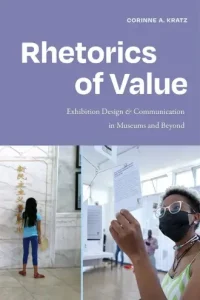
Rhetorics of Value: Exhibition Design and Communication in Museums and Beyond
Corinne A. Kratz
Duke University Press, 2025
~~~
from Chapter 6, ‘Redesigning Popular Histories and Facing Race through Exhibition’
Redesigning Popular Histories and Facing Race through Exhibition
The great force of history comes from the fact that we carry it within us, are unconsciously controlled by it in many ways, and history is literally present in all that we do. It could scarcely be otherwise, since it is to history that we owe our frames of reference, our identities, and our aspirations. And it is with great pain and terror that one begins to realize this.
—James Baldwin, ‘The White Man’s Guilt’
That’s history. It’s heavy. You just bear the weight as you set forth to graze thousands of chronologically arranged facts, names, photographs, things, explanatory guides, problems.
—Wesley Morris, ‘Visiting the African-American Museum’
How are popular histories rewritten, and what assumptions and values are reframed in the process? These questions involve long-term social and cultural transformations that unfold in many contexts, interactions, forms, relationships, and institutions. This chapter focuses on one facet of this: how museum exhibits, specifically exhibit design, might contribute to and help shape such redefinition and transformation—or not. In particular, it considers how often entwined understandings of history, race, and the role of race in history might be redefined in part through exhibitions, reshaping the way history is ‘present in all that we do’, as James Baldwin emphasizes in the epigraph. In many cases, these understandings are connected with national histories and identities, and exhibitions become ways to rethink, for instance, the role of slavery and the slave trade in shaping nations like Denmark, Portugal, or the United States (Ruffins 2006; Andersen 2020; Santos 2020).
Cultural understandings, identities, and values are represented and shaped through museum exhibits, whether addressed explicitly as topics or incorporated implicitly in subtle details and background assumptions. This includes popular ideas about history, race, ethnicity, gender, and more. Exhibit design is the means through which this occurs, combining diverse media to craft compelling narratives and aesthetic and affective presentations that convey these ‘rhetorics of value’. ‘Museums depict narratives that can be crucial to an understanding of the past for their visitors. The use of terminology and physical presentation of objects becomes collective memory, particularly in a national museum’ (Saeji 2014, 617). Yet over time, knowledge frameworks, narratives, and social expectations may diverge from those current when long-term exhibits were created (Arnoldi 1999, 712; Shelton 2001b, 150). It’s always important to ask, then, whose understandings and values are included, from when?
Such questions were central to analyses of histories and politics of representation in the critical museology that burgeoned between the 1980s–1990s and now, as were questions about museum-community relations. They were important, too, in critical race studies and Indigenous studies developing over roughly the same time, sometimes framed in terms of ‘decolonizing the museum’. While responses to these issues in the last forty years moved many institutions toward greater collaboration and a more ‘interrogative museum’ stance (Karp and Kratz 2015), these are perennial challenges that historically have shaped the very nature of museums, their collections, and the exhibits seen as worthwhile or even possible.
Artist Fred Wilson draws attention, for instance, to how particular ethno-racial formations and assumptions become embedded in museum collections, key resources for his installations and for exhibits generally: ‘When I’ve worked in the United States and in many other countries, the mainstream museums just didn’t have as much stuff on slavery as this . . . [Jamaican museum] does because it’s a black country. In the United States, museums are focused on white culture, so it was all about the absences in Mining [the Museum—his breakthrough 1992 work]’ (quoted in Copeland 2010, 1035) (plate 3). Working internationally in museums of history, ethnography, and natural history, as well as art galleries, Wilson also draws attention to the varied ways cultural frameworks related to ethno-racial diversity and representation play out in different national settings and kinds of museums. His work further highlights perspectives, priorities, and interests that African American and Native American curators and visitors might bring to exhibits. Similarly, Lonnie Bunch III describes building a collection for the new National Museum of African American History and Culture when most believed there was ‘a paucity of objects [extant] that illustrate African American history and culture . . . [or] explored race . . . making the crafting of traditional exhibitions very difficult and usually unlikely’ (2019, 90).
[image not shown in this excerpt]
Plate 3. Case on ‘Metalwork, 1793–1880’ in artist Fred Wilson’s installation Mining the Museum (1992–1993) at the Maryland Historical Society. Wilson’s installations often make astute, sometimes acerbic, use of juxtaposition to draw attention to problematic practices and categories. Courtesy of Maryland Center for History and Culture, Maryland Historical Society Archives, MS 2008.
To think about how exhibits might recast values and ideas related to popular history, race, and other social distinctions, I consider examples in two settings where such shifts have been striking and important: South Africa and the National Museum of African American History and Culture (NMAAHC), opened in Washington, DC, in 2016. Both settings emphasize that race and history are essential twins in analyzing exhibit representations in different prevailing ethno-racial formations. Comparative perspectives can illuminate varied dynamics and commonalities across such formations. As Goldberg notes, there are many racisms; the questions are how they change over time and in particular historical moments, and what modes of subjectification are involved (2005, xii; cf. Stoler 2016, 241). Dimensions of difference most salient in the United States may be less salient elsewhere, and vice versa, as they are recast through social configurations and historical trajectories in Africa, Europe, Asia, Latin America, Australia, and elsewhere. At the same time, these histories are entangled, with diverse ethno-racial formations sharing colonial and imperial roots (Rogoff 2002; Lowe 2015; Stoler 2016).
Museums also have been bound up in these histories, with ethno-racial formations incorporated into and reproduced through exhibits, part of the ‘rhetorics of value’ conveyed through exhibit design and narrative. The varied media of exhibit design—objects, texts, space, lighting, color, and more—together orchestrate experiences and evaluative meanings for visitors to engage, echoing and interlocking with representations in other contexts from film to festival, from social media to advertising. Similarly, Witz affirms that ‘sites of production [for public pasts] include museums, monuments, memorials, television, tourist routes, interpretive centres, government commissions, comic books, festivals and so on’ (2000, quoted in Witz 2022, 7). In this way, images, themes, and different forms of representation circulate among different settings and domains of practice, creating connections and resonances that help define social values and make them seem ‘natural’ through repetition and extensive dispersal, as chapter 2 noted.
Edward Ball noted the power of exhibit design in his review of the new NMAAHC: ‘Exhibition designers are the unacknowledged poets of public history. It is a three-dimensional art, and in a way subconscious in its effects, involving spatial arrangements, lighting, and stagecraft. The visitor may not pick up that the wall color changes from ox-blood red in the slavery galleries to gradually lighter colors until the walls are pale teal on the top floor’ (Ball 2016). There is more to NMAAHC’s wall colors—the slavery galleries also have gray-blue and metallic bronze walls—but Ball aptly identifies the ways visitors are addressed through diverse design components that modulate over time and space. This provides rich resources for reproducing and/or transforming interwoven concepts about popular history, ethno-racial formations, and identities, presenting them in ways that can engross, engage, and edify visitors.
Addressing Mandela’s Mandate
In Desegregating the Past, Robyn Autry contrasts the dramatic restructuring of society expected in South Africa after apartheid’s demise with ‘less radical reforms in a very different sociopolitical setting’ resulting from the US civil rights movement (2016, 7). Yet both cases set in motion changes in senses of national history and identity and in the workings of dominant ethno-racial formations; public representations responded to and shaped those changes. Both show that particular events and moments can expose tensions and contradictions in these shifting intersections, and sometimes open public debate about how they are treated in exhibits. The very boundaries of what exhibits can address, what can be said and shown, and where it can be shown can change in different situations and times, like exhibition-related Overton windows.
South Africa’s apartheid system, implemented through laws passed after the 1948 election, built on a history of racialized discrimination. Part of the fabric of daily life, apartheid’s racial categories and assumptions were also incorporated into museums and exhibitions of history, natural history, science, and art. The South African Cultural History Museum, for instance, opened in 1966 and featured displays of white history, while Black South African heritage was relegated to the South African Museum, the continent’s oldest museum, focused on natural history.
South Africa’s first democratic election in 1994 began an official era of transformation. Change in the museum and heritage sphere was mandated as the country sought to address apartheid’s legacy, forge a new nation, and grapple with the contours and meanings of the postapartheid. The 1996 ‘White Paper on Arts, Culture and Heritage’ directed museums to reclaim the nation’s heritage as the country was ‘emerging out of a troubled history’. In his 1997 Heritage Day address, opening Robben Island Museum, President Nelson Mandela called for museums to reimagine their roles and representations: ‘During colonial and apartheid times, our museums and monuments reflected the experiences and political ideals of a minority to the exclusion of others. . . . The demeaning portrayal of black people in particular—that is African, Indian and Coloured people—is painful to recall. . . . [W]e have to acknowledge that the redressing of this situation has barely begun’ (Mandela 1997).
How did South African museums address this mandate and moment through exhibits? ‘Narratives of pastness were re-made and bold assertions made to disavow prior interpretations, rectify empirical errors and recover hidden and neglected pasts through the institution of the museum’ (Witz 2022, 2). Newly established museums presented different narratives, featuring apartheid’s ravages, courageous resistance, resilience, and community histories, often illustrated with individual profiles. These included the Robben Island Museum, Apartheid Museum, Hector Pieterson Museum, Nelson Mandela Museum, Freedom Park, District Six Museum, Lwandle Migrant Labour Museum, and many more. The historiography of new exhibits in the 1990s tended to combine the social history prominent at the Wits History Workshop with resistance and nationalist histories (Witz, Forte, and Israel 2016, 11–13).
Established museums began rethinking exhibits in the late 1980s and 1990s. Some exhibits, in place since the 1970s or before, were out of date on many levels. Dilemma labels were used to mark problems and transformative work in progress. Museums also created new exhibits on a broader range of topics and sought to adapt or revise existing exhibits—with varying degrees of speed, thought, will, and budgetary commitment (Witz, Rassool, and Minkley 2017, 151). Some museums resorted to ‘add-on’ design approaches, seeking to address transformation by shoehorning information on Black actors or concerns into existing exhibits (Witz, Rassool, and Minkley 2017, 163; cf. Rogoff 2002). This approach commonly means little effort to rethink overall narrative and presentation, categories that define them, or the role of the museum itself. The Magersfontein Battlefield Museum’s addition was a good example of this, taking the occasion of the 1999–2002 centenary of the Anglo-Boer War to refurbish and fill out a display case on Anglo-Boer War participants to include Boer, British, and Black figures, but not to interrogate categories of race and the larger narrative of the war that was presented (Witz, Minkley, and Rassool 1999) (figure 6.1).
[image not shown in this excerpt]
Figure 6.1. The Magersfontein Battlefield Museum added Black participants to some of its displays in response to postapartheid conditions after South Africa’s first democratic election in 1994. Photograph by Paul Grendon (1999).
District Six Museum took a very different, thoughtful approach to designing its opening exhibits, one rooted in its community work and cognizant of the politics of memory. Opened in 1994, the museum grew from NGOs founded to preserve the memory of District Six, a multiracial working-class area of Cape Town targeted for forced removals in the 1970s after being declared a white area. Its exhibit design included new perspectives, personalized apartheid and postapartheid history and underlying ethno-racial assumptions, and shifted the way visitors were addressed, engaging them in sometimes intense ways. The opening exhibit, Streets: Retracing District Six, used street signs recovered from the razed area, ‘fragments of daily life’, family photos, and memorabilia to ‘constitute an “archaeology of memory” that attempted to reconstruct the material fabric and social landscape of District Six in imaginative terms’ (Rassool 2006, 290–91). Large portraits of former residents hung high, and two interactive elements in the ‘visual framework’ acted as ‘signposts for retrieval’ of memory and experience (Delport 2001, 31). First, a large sketch map of District Six that visitors could annotate covered the central exhibit floor. Second, the museum hung a long cloth where visitors could write ‘their names, messages, and other information, turning the calico into a “memory cloth”’ (Rassool 2006, 290) (figure 6.2). Six years later, a new core exhibit, Digging Deeper, drew on the museum’s Sound Archive, incorporated more personal stories, and retained the now-iconic map and memory cloth.
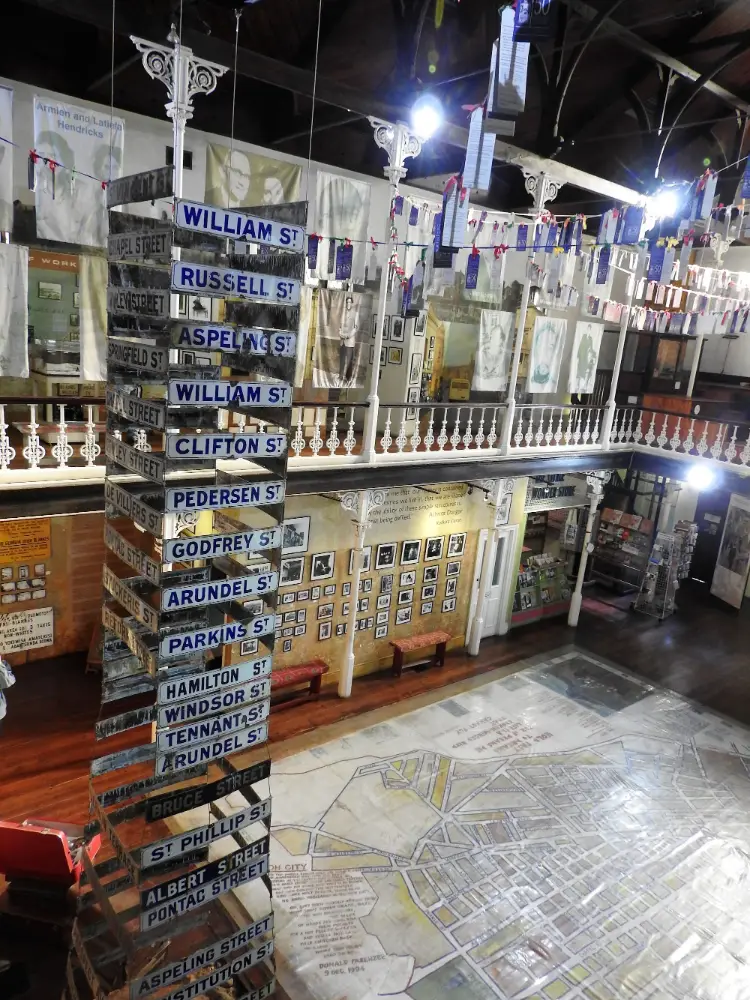
The new museums and new and revamped exhibits that unfolded during the early postapartheid years began recasting popular understandings of South African history by including new topics, actors, perspectives, events, and narratives that countered or challenged previous versions. They foregrounded different aspects, though some embraced new visions only partially or reluctantly. Yet together these exhibits became part of a spirited conversation and debate about public history and how South African history should be presented through museums, monuments, school curricula, and popular culture. ‘Public presentations of the past could open up debates about the nature of history by considering the different ways that pastness is framed and claimed as history in its own right’ (Witz 2000, quoted in Witz 2022, 8).
The South African exhibit landscape continues to be uneven and transformation work continues, even as the moment has evolved beyond immediate postapartheid hopes. Yet in many South African museums today, postapartheid histories and ethno-racial formations are now the ones taken for granted. Before turning to the Smithsonian’s NMAAHC, I look briefly at how new histories and assumptions were embedded in exhibit designs in 2016 at the Lwandle Migrant Labour Museum (LMLM) and the Iziko South African National Gallery (ISANG), reflecting and shaping notions of popular history. Chapter 5 introduced LMLM, one of the new community museums opened after apartheid’s official end. By contrast with the small, recently established LMLM, the Iziko South African National Gallery is a large, long-established national museum. It began with creation of a national collection of art in 1872 under the South African Fine Arts Association, taken over by national government in 1895; its current building opened in 1930. The South African National Gallery became part of the Iziko consortium in 2001.
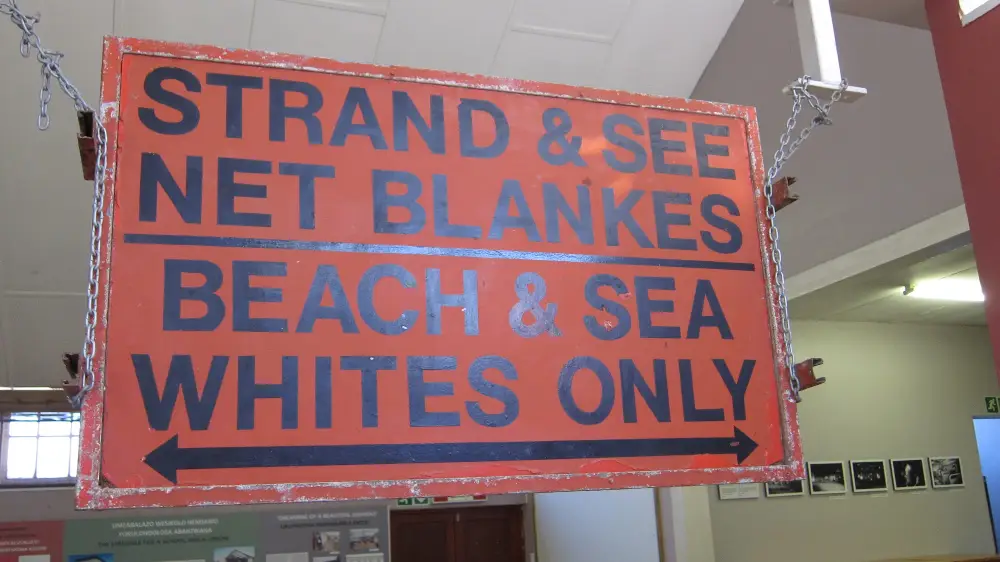
Opened in 2000, LMLM’s very existence is an artifact of apartheid history and the migrant labor system central to it. Design elements and exhibit themes make this clear. The ‘Whites Only’ sign at the entrance marks this origin, and introductory texts explain how the location began within the apartheid system (figure 6.3). The bilingual sign in Afrikaans and English both evokes the texture of apartheid life and contrasts with bilingual exhibit texts throughout the museum in English and isiXhosa. Multilingual texts signal ethno-racial structures undergirding South African society, while exhibit texts mark different perspectives, a different vision of visitors, and a different mode of address.
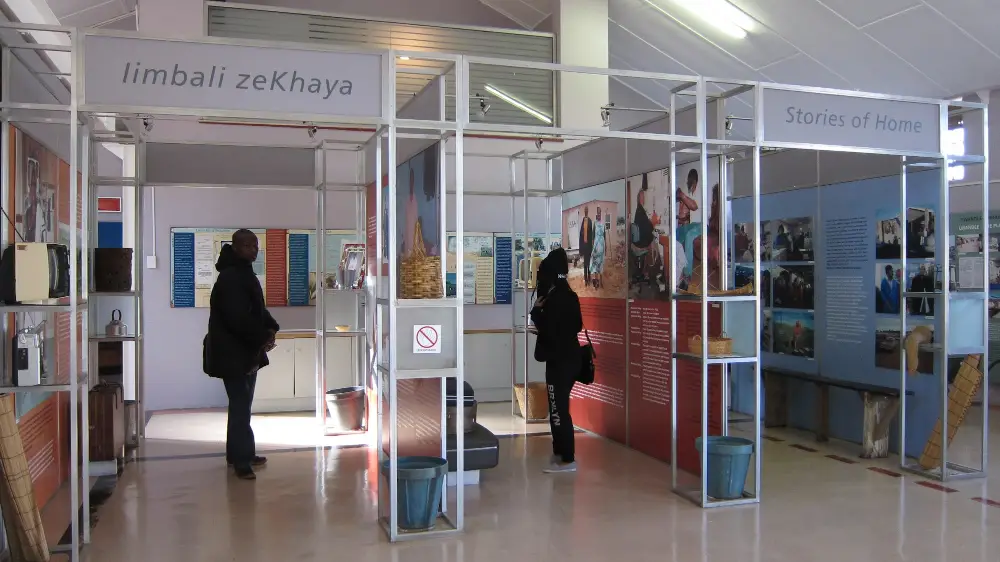
The Stories of Home/Iimbali zeKhaya exhibit makes this range of perspectives explicit (see plate 8). Based on Lwandle oral histories, texts are in the first person, accompanied by large photos of speakers and their personal objects. They recount life histories, family connections, hopes and desires, and the privations of hostel life. Nearby, David Goldblatt’s 1989 photo essay, The Transported of KwaNdebele, was displayed. His images of African workers’ punishing daily journey from the KwaNdebele ‘homeland’ to Pretoria connect Lwandle workers and hostels to other grueling apartheid labor conditions. They foreground the political economy of apartheid and its personal toll, a history continuing to shape the country.
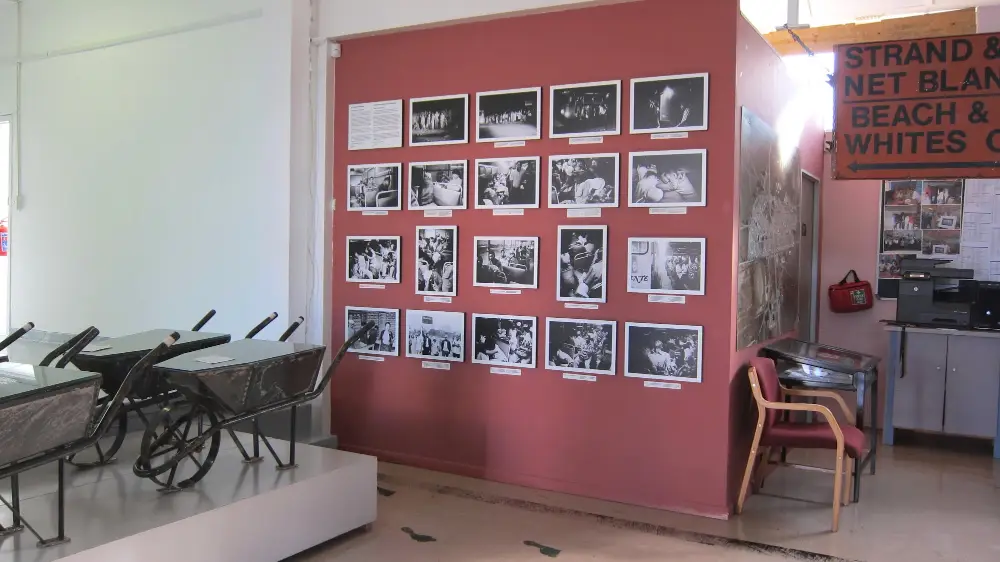
Over the years, LMLM has shown the Goldblatt photos in different ways. Likewise, artist Gavin Younge’s Workman’s Compensation (1979) has been a regular component of LMLM displays, in different configurations. As chapter 5 noted, Younge’s work consists of glass-topped wheelbarrows holding objects collected from workers in Langa and Guguletu: battered enamel cups and plates, the infamous apartheid-era passbooks Africans had to carry, even letters between separated relatives. When I visited LMLM in 2016, the Goldblatt images were massed on a single wall, set off by its ocher background. Workman’s Compensation was just in front of the wall, arranged on a raised platform (see plate 9). For me, the close juxtaposition heightened the effect each has, with the wheelbarrows bringing a sharp material sense of workers’ domestic life to the harsh conditions of their long daily commute shown in the photos. Together they provided a searingly embodied sense of life under apartheid through postures and expressions in the images and the meager, dilapidated personal objects. As Goldblatt noted in 2006, it was ‘a reality some of which will be with us far into the future’. Histories and ethno-racial relations embedded in exhibits at LMLM are presented from a postapartheid stance, foregrounding brutal apartheid conditions of the past, ways migrant workers endured and made lives, and the current Lwandle community that survives that past.
Meanwhile, in downtown Cape Town, the Iziko South African National Gallery was showing several well-conceived exhibits. At the transition, ISANG, ‘probably more than any other national museum . . . explicitly committed itself to “redress” . . . “social and educational responsibilities” and . . . preserv[ing] and present[ing] “a multiplicity of cultural manifestations”’ (Witz, Rassool, and Minkley 2017, 159). What was striking in the 2016 exhibits was their integration of South Africa’s colonial, apartheid, and postapartheid histories into the presentation of art. Installation design followed white cube art conventions, varying some walls to light gray. With designed use of space, color, and lighting relatively constant, I focus more on the exhibits’ thematic organization, texts, and object selection, all key to rhetorics of value related to history and ethno-racial structures and identities. The exhibits used these to address history and race both directly and obliquely.
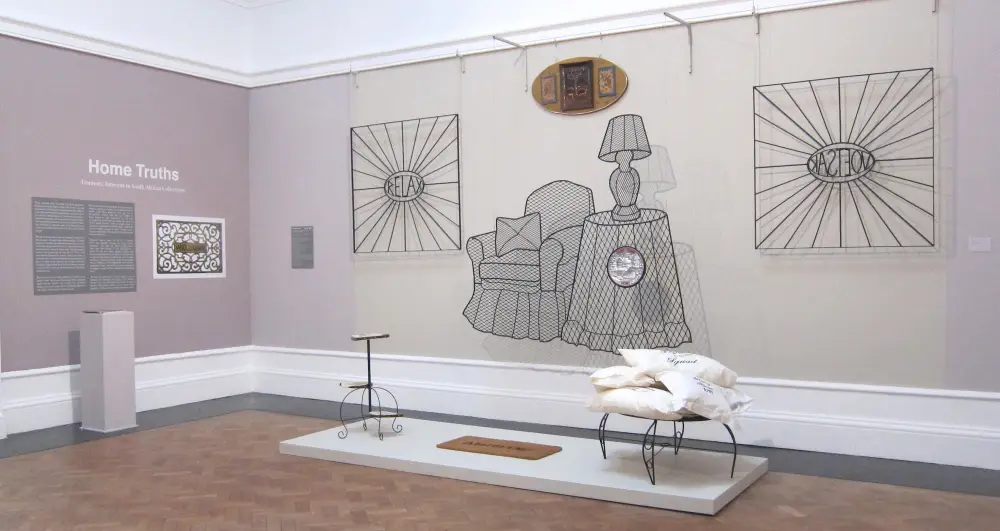
For instance, the opening section of Home Truths: Domestic Interiors in South African Collections juxtaposed photographs of informal settlements and makeshift homeless shelters with Lisa Brice’s Make Your Home Your Castle (1995) (figure 6.4). The doormat in her installation asks ‘Alarm on?’; the gate bids inhabitants ‘Relax’ but its outward-facing message is ‘Voetsak’ (get lost). Brice’s wry piece underlines South African intersections of race, class, and modes of insecurity just as the curatorial juxtaposition recognized the country’s depth of inequality. Popular understandings of history and South Africa’s ethno-racial formation shaped the framework through which visitors were addressed and interpretations of domestic space were presented.
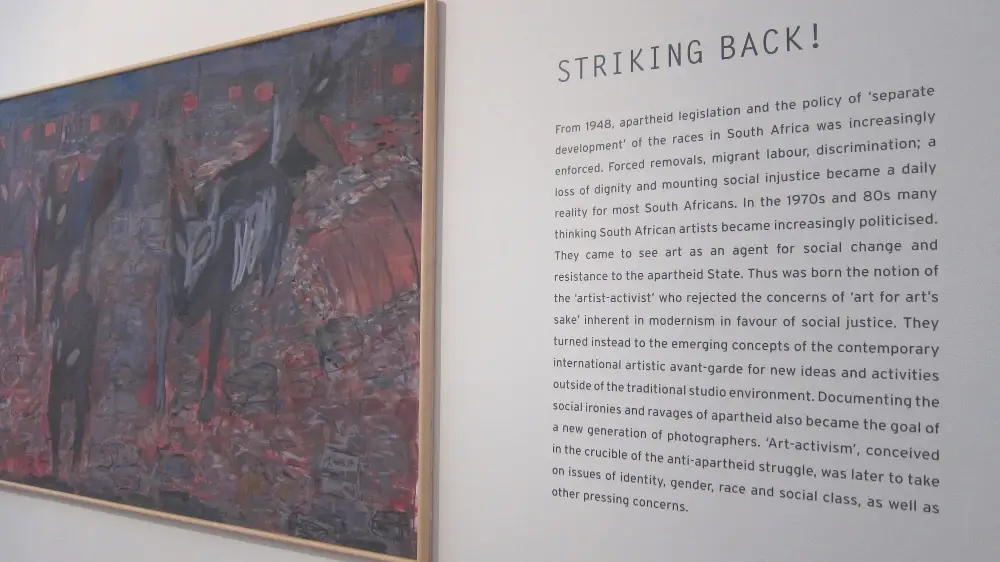
Studio, the largest exhibit, offered a South African art history, by its nature bound up with history and politics. Thematic and chronological sections filled six galleries. Early periods were covered in ‘Sacred Heritage’ (Indigenous arts in the colonial era) and ‘The “Quest”’ (the search for a distinctive South African art that began with settlers and continues still). Three sections on later periods embedded artists in an account of popular history. ‘The Original Report’ addressed art depicting social and economic change after gold and diamond discoveries. ‘Striking Back!’ covered apartheid artist-activists in the 1970s–1980s and their successors (figure 6.5). ‘The “New” Report’ featured post-1994 work engaged in ‘dismantling the deep-seated legacy of apartheid . . . [and] development of a shared national identity’. Texts referred to the South African Constitution and artists’ ‘critical reassessment and rewriting of colonial history and focus on the politics of representation’. Finally, ‘The Body Politic’ focused on artists directly addressing categories and practices defining South Africa’s ethno-racial formation.
While Studio’s structure and texts provided a historical-artistic framework, the works selected brought specific textures, memories, affect, and issues to the sense of popular history and South Africa’s ethno-racial formation embedded in its design. Certain iconic artworks would evoke memories for some visitors. For instance, Jane Alexander’s The Butcher Boys (1985–1986) responded to apartheid’s dehumanizing effects and the state of emergency then (figure 6.6) (SAHO and Artthrob, n.d.; Wikipedia, n.d. a). Similarly, Thembinkosi Goniwe’s piece on ‘flesh-colored’ Band-aids first appeared in 2000 as a billboard in the public art project Returning the Gaze (figure 6.7).
Postapartheid transformation in South Africa’s museums may yet be uneven, but since 1994 museums and exhibits have been fodder for lively debate about public history, citizenship, and institutions of public culture. These recent examples suggest how the exhibit landscape has shifted and how exhibit design incorporates and continues to shape notions of popular history and South Africa’s ethno-racial formation. When the National Museum of African American History and Culture opened on the Washington Mall in September 2016, design of its inaugural exhibits was equally important in shaping the stories and values it conveys. The intertwining of popular histories and US ethno-racial formations was central.
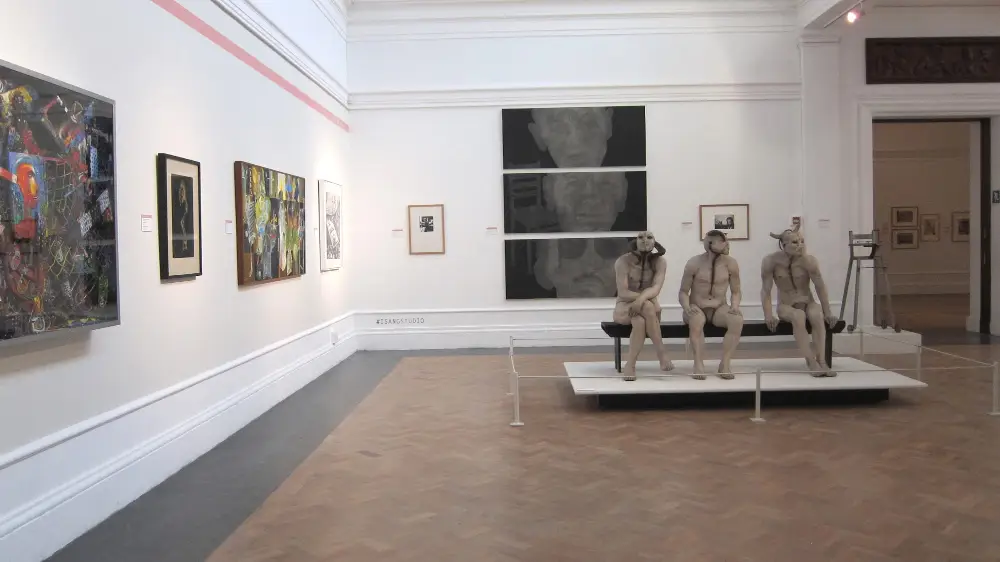
Figure 6.7. This work by Thembinkosi Goniwe was in the 2016 Studio exhibit’s ‘Striking Back!’ section, which focused on artist-activists. It first appeared as a public billboard in Rondebosch, Cape Town, as part of the Returning the Gaze project (2000).
~~~
Corinne A. Kratz, ‘Redesigning Popular Histories and Facing Race Through Exhibition’, in Rhetorics of Value: Exhibition Design and Communication in Museums and Beyond, pp. 171–209. Copyright 2025, Duke University Press. All rights reserved. Republished by permission of the copyright holder, and the Publisher. www.dukeupress.edu.
- Corinne A. Kratz is Distinguished Professor of Anthropology and African Studies Emerita at Emory University, Research Associate of the Museum of International Folk Art, and Senior Scholar at the School of Advanced Research in Santa Fe. She is coeditor of Museum Frictions: Public Cultures/Global Transformations, also published by Duke University Press, and author of The Ones That Are Wanted: Communication and the Politics of Representation in a Photographic Exhibition and Affecting Performance: Meaning, Movement, and Experience in Okiek Women’s Initiation.
~~~
Publisher information
‘Rhetorics of Value makes a major contribution to the theory of museum exhibitions by focusing on the relationship between the design of exhibitions and the way they are open to interpretation and their impact. Covering a diverse set of exhibitions, this important book will engage with a wide audience and will influence discourse in museum studies, cultural studies, African studies, and anthropology more generally’.
—Howard Morphy, author of Museums, Infinity, and the Culture of Protocols: Ethnographic Collections and Source Communities
In Rhetorics of Value, Corinne A. Kratz explores how exhibition design creates and conveys values that have the potential to touch, educate, and engage visitors. Drawing on case studies from the Victoria and Albert Museum, museums in South Africa and Kenya, a Hawaiian resort hotel, and the Smithsonian’s National Museum of African American History and Culture, among others, Kratz shows how exhibits help shape and narrate cultural categories, values, and histories while provoking questions and evoking memories and experiences. She crosses contexts to consider ethnographic, history, and art exhibits in national and community museums and other display settings. Through these examples, Kratz traces how exhibition designers combine objects, texts, images, lighting, audio, space, and narratives to craft a complex, multilayered communicative form that visitors experience as they move through museums. By investigating the relationship between audience reception and exhibition design strategies, Kratz contends that through design, exhibits can shape the ways we know, the stories we tell, and our contours of meaning and engagement.