The JRB presents an excerpt from Isaiah Bud-M’belle: The Life of Isaiah Budlwana M’belle, 1870–1947, the new biography by Brian Willan and Brown Maaba.
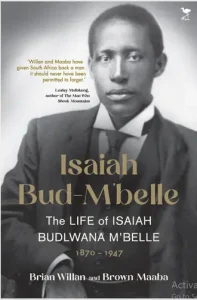
Isaiah Bud-M’belle: The Life of Isaiah Budlwana M’belle, 1870–1947
Brian Willan and Brown Maaba
Jacana Media, 2026
~~~
Preface
Isaiah Budlwana M’belle was a man of many talents and many accomplishments. Born in Burgersdorp, in the Cape Colony, in 1870, he lived his life in the shadow of South Africa’s transition from colony to a racist unitary state, and then its consolidation as a dominion within the British empire. Bud-M’belle, as he would usually be known, was a black South African, of Mfengu origin, and traced his ancestral origins to what is today’s province of KwaZulu-Natal. His family ended up in the Cape Colony, however, became Christians and, like many other Mfengu, were known for their belief in the power of education and their loyalty to the British government. Isaiah Bud-M’belle, more than most of his contemporaries, would take the fullest advantage of the opportunities that arose, achieving things none of his race or colour had done before.
This was often a matter of public celebration by his peers. One such occasion was a gathering in the city of Kimberley, in the northern Cape, on 29 January 1916. That evening, friends and admirers gathered in the St John’s Hall to pay tribute to him, wishing to mark in an appropriate manner his retirement from the position of interpreter to the Griqualand West High Court. The message conveyed by Arthur Tsengiwe, the chairman of the committee of arrangements, was that they should regard Isaiah Bud-M’belle as an example to them all. Few in the audience were unaware of the range of his accomplishments and his reputation as the finest court interpreter of his day. He was the first African to have passed the civil service entry examinations; he had been 22 years as interpreter in African languages in the Griqualand West High Court, and was fluent in isiXhosa, Setswana, Sesotho and isiZulu as well as English and Dutch/Afrikaans; he was the only African in the administrative and clerical first grade in the civil service of the newly created Union of South Africa; he was only the second African to have passed the Cape Lower Law examination, which qualified him for the position of magistrate; and he was the author of a well-known book, Kafir Scholar’s Companion, published by the Lovedale Press in 1903.
But Tsengiwe was at pains to point out that they should admire Bud-M’belle not for his achievements alone, impressive as these were, but because he had used his talents for the benefit of the community. He was one of those, he said, who had ‘sacrificed themselves for the rights and for the cause of enlightening their people’, and he ‘had taken the welfare of his people at heart’. Tsengiwe went on to cite, as examples, his efforts on behalf of the local Lyndhurst Road Native Public School and the country-wide scheme for higher education for Africans – the Inter-State Native College – which would come to fruition a few months hence. Others, later in the evening, would mention his work for the Wesleyan Church, and his success in persuading the De Beers company to donate trophies for black cricket and rugby, and in raising funds to build a Queen Victoria Memorial Hall for the use of Kimberley’s African community.
*
In the context of early twentieth-century South Africa this was an impressive record. Perhaps, in retrospect, it can be seen as a high point, although in 1916 there was still much to come. He left Kimberley for Johannesburg in 1917 and for two years was general secretary of the South African Native National Congress, precursor of today’s African National Congress. In 1919 he resigned from this position and embarked upon a second career in government service as senior clerk and interpreter for the Native Affairs Department in Pretoria, working in its head office. This did not prevent him from becoming deeply involved, as in Kimberley, in the affairs of his new local community and in working to improve conditions in Marabastad, the township in which he went to live.
Eleven years later, after his second retirement from government service, Bud-M’belle re-entered national politics but narrowly failed to be elected to the Natives Representative Council, a new advisory body that provided a limited degree of representation for Africans in supposed compensation for the loss of the non-racial Cape franchise. He died in 1947, a year before the coming to power of the Afrikaner Nationalist government.
As was clear at that evening in Kimberley in 1916, Bud-M’belle left a deep impression upon the lives of his contemporaries. As well as expressing their hopes and aspirations, his life also encapsulated the challenges and complexities of living in a country which increasingly denied them a place as full citizens. Surprisingly, beyond a few short pieces, his story has not been told before. In the burgeoning literature on African politics and biography in South Africa, his name crops up quite frequently but information about him is sparse and often inaccurate. He tends to be seen as no more than a bit player in grander narratives that others take forward. In a short history of the ANC written by the Rev. James Calata in the 1950s, his name is unaccountably missing from the list of its general secretaries. He is often confused with his nephew Horatio, and bizarrely he appears under the name ‘Horatio Isaiah Budlwana M’belle’ in the New Dictionary of South Africa Biography, published in 1995.
In one field, that of the history of black cricket and rugby in South Africa, where recent research has uncovered a long-forgotten story, Bud-M’belle’s contribution is now recognised. But his writings in and on isiXhosa have been largely ignored, particularly his book Kafir Scholar’s Companion. Its title may not be one to commend itself to a modern audience, but its content deserves far more attention than it has received. The same can be said of his contributions to the press, in both English and isiXhosa, particularly his writings on the history of his people.
Probably the commonest thing said about Bud-M’belle is that he was a brother-in-law of Sol Plaatje, the more famous writer, journalist and politician. Factually, that was true enough, for Plaatje married Isaiah’s sister Elizabeth, but there are many other things for which he deserves to be remembered.
Plaatje was not always the more famous of the two. For most African residents of Kimberley in the mid-1890s, when the two men first met, Isaiah Bud-M’belle would have been considered the leading figure, by some margin, in the affairs of their community. A praise poem in the English–isiXhosa weekly newspaper Imvo Zabantsundu, in 1897, relating his accomplishments in traditional idiom, could not have made the point more clearly or more eloquently. Young Sol Plaatje, by contrast, had only recently joined the Kimberley Post Office as a messenger, its lowest rung, and had still to make his mark.
After that, their relationship grew closer but their careers and reputations diverged. Today Plaatje is revered as a great spokesman for the African cause, his achievements and his writings widely celebrated and memorialised. A new university, among many other things, is named after him.
Bud-M’belle has not been memorialised to anything like this extent. The only institution named after him is the Bud-M’belle Primary School in Atteridgeville, Pretoria, which serves the needs of one of the region’s most deprived communities. The school started life as the Methodist Combined School in Marabastad. It later relocated to Atteridgeville and in 1957 was renamed the Bud-M’belle School in recognition of the part he had played in its foundation. The school is proud of its association with Isaiah Bud-M’belle and it draws inspiration from his life and his achievements.
But they are largely alone in this, and it is not difficult to see why. Isaiah Bud-M’belle has lacked the appeal, in present-day South Africa, of the better-known leaders of his day like Sol Plaatje, John Dube or Pixley ka Isaka Seme. A career spent in government service would not always be viewed so sympathetically as it was by his friends in Kimberley in 1916. His identity as an Mfengu had led, as some saw it, to an excess of loyalty to the white governments of his day. He believed in working closely with whites as the best hope of improving the position of his people and was not persuaded by those who argued for greater self-reliance alone. He was a notably loyal member of the Wesleyan Church and disapproved of the separatist churches that broke away from the established religious denominations, seeking, as they did, freedom from white control. That was not his way.
~~~
- Brian Willan holds a doctorate from the School of Oriental and African Studies, London, and is currently Senior Research Associate at Rhodes University and Extraordinary Professor at Sol Plaatje University. He has written extensively on Sol Plaatje and other aspects of nineteenth- and twentieth-century South African history. He is the author of Sol Plaatje: A life of Solomon Tshekisho Plaatje, 1876–1932 and co-editor of Sol Plaatje’s Mhudi: History, Criticism, Celebration. His most recent book, Sol Plaatje’s Mafeking Diary: Reconsideration and Restoration, edited with Sabata-Mpho Mokae (Jacana, 2023), won the National Institute for Humanities and Social Sciences award for Best Non-fiction Edited Volume in 2024.
- Brown Maaba holds an MA from the University of Fort Hare and a PhD from the University of Cape Town. He has held positions at the University of Fort Hare and Wits University. He has published various books, numerous scholarly and popular articles on liberation history, heritage, education and visual art. He has served as speechwriter for the former Minister of Higher Education and Training and for the former Executive Mayor of Johannesburg, Parks Tau. He is currently a Research Associate at the Johannesburg Institute for Advanced Study (JIAS), University of Johannesburg.
~~~
Publisher information
‘Willan and Maaba have given South Africa back a man it should never have been permitted to forget’.
—Lesley Mofokeng, author of The Man Who Shook Mountains
Isaiah Budlwana (‘Bud’) M’belle (1870–1947) was one of the most talented Black South Africans of his generation yet today his life and many achievements have been largely forgotten. If he is remembered at all, it is as the brother-in-law of the more famous Solomon Plaatje, who married his sister Elizabeth. This biography tells his story for the first time.
Born in the Cape Colony in 1870 and of Mfengu origin, M’belle was the first African to pass the Cape civil service entry examinations. He became a highly regarded High Court Interpreter and, after Union in 1910, went on to a second career as a senior official in the Native Affairs Department in Pretoria. He was by some margin the best-paid Black civil servant in the country. His achievements extended well beyond the civil service: he played a leading role in organising non-racial cricket and rugby in South Africa, was deeply committed to the cause of education for his people and served for two years as General Secretary of the South African Native National Congress. Later in life he was involved in the Joint Councils and the All African Convention and stood for election to the Natives Representative Council in 1937.
Drawing on extensive archival research, Brian Willan and Brown Maaba trace M’belle’s life from his family’s origins in the Lenge mountains in KwaZulu-Natal, through his education at the Wesleyan Healdtown Institution, his rise through the civil service, the books he wrote and sponsored, his trip to England in 1908 and his years in both Kimberley and Pretoria. In doing so, they uncover his triumphs and failures as well as the complexities and contradictions of his position as both government servant and spokesman for his people.
Through M’belle, readers encounter the broader landscape of Black intellectual and political culture in the late nineteenth and early twentieth centuries – the networks, institutions, ambitions and constraints that shaped an era. Isaiah Bud-M’belle restores a significant figure to his rightful place in South African history and makes an important contribution to the historiography of early Black politics, law and intellectual life.