The JRB presents an excerpt from Original Apartheid Hustler: The fiction and fabrications of Dugmore Boetie, the new biography by Benjamin N. Lawrance and Vusumuzi R. Kumalo.
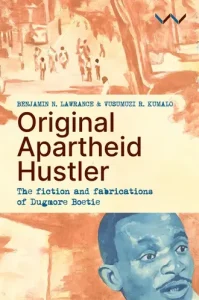
Original Apartheid Hustler: The fiction and fabrications of Dugmore Boetie
Benjamin N. Lawrance and Vusumuzi R. Kumalo
Wits University Press, 2026
~~~
Prologue
In mid-November 1966, in a hot and humid ‘Bantu’ hospital ward in Nquthu, Zululand, the novelist and short story writer, Dugmore Boetie prepared to take his final breath. His journey towards Lethe was peaceful; riding high on morphine, he nestled cosily in crisp bedsheets, tended by doctors and nurses. While no one had divulged his lung cancer diagnosis to him, he was no fool. He knew what ailed him, what rendered one arm limp, what underlay the persistent chest-shuddering cough. Yet during occasional moments of lucidity, he eschewed resentment and anger. Instead, he dwelled on what he had accomplished, what he had achieved as a Black African writer, and all in barely half a decade.
Only four months earlier, his gripping short story ‘The Confederate Trickster’ had appeared in Johannesburg’s Sunday Times, the epitome of elite, white, Anglo, middle-class respectability. His playful depiction of thieves casing the hallowed corridors of the venerable OK Bazaars department store by daylight was so enthralling, readers voiced shock and dismay. Eish! The newspaper’s editor even felt compelled the following week to assure readers that his depiction of Black urban hustle was pure fiction. Nat Nakasa had never had such a triumph! And, while he had yet to receive his print copy, that high-minded cosmopolitan arbiter of anglophone prose and poetics, The London Magazine, had just accepted a second piece. Only six years earlier he had tried so hard to escape to England. He recalled his two-thousand-mile trek with his broken prosthetic leg, from Sophiatown to Dar es Salaam. How desperate he had been to board any flight destined for almost anywhere. Quickly putting aside such thoughts, he chuckled to himself. Bloke Modisane had never graced the pages of TLM. Now he had arrived. His friends, Ruth First and Barney Simon, were shopping around his first novel, ‘Chocholoza’, in London. Celebrated at the metropolitan epicentre of letters, he closed his eyes, knowing his literary legacy was assured.
Introduction | Deciphering a Hustler
Boetie means anything; mostly it means nothing.
— Dugmore Boetie, Familiarity is the Kingdom of the Lost
Scant records describe the last few months of Dugmore Boetie’s tragically short life (see Figure 0.1). A handful of letters from various individuals, several oral historical narratives. But little else. We like to imagine that he died peacefully and without too much pain, thrilled that his work had reached an international readership. The preceding prologue represents our approximation of Boetie’s state of mind as he passed. But, to be clear, it is pure fantasy, or … historical fiction. Boetie died of cancer, but little else that occurred just before he passed is known. Boetie’s literary legacy was not assured, however. Indeed, the fame he so desperately craved was deeply imperilled.
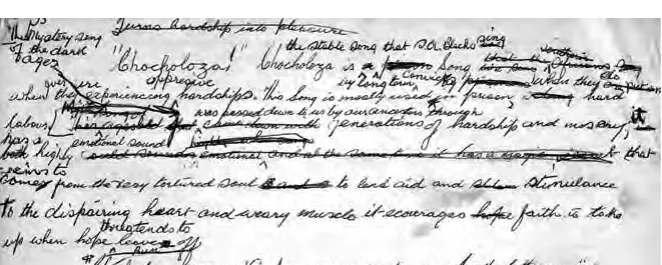
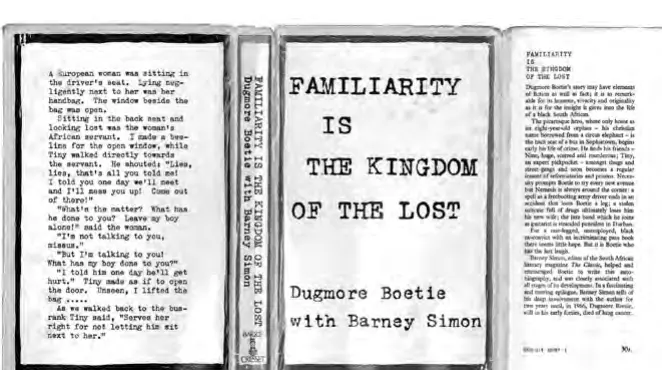
Three years after Boetie’s death, the London publisher Barrie & Cresset released Familiarity is the Kingdom of the Lost. Beneath the book’s title, its dust jacket announced ‘by Dugmore Boetie with Barney Simon’ (see Figure 0.2). The inside pages listed Simon as copyright holder. Not only did Boetie die before his autobiographical novel, ‘Chocholoza’, appeared but, without his consent or even knowledge, Simon changed the title, asserted a claim to co-authorship, appended an ‘epilogue’ to Boetie’s original manuscript, and copyrighted the entire work in his name. Simon’s unauthorised essay disassembled the novel’s fictional protagonist, Duggie, labelled Boetie a ‘conman’ who ‘conned people all the time’, and recategorized the book as the autobiography ‘of a shit’. While Simon described Familiarity as ‘a work of imagination’, many enjoying Boetie for the first time inevitably find themselves wondering what degree of truth is concealed by its fictionalised absurdities. Boetie and Simon co-created a profoundly complex historical and literary question: is it possible ever to know the real Dugmore Boetie?
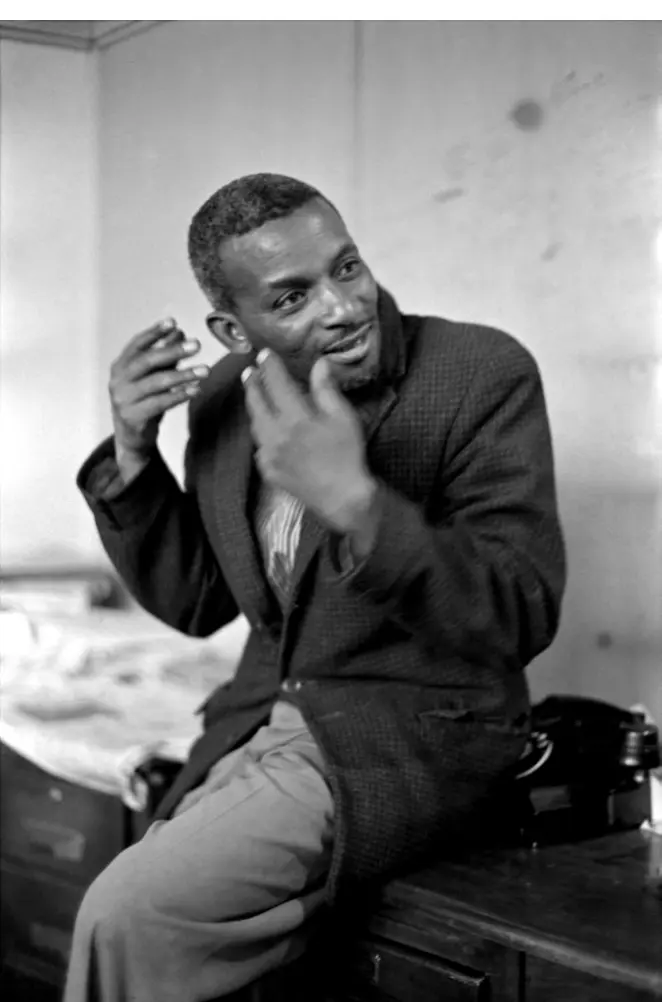
Since 1969, Boetie’s reputation has been besmirched as a Black liar, an African con artist, and a Bantu fraud. Periodically, stories percolated at home and abroad, dissimulating Boetie’s background, or essentialising his identity. Three terms – conman, cripple, and one-legged – dominated biographical sketches. Largely misrepresented and misunderstood by contemporaries and critics, Boetie was cast out, as the leading South African humanist of the era, Es’kia Mphahlele put it, with ‘the debris of Black life’. Over a century after Boetie’s birth, an impenetrable fog obscures the life of this Black African creative. He is almost unknown in South Africa. Simon’s unauthorised essay remains the touchstone for scholars and critics alike intrigued by the ‘Dugmorean’ way of life. ‘Alienated from himself’, his autobiographical novel resides on the periphery of the South African literary canon.
Original Apartheid Hustler drives a wedge between the racialised historical and literary tensions surrounding Dugmore Boetie’s life-story by engaging contemporary and historical debates about agency, racism, erasure, and decolonial praxis. In this interdisciplinary living social history, we argue that it is possible to undo the historical erasure and literary violence of apartheid and post-apartheid indolence and to restore a legacy misplaced and misappropriated by white privilege and structural racism. For those eager to reclaim South African history from the forces that defrauded them, Boetie and his writings offer a new interdisciplinary decolonial approach.
By creating space and opportunity to engage directly with living generations impatient to reclaim their heritage, Original Apartheid Hustler creates a new framework for family social history that short-circuits the historical undercurrents of South African whiteness and privilege and their contemporary reverberations. Using insights from interdisciplinary historical writing, disability studies, and comparative literature, we unravel the web of fact, fantasy, myth, and outright mendacity surrounding Boetie’s historical identity and literary heritage, to expose the sociocultural, political, legal, and intellectual violence during apartheid and post-apartheid that marginalised, silenced, and erased his legacy. In short, we show how Boetie, the man and writer, has been completely misunderstood, and work to undo this misunderstanding.
An Impossible Biography of a Hustler
Original Apartheid Hustler is the unlikely story of an accomplished South African writer who supposedly left little historical record. While Boetie’s celebrated novel was printed and reprinted on three continents, he is largely unknown in South Africa today. For over half a century, scholars and public figures have insisted that, with the exception of Familiarity is the Kingdom of the Lost, he left no substantive historical trace. One twentieth-century survey of Black South African literature cockily asserts, ‘it is impossible to give any indisputable facts about Dugmore Boetie’. Others express frustration at vain attempts to gain any deeper understanding. Simon himself once proposed a ‘Quest for Duggie’. But even he abandoned this embryonic idea, remarking that all ‘attempts I have made to establish the facts of his life have led only to chaos and contradiction’. In the early twentieth-first century, some South Africans even doubted Boetie’s very existence. How then does one write an impossible biography?
Biographical writing is a rich and multifaceted South African tradition, ranging from celebratory studies to explorations of more quotidian figures. While sprawling studies of the Mandelas and other luminaries often revel in tropes or challenge clichés, biographies of the marginalised, ordinary people can illuminate a region, a period, or a moment. If only Boetie were so easy to compartmentalise. Neither a literary notable nor entirely peripheral to mid-twentieth-century South African writing, he was once lionised in the global North yet entirely sidelined in South Africa. As the Drum journalist and short story writer Casey Motsisi remarked, his friend ‘Bra Dougie’ was ‘all knowing, but himself an enigma’. Indeed, everyone seems to have heard of him or to have known of him, but no one appears to have truly known him.
Boetie appears to have been a recalcitrant, even truculent autobiographer. He provided only one autobiographical ‘note’ during his lifetime, relayed from a hospital bed to his friend and champion, the future Nobel laureate, Nadine Gordimer. Her notes are as tantalising as they are cryptic.
Born in Sophiatown, Johannesburg, forty years ago. Has had 17 criminal convictions; lost his left leg in the Western Desert during the second World War. Has had more jobs than he can remember, ranging from circus elephants’ foot washer to jazz guitarist. At present concentrating on writing an autobiographical novel.
This frivolous almost epitaphic fragment is replete with both truth and falsehood. Boetie leaned into fabricating self-caricature via cryptic autobiographical exposition, and with almost parodic irony. With understated wit, Gordimer noted, ‘it was not in his nature to establish facts about himself’.
Against Boetie’s resistance to letting people know him, we set his biography in our sights. Working with living generations of the Boetie/Buti/Butie clan, our treatment of Boetie emerged in conversation with newly unearthed sources, richly revealing archival materials, and freshly recorded oral testimonies. Our interdisciplinary approach engages multiple registers. It may be read as a biographical study of Boetie himself; as a deconstruction of ‘Chocholoza’s’ composition and misappropriation or, more broadly, as a meditation on race, racism, and racialised exclusion and exploitation in the creative arts in mid-twentieth-century South Africa.
Our narrative and analysis centre the ‘hustle’, a term we deploy to address his fabrication of multiple identities and his resilient self-fashioning, the collaborative activities between Boetie and various communities of writers and artists, and the concealment and erasure of Boetie’s disability and literary contributions by ableist, racialised and racist sociocultural and political currents during his life and after his passing. As a conceptual device, hustle is quite distinct from the pejorative sense of conman, a frequent literary and criminological term steeped in ideas of deceit and delinquency. Hustle and hustling offer disciplinary and interdisciplinary scholars an opportunity to disembed a spectrum of coexisting subversive Black African identities, experiences and ambiguities from colonial, neocolonial, Eurocentric, and white racist contexts, and reframe lives within appropriately idiosyncratic and decolonised spaces.
Contemporary African hustlers may be economic misfits, such as pirates, hackers, gangsters, but also sociocultural fixtures, such as bar hosts, street vendors, barbers, or hip-hop artists. Reflecting on her struggle against patriarchy and sexism, Agnes Sithole self-identified as a hustler. She explained that ‘instead of fighting for somebody to do things for me, I would do it for myself’. The hustler as ‘someone who wakes up every day with nothing, but at the end of the day will have something to show’. Viewed in this light, hustling is a survival mechanism, confronting inequity, providing for the refashioning and stylisation of the self, and embracing a language of aspiration.
South African hustlers – of all gendered self-presentations – reside in defensive postures and liminal spaces, strategically slipping between informality and legality. Among Kwaito musicians, for example, hustling is one township manifestation of overlapping anti-social identities, emerging from social banditry but with a fluidity and directional impulse to ‘to go legit’. Hustling invokes suffering, precarity, resilience, camaraderie, delineated against the presence of death. Hustling accounts for fashion industry interlocuters’ presentism and entrepreneurialism with the seemingly insurmountable challenges ‘to fashion a good life’. Invoking Zulu slang – ukupanda – hustlers try; and they continue to try until they get what they want because ‘it is a way of living without guaranteed success’. Hustling thus also decentres the masculinity embodied in the conman.
Framing Boetie as the original apartheid hustler attends both to his persistence, resourcefulness and an innate capacity to refabricate from multiple sources, but also the fact that he is the only Sophiatown-born writer to write while navigating the intense ‘rise and grind’ of disability and racial prejudice during the oppressive formative decades of the white supremacist state. Among rival urban Venda communities, the ‘original Venda hustler’, was one focused on finding ‘a means of making ends meet’ in a world of scarcity and increasing inequality. The nature of the hustle is a ‘combination of skill, chance and perseverance’; a hustler doesn’t wait: they have drive, they try to become something, they search and make a way. While others fled to write abroad, Boetie – as enigma, writer, musician, actor, journalist, friend, ‘cripple’, son, cousin, uncle, and brother – improvised in response to poverty, incarceration, abandonment, discrimination, dispossession, housing precarity, illness, disability, and political and social violence, and then he wrote it all down. Ironically, by forgoing exile abroad, he authored the only novel by a Black writer residing in South Africa during the immediate post-Sharpeville period.
But we also engage literary retrieval and reclamation, albeit with the clear understanding that we are social historians, not literary theorists. Boetie’s originality has come under intense scrutiny. Nat Nakasa warned Simon that many of Boetie’s stories, which centred on himself, were ‘apocrypha of the townships’. Nakasa would know, having been part of a journalistic cohort that constantly rehashed sensational ‘pot-boilers’. Indeed, reviews and critics point to how Boetie and his fictional character, Duggie, become caught up in the quintessential ‘Black experience’, the so-called ‘Black story’: a set of agreed-upon experiences, often arbitrated by white gatekeepers, but really the terrain of masculine tropes that complicate any sense of originality and mediate Black capacity. Reminiscent of contemporaneous critiques of Amos Tutuola’s authenticity and originality, or recent re-evaluations of Olaudah Equiano’s ‘autobiography’, some scholars and critics wondered whether Simon entirely fabricated Dugmore Boetie and his writings. Even today, the full extent of Simon’s editorial hand would benefit from deeper inquiry, and artificial intelligence-driven natural language processing technology may now provide answers.
Framing Boetie as an original apartheid hustler helps track him through his Black survival struggle and the posthumous paratextual mythmaking and its deeply racist institutional context, and it centres our investment in the ethical reclamation of his fictionalised autobiographical subject. It moves readers beyond the colonial white narrative of Black deceit and Bantu illegality, with its distinctly South African racialised connotations and overt racism, and centres the ideological work of his own identity formation. Our arguments are deliberately shifting and provocative, engaging as they do the realities of apartheid which took hold in the late 1950s and early 1960s. Moreover, intentionally envisioning Boetie as a hustler, and not a conman or liar, foregrounds the agentive connotations of his narrative practice in Familiarity and his other writings (more on this below) because hustlers sit at the ‘nexus’ of struggle, solidarity, and social death.
Most importantly, our framing of Boetie as an original apartheid hustler reinstantiates Boetie’s historicity to elucidate the paratextual tensions and contradictions befalling him and his work and the inconsistences and meanings they accrued on their dual journey through time and space. Boetie’s life, his work, and his terminal illness resided entirely within the differentiated late capitalist state, a political and geographic unit founded on racial hierarchy and legally-mandated inequality that was designed to crush any form of collective mobilisation. Boetie operated within apartheid, a governmentality that, as exiled contemporary Harold Wolpe explained, did not simply exist as an extreme expression of racism but rather emerged as an intentional technique to safeguard the structure of racist exploitation.
So, what precisely was Boetie’s hustle? What makes Boetie an original apartheid-era hustler? While Boetie never used the term ‘hustle’, several recurring themes pushed us to conceive of him as a hustler, notably his fabrications, collaborations, his resistance to erasure and his determination to do and write as he wished. Boetie’s capacity for humorous fabrication is perhaps his most celebrated trait. ‘Chocholoza’ is a rich tapestry of memories and anecdotes, of inventions and apocrypha. But the hostility with which Simon and others objected to Boetie’s propensity for fabulism, and primarily posthumously, resulted in the neglect of the historical value and literary complexity of his particular mode of self-fashioning and passing. Among many identities, Boetie passed as Black, Coloured, able-bodied and as a disabled war veteran; his capacity to pass was multifaceted and polyvalent and reflected his personal struggles as much as the national political climate.
The man we know as Boetie went by different names and adopted numerous identities, most known only to discrete clusters of family and friends. We introduce them throughout the book. Moreover, fabrication extends beyond Boetie’s own hustle to other figures in his circle, including Barney Simon, Casey Motsisi, Ruth First, Nat Nakasa, Nadine Gordimer, and the actor and singer Dan Poho of Union Artists, who, after Boetie’s passing, wove a complex web of paratextual misdirection, misrepresentation and misappropriation. Fabrication, self-fashioning and refashioning of relationships were among the defining characteristics of political, cultural and social hustling in racialised and segregated South Africa during apartheid. Taking account of them permits us to deepen scholarly understanding of hustling beyond thinking of it as ‘mere opportunism rooted in social and economic survival’. The hustle affirmed power and hierarchy, revealed vulnerabilities and contingencies, but also instantiated new inequalities and marginalisation. To discern these dynamics, we need to connect the threads of Boetie’s life with insights from his published and unpublished work and consider his unconventional relationship with ‘the truth’.
Boetie’s published and unpublished writings offer vivid testimonials permitting us to explore the vibrancy of the Johannesburg hustle in the face of encroaching white supremacy. In striking prose, Boetie lovingly celebrated the city of his birth, capturing the larger-than-life characters of Black Johannesburg and life on the Rand during the 1930s, 1940s and 1950s. And he mourned Sophiatown’s destruction, part of the policy of forced clearances – or ‘slum removal’ – a racist trope that eroded Black social and economic life in vital urban centres such as Johannesburg, Cape Town, Port Elizabeth, East London, Durban and elsewhere.
~~~
- Benjamin N. Lawrance is Professor of History at the University of Arizona. He is the author of Amistad’s Orphans: An Atlantic Story of Children, Slavery, and Smuggling (2014) amongst other books. He is a research fellow at the Johannesburg Institute for Advanced Study (JIAS).
- Vusumuzi R. Kumalo is Senior Lecturer in History at Nelson Mandela University in Gqeberha. He is author of From Plough to Entrepreneurship: A History of African Entrepreneurs in Evaton 1905–1960s (2020) and South Africa’s Struggle for Independent Education (2023).
~~~
Publisher information
‘Lawrance and Kumalo brilliantly unravel the intertwined histories of authorship, race, disability and literary production under apartheid, revealing the creative strategies through which Dugmore Boetie fashioned both his life and his art. This is an indispensable contribution to South African literary, intellectual and social history’.
—Joel Cabrita, Professor of History, Stanford University and Director of the Center for African Studies
Original Apartheid Hustler unveils the enigmatic life of Dugmore Boetie, a writer remembered for the posthumously published Familiarity is the Kingdom of the Lost (1969), his humorous autobiographical novel narrating the topsy-turvy life of a fictionalised Sophiatown-born youth from the 1920s to 1950s.
Engaging multiple registers, Original Apartheid Hustler is a biographical study, an analysis of Boetie’s writings, and a decolonial meditation on apartheid-era exploitation and erasure. Based on archival research and interviews with Boetie’s family and friends today, the authors provide insight into Boetie’s background, his struggle to find his place as an artist and writer, and his collaborations with prominent intellectuals, including Ruth First, Nat Nakasa, Nadine Gordimer, and Barney Simon. Simon, pivotal in globalising Boetie’s work, controversially controlled his copyright, influencing his posthumous narrative.
This book unravels webs of fact, fantasy, and myth, exposing the highly racialised socio-cultural, political, legal, and intellectual violence Boetie and his legacy suffered during and after apartheid. It reveals Boetie’s resilient self-fashioning, his multiple fabricated identities, and the concealment of his disability and political activities.
Original Apartheid Hustler is a profound contribution to debates about authorship, privilege, legacy, and race, from apartheid to the present day.