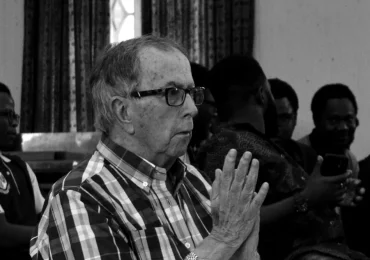
When the publisher of a new Brazilian edition of Dambudzo Marechera’s The House of Hunger needed help with the book’s Shona songs and local allusions, they sent their questions to Musaemura Zimunya, Marechera’s contemporary at the (now) University of Zimbabwe. Here are their questions, and his notes. Marechera’s writing is quoted from: D. Marechera, The House of Hunger. London: Heinemann, 2009.
~~~
1) The House of Hunger contains two references to excerpts from songs in the Shona language. For our edition of the book, we would like to include some information about these songs in footnotes to help readers understand the context.
Harry, whose cubicle was next to mine, began to sing tragically:
Shure kwehure kunotambatamba haaa!
Prostitute’s booty is bouncing and twerking
Shure kwehure kunotambatamba haaa!
Prostitute’s booty is bouncing and twerking
Kana ndazofa ndinokuchengetera nzvimbo haa!
Should I pass on, I’ll keep a place for you
Kana ndazofa ndinokuchengetera nzvimbo haa!
Should I pass on, I’ll keep a place for you
Musaemura Zimunya (MZ): This would appear to be a pranky boys’ club song in appreciation of a sex worker’s dancing skills, though it borders on the gross. What’s tragic about it is the last line alluding to death. Shona folk tunes of the mid-twentieth century frequently celebrated death of the lone wanderer. It’s not surprising when one considers there was much internal migration to places far and wide, especially the big cities or mining towns—soon to be nicknamed ‘places-of-no-return’. Some rural women joined this migration/train as sex workers, a new opportunity to escape the oppressive demands of rural patriarchy. A pattern soon formed where some would return home as dead bodies while others never returned.
Someone mistook Harry’s song for a political one; and began to join in with:
Tsuro tsuro woye ndapera/wapera basa!
Rabbit, rabbit I’m/you’re finished
Tsuro tsuro woye naNkomo!
Rabbit rabbit by Nkomo
[incomplete without the following:
Tamba naChikerema, Tamba naNyandoro, Tamba nachibwechitedza]
You’re playing with Chikerema, playing with Nyandoro, messing with Nkomo—the slippery rock.
MZ: These were the political stalwarts who remained in the Zimbabwe African People’s Union (ZAPU), until then the sole African nationalist party before the split in 1963.
This little song is a punchy political taunt of the leaders of the newly formed ZANU (the Zimbabwe African National Union) who had broken away, namely: Ndabaningi Sithole, Leopold Takawira, Robert Mugabe, Enos Nkala, among others. It was a split over ideological, leadership and ethnic differences but mainly over whether to use violence or guerilla warfare to overthrow the colonial order or pursue the option of peaceful dialogue with the settler regime. ZANU was radical, left-leaning and Marxist while ZAPU was pro-capitalist and liberal in persuasion. Therefore, this led to civil conflict and deadly interparty violence, characterised by the use of Molotov cocktails, pitting the two rival organisations. ZAPU was bigger at the time. But, as time went by, ZANU was to gain numerical advantage over its rival on account of its ethnical Shona superiority over Joshua Nkomo’s Ndebele.
2) In another passage of the book, the narrator refers to Harry as Wankie, the town in Zimbabwe. Is this a joke about people from that place? Or is it a reference to something more specific?
I opened the packet he had given me and lit one. It was as good as he had said. All of a sudden I was a child again, enjoying myself. Mentally dancing with glee. And Julia …
‘A brandy is it, Julia?’ I coughed smoke into Harry’s face.
His Wankie face.
MZ: A joke. Wankie is the country’s largest producer of coal where, notoriously, 400 miners were trapped and perished underground in 1970. Ironically, the narrator satirises Harry’s skin color through the word Wankie, as a metaphoric dig at the deep black of coal of his skin in this context. Joke? Perhaps. However, among fellow black people, it would not pass as a racial offence because, after all, your pigment can’t be had for supper. In other words, it’s an existential issue. Note also that ‘Hwange’ was the original pre-colonial name of the region which the colonials chose to rename and distort as ‘Wankie’ out of their own whims.
3) At one point, the character Nestar makes a reference to the Mau Mau. Is this a reference to the Mau Mau Rebellion, which took place in Kenya (1952–1956)?
She stroked ash from her cigarette; her fingernails were neither long nor painted. She had become the kind of person who has no need of claws. She said: ‘His friend Mike was weird, though. Not utterly. He made me stand naked and astride a sort of bull’s-eye thing and he would throw all kinds of jellies right at my hole, you know. And while aiming and all he would chant a thing about the Congo, the Mau Mau, Algeria, and one of our leaders who shall remain nameless.’
MZ: YES! Congo, the Mau Mau, Algeria—these are iconic names in the history of African liberation. Congo, for the humiliation and assassination of Patrice Lumumba, the great nationalist and visionary, by the CIA in collaboration with the Belgian intelligence and the degrading and treacherous bloody military takeover in the 1960s, thereafter.
Mau Mau is the Kenyan liberation war which is legendary in the history of the African struggle for freedom.
The great Algerian revolution preceded the Kenyan Mau Mau and for a while stood as a powerful symbol of what the dislodgement of the formidable French colonial rulers meant in the annals of Africa’s struggle for freedom.
One could also guess that Marechera deploys his Rabelaisian humor to paint a pessimistic impression of or trash these hallowed events and their heroes in African history as much as mocking Nestar’s sexual excesses.
4) In the same passage of the story mentioned above, when a commotion breaks out at school, one of the characters says, in Shona: ‘Magandanga edau!’ What does this term refer to?
‘Bloody missionaries!’
‘Bloody whites!’
‘They had the Bible!’
‘We had the land!’
‘Now they have the land!’
‘And we have the Bible!’
‘Bloody sell-outs!’
(Harry looked as though he had just been swallowed alive by Jonah’s whale.)
‘And what about Tangwena!’
‘And where is Nkomo!’
‘Sithole!’
‘Magandanga edau!
MZ: ‘magandanga edu’, not ‘edau’ (misprint or spelling error), means, affectionately or even sarcastically, ‘our terrorists’ or ‘heroes’, in a way of taunting or neutralizing the official discourse that painted liberation fighters as evil and ruthless black monsters.
5) One of the political leaders mentioned, Rekayi Tangwena, was from the Manicaland region of the country. What is the context here?
MZ: Chief Rekayi Tangwena was one of the greatest heroes of Zimbabwe’s liberation war who led his people through resistance against displacement from their ancestral homeland in Nyafaro by the settler government in 1969, following the passing of the Land Tenure Act of that year. Subsequently, in 1975, Tangwena was to assist Robert Mugabe to escape into Mozambique through the densely forested Nyanga Eastern Highlands of Zimbabwe to wage war against his Rhodesian oppressors. The trials and tribulations of the Tangwena people mimic the story of African liberation. Marechera himself traced his roots to the same area of the Manicaland Province.
6) Following the passage above, Marechera offers a grim description of a photograph depicting a Black man with a label attached to his cheek bearing the inscription ‘Fugard’. What does this term, ‘Fugard’, refer to? Is it a reference to the South African writer Athol Fugard?
MZ: This is a reference to Athol Fugard, the famed white South African anti-apartheid playwright and activist author of Sizwe Bansi Is Dead. He was a great hero to many, especially African writers and activists at home and abroad, which may explain the relevance of this sticker, as a mere political gesture. So, as with much of Dambudzo’s style, it could be a double-edged cynical intent to this character’s gesture. Fortunately, Dambudzo didn’t have to target the anti-apartheid movement whose bus regular/monthly rides from colleges to London elicited much pessimism from African students of my mid-seventies for its perceived ‘superficiality’.
~~~
- Musaemura Zimunya is a Zimbabwean poet, editor and retired teacher who taught at universities in the United States and Zimbabwe. His poetry collections include Country Dawns and City Lights and Thought Tracks and, with Mudereri Kadhani, he is the editor of the poetry anthology And Now the Poets Speak.