Wamuwi Mbao reviews The Crying Bride & Other Hallucinations by Dominique Botha, a keenly alive collection from the new Painted Dog Press.
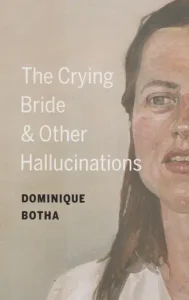
The Crying Bride & Other Hallucinations
Dominique Botha
Painted Dog Press, 2026
Dominique Botha’s The Crying Bride & Other Hallucinations is a tightly woven arrangement of lyrically essayistic writing. Fresh off the rollers of the new Painted Dog Press, the book threads the found material of autobiography through a collage of memories and meditations, forming a self-study that feels like something we might term an Afrikaner Gothic travelogue in its enthrallment to the savage poetics of life and death down on the farm.
Many of the murky fixations from Botha’s previous writing (the muddily elegiac debut False River, the poetry collection Bloodwood) bob to the surface—tragic early deaths, the knotting and fraying of generational loyalties—but here they are suffused with a dry interiority that is persuasive and affecting in its need to be told. Tempering my suspicion that this is simply Yellowstone for people who listen to Radio Sonder Grense, The Crying Bride emerges as a careful and rather good telling of a life through (not simply in) writing.
The opening essay of the book, ‘The Masked Ball and the Poem of Truth’, is a kind of kaddish for a world teetering on the brink of vanishing. It is not, in the style of such collections, a blunderbuss statement. Instead, it quietly introduces the stakes of the engagement: the family farm (‘where flamingos hoisted the late afternoon over the pan on a banner of rose and fire’), the connections with the Black people who work the land and live on it alongside the Botha clan, the grief that soaks the soil. In a Bothaville hotel bar, a local intemperate tries to charm the author by relating his plan to shoot her father:
To him, Pa was just a Boer with the wrong politics. He was planning to lie in wait for him at the farm entrance, but on the morning of the assignation the gearbox of the Bantam jammed, because he had been throwing handbrake turns on the town’s rugby field the night before.
As a framing of the author’s being and becoming, the opening essay is muted in tone but powerful in its impact. Like many of the stories encapsulated in these 19 pieces, it swipes impressionistically at life. ‘Meditative’ is an over-used descriptor in literary reviews, but it aptly characterizes the texture of Botha’s work.
The spatial is the strongest recurring thematic in this book, whether travelling the length and breadth of the country or stretching away from it for periods of time. There is a dark incommensurate valley separating the Free State pastoral of Botha’s youth from where she finds herself in the later essays, at the foot of the Drakenstein mountains in the Western Cape. Here too, there are battles to be fought:
At first, I had stood here aghast, wondering what had possessed us to buy a pile of ruins on land ravaged by hakea and Port Jackson. Beetle in the ceilings. Craters in the walls. Heritage functionaries inert in their burrows until shaken loose from their cold quiche and bar heaters by the word ‘restoration’. Instantly identifying a class enemy, like the Russian secret service of old, a punishment in search of a crime.
Botha’s writing voice is involvingly funny, whether being nudgingly conspiratorial or unabashedly stringing out her own histrionics. In another essay, we loiter companionably with the family as they explore modern-day Bloemfontein on the weekend of a derby between Grey College and Paul Roos. Ruefully surveying the altered city, some of it preserved, much of it decaying unheeded, the family pause at an oasis of a teahouse:
What are you reading? Asks Aunty A.
‘Karel Schoeman’.
‘Never heard of him’, says Aunty A.
I read a passage aloud about the state of the Netherlands in Van Riebeeck’s era from a contemporary source: ‘Bitter with discord, tangled with mutiny, stained with murder, harsh with cruelty’.
‘Sounds like a family holiday!’ laughs Ma.
I read further: ‘Earthquake, plague, hunger, hard winters. All corners of Europe filled with refugees. Particularly fierce witch hunts.’
No wonder our people fled.
To the beloved country.
To a sky full of bright clouds.
To this life.
In its treatment of the present as a tangled confluence of cultural and political histories, The Crying Bride reads companionably alongside such works as Azille Coetzee’s Desire at the End of the White Line and Antjie Krog’s house fire of a work, Blood’s Inner Rhyme. All three are works that try to language a relation to the messy slurry of history and belonging that defines Afrikanerdom. In terms of how it retrieves from the ouroboric store of self-history, Botha’s work is enmeshed in the sentimental, but it deploys its sentiment to good effect, mostly.
The writing that results is keenly alive, the style slickly impressionistic. It owes something of its acuity to New Journalism and yet it is inflected with a beguiling South Africanness. Botha is clearly a fastidious reader, and the carefulness feeds her writing. A jaunt into the Klein Karoo in search of Rian Malan blooms into a lovely bit of road trip writing, a two-hander which is mostly not about Rian Malan. Essay writing is often at its best when it is unhurriedly digressive, where it can show off its author’s noticing, and many of the pieces in The Crying Bride strike this note.
Botha is a polished writer whose sentences float on hidden music. Sometimes, she strains for poeticality in a way that is often lovely (‘summer was an opera of brooding thunderstorms’) and occasionally strung up by lushly overwrought style not to the benefit of the writing. So much depends, with this book, on what patience you have for writing that, for all its unflinching honesty, is essentially self-interested: the insistence on one’s interiority is a louche sort of privilege that in this country is distributed unequally. Moreover, in how it paints white Afrikanerdom as a fundamentally benevolent mom-and-pop enterprise, The Crying Bride can come over all very How Green Was My Valley. Convincing as it can be in the hands of a capable writer, the idea of land as having some staunch honesty, true for all to see, is a stubborn fiction. The land is never as empty as it appears. Farming is a difficult business for little reward. ‘Hope and debt: that is all that grows on a farm’, Botha’s father remarks in an early essay. Later, a neighbour makes the austere observation that ‘in the end farming makes us all poor, but at least you live the right sort of life’.
This sort of homily-braised wisdom risks throwing a folksy cloak over this country’s long history of land-ownership shittiness. Unsparingly derisive of the ANC, Botha is tirelessly scornful of the institutional wrongheadedness of the democratic government, with some merit. But the asides, like hidden rocks of condescension on which one scrapes without warning, are jarring. On the way to a farming summit organized by Landbouweekblad, the author and her father look out on a crumbling world:
The rural areas are being forsaken for the cities. Farmhouses are abandoned. Workers’ houses stand empty. The government is closing down farm schools. For a bit of education, many farm labourers’ children are now living alone in mukhukhu in the townships, left to the mercy of tsotsis and the elements. Champagne Serifi’s granddaughter was felled by a lightning strike when she ran out into the night in fear of a thunderstorm. Our family and the Serifis have known each other for four generations. Pa paid for her funeral, like for many others. Yet closing farm schools is progress, according to my friend the policy advisor, because it breaks the evil cycle of baaskap. Another pious idiot paving the road to hell with good intentions.
White people are often unaware of how tone registers an estranging and sanctimonious distance between the certainty that privilege grants their world, and the precarity in which other people are sunk. The antagonism of Botha’s disdain for the misdeeds of the new government thumps home rather too clumsily to have the fighting power its author desires.
In any essay collection, there are stronger and weaker pieces, and the rule applies here too, where a richly human scene is occasionally wont to slip into mawkishness:
There were times that Ouma made Oupa pack up his fishing tackle and accordion and birdseed on the same day that they arrived, while she waited in the passenger seat and told us children through the window, ‘julle sal nie verstaan nie’. Then she made Oupa drive her back to Pretoria while Pa was with Ma behind a locked bedroom door and we could hear Ma crying.
Perils attend this sort of child-voiced narration, which is a repellent staple of a certain mode of white South African creative writing, and it doesn’t work well because it is both manipulative (see how that punctum arrives!) and cheaply exculpating. Some readers enjoy this kind of writing, but it chafes a little, here.
On the whole, though, the flaws are few and far outshone by the general eloquence of Botha’s writing. The handful of pieces on Breyten Breytenbach towards the end of the book fulfil their responsibility to the work of tribute. The first details with understated humour and pathos a traipse around the Netherlands with the great poet. Another relates the author’s journey to France to attend Breytenbach’s funeral. They gain amplitude from what they reveal about their subject. Breytenbach became in later life a slightly unreal figure, over-familiarized by a cultural fascination that ossified into a too-tightly held idea of the troubadour-as-feticheur. The two essays are beautiful and redemptive, putting their subject into human scale in an affectionate way.
The Crying Bride & Other Hallucinations is compellingly readable, made all the stronger by writing that reverberates with feeling. It is certainly Botha’s strongest book yet, attaching itself to the reader in a distinctive and insistent way. Its great achievement is to show how a writer can display the infrastructure of their feeling, of their attachment to life, so clearly.
~~~
- Editorial Advisory Panel member Wamuwi Mbao is an essayist, cultural critic and academic at Stellenbosch University.