The JRB presents an excerpt from The Fragile Mental Health of Strong Women, the debut novel by Michelle Kekana.
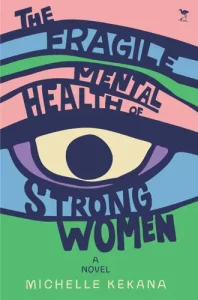
The Fragile Mental Health of Strong Women
Michelle Kekana
Jacana Media, 2025
~~~
The Book of Ayanga
My baby is born angry; he rages. When he is not sleeping, he is wailing, tiny fists clenched, trembling with disapproval at being in the world. When Lunga cries, he is completely inconsolable. His knees bend into his tiny tummy – foetal position – and his tiny face turns an angry maroon as he closes his eyes, mouth quivering.
It has been days of bad feeding and enthusiastic wails. I am exhausted. A week before his birth, I experienced a nesting instinct so profound that I cleaned for days; mopping, scrubbing, dusting and polishing until every drawer, from the kitchen to the bathroom, was immaculately organised. He has been home for three days and all that organisation is now a myth, folklore. The house is in complete disarray. Baby paraphernalia is scattered everywhere: there are rejected pacifiers on top of my pedestals, open jars of baby cream, discarded wipes, and three cups of coffee – full, cooled before I could drink them.
I had pictured motherhood differently. The baby in my head was fatter, happier. He cried too, but only to alert me of his needs. To remind me to fill his stomach, to change his nappy, to keep him company. The baby I have cries whenever he is awake. He is quiet only in his sleep. It takes too much effort to get him settled enough for slumber. By the time Morpheus takes over I am tearful, an exhausted maternal mess. I miss the baby I had pictured. That baby saw me as a source of comfort. In my head, the baby and I would spend time lovingly looking into each other’s eyes, bonding. The placid baby of my dreams proves fictional. I am falling into a deep, disappointed despair. Lunga seems determined to cry himself to hysterics, and then to sleep furtively, his little chest still heaving from uncried sobs.
I am alone with him all day. By the time Sizwe comes home from work, our once pretty house is plundered, pillaged of peace and order. There is stuff everywhere: an open bottle of Buscopan syrup, a tossed-aside vest, a partnerless sock, a half-eaten avocado sandwich, its mashed flesh darkening like my spirit. Sizwe looks around at the state of the house, and there is a flicker of disapproval in his eyes.
‘What did you guys do all day?’ He asks.
His question about what the baby and I got up to during the day makes me feel hostile. There is an unspoken criticism there; I feel he is implying that the house should be neater, more structured.
‘Your son cried all day. I had to settle him; I could not tidy up,’ I reply, a lump of tears beginning to form in my throat.
‘All day?’ Sizwe replies, choosing to repeat the part he does not believe.
A single tear rushes from my right eye, and I lift my hand to quickly wipe it off, embarrassed by the hypocrisy of displaying the very behaviour I am accusing Lunga of. Sizwe looks at me, then peers into the bassinette where Lunga is finally sleeping after a forty-minute-long cry. He looks sweet in his sleep. My claim that he cries all day sounds like a false accusation. Sizwe looks at his son with such pride that I force myself to smile. He then reaches into the bassinette to pick up the baby. I hiss at him loudly.
‘Let the fucken baby sleep! Put him down.’
Sizwe looks shocked by my anger. My voice is surprisingly menacing. I am embarrassed. Lunga is startled out of his brief sleep. His arms and legs flail as he wakes up screaming. Sizwe puts him over his shoulder while supporting his tiny head like an experienced father. His attempts at shushing make Lunga louder. I swear he preferred the womb. I had the easiest pregnancy. I was convinced I would have a contented, placid baby.
Lunga’s little lips are shaking when I take him from his father. I put him over my shoulder, and he cries directly into my ear. Then I walk around the house humming a lullaby, my voice cracking – I want to cry, too. I am dog tired. I feel like I am wading heavily through mud. I would trade a lung for a scalding shower followed by eight solid hours of uninterrupted sleep. My attempts at singing to Lunga prove futile. His little body stiffens; he uses his voice as a protest tool. I am at a loss about what to do. I look outside and see Sizwe smoking and pacing in the garden. I could use a cigarette too, something to take the edge off. I resent Sizwe’s ability to step outside of parenting, to find comfort in nicotine. When new parenthood is stormy, it is only mothers who get wet. Fathers remain blissfully dry, in the light, the sun.
Sizwe kills his half-smoked cigarette and comes back into the house. He marches in, a man with a plan. He gently takes Lunga into his arms, cradling him. He sits down on the couch and he makes direct eye contact with the baby.
‘What is wrong, son? Tell Daddy so I can fix it.’ Sizwe talks to Lunga like he is a reasonable adult, using the tone he reserves for work subordinates.
‘There is nothing wrong at all, see?’ he continues. ‘So you will be quiet, and go back to sleep,’ he says to his son.
For a moment Lunga listens and the house is quiet – then he starts crying even louder than before. Mouth wide open, his tiny fists balled, his lower lip quivering. Sizwe looks frightened at the conviction of the shriek. A petty part of me is happy that Sizwe witnesses this. He hands Lunga over to me. Just then his phone rings and he goes outside to answer it. I am left alone with a wailing baby. I unbutton my shirt and take out my breast from the cotton feeding bra. I try to feed Lunga and he struggles to latch, so I touch my cracked raw nipple to make it erect, using my finger. The touch is painful. As he finally sucks on my nipple, the pain radiates through my entire being. I want to fling away from my sore breast, but I don’t. I let him feed. He sucks hungrily, hurting me. After a while, Lunga’s tiny eyelids get heavy and he sleeps. I disconnect my raw mangled nipple from his mouth. It bleeds a little, blood mixing with milk, a maternal Eucharist. I stuff my breast back into the cotton bra, and the flesh sticks wetly to the fabric. I curse out loud. I put him over my shoulder and rub his tiny back. He burps loudly, posseting warm milk onto a clean shirt I just changed into. I wipe his little lips with the palm of my hand, place him back inside the bassinette, then go and run a shower.
Sizwe comes into the bathroom.
‘What are you cooking for supper?’
I give him a look that makes him retreat, hands raised in surrender. I test the shower water with my hand, then undress and walk in. I am in there for two minutes when I hear the baby wail again. His cry is a personal attack. Sizwe tries and fails to comfort him. Soon he is knocking politely on the bathroom door, telling me that Lunga needs me. I dry myself quickly with a towel, and Sizwe comes in with the baby. My left breast leaks clear, watery milk, and I breastfeed Lunga while sitting completely naked on the cold toilet seat. He eventually falls into a deep sleep.
From the kitchen, the house fills with the welcome smell of frying bacon, and a short while later Sizwe hands me a plate of the tastiest toasted cheese and bacon sandwich. We eat in silence. I purposely do not ask him about his day at work. I cannot handle any stories of corporate triumph at the moment. I would like to tell him how different motherhood is to how I imagined, but I know how much Sizwe hates seeing us fail, so I keep quiet. He takes the dishes away and I push the bassinette into our bedroom, praying that Lunga does not wake. Only then do I manage to put lotion on my skin. I look first-trimester pregnant even though the baby is six days old. My stomach is still rounded but not firm. The only thing that makes my silhouette attractive is the way my breasts have filled up as a result of breast-feeding. I might be far from thin, but my body has kept its hourglass shape. I feel Sizwe looking at me with want, so I give him a look that clearly says ‘no’. He takes his phone and goes into the bathroom and I know exactly what he is doing in there.
Much later, when he is snoring next to me, I look through his search history and see that he was looking at a porn category called ‘fat slippery bitches’. I am not sure whether to be offended or flattered, but soon I fall asleep. Two hours later, the baby wakes up to cry and make me feel incompetent. We stay awake in unhappy companionship until four in the morning. I wake up late for his seven-day wellness check.
Sizwe took three days of paternity leave when I had Lunga. He came to the hospital daily and sat with me while I struggled with the after-effects of a caesarean. I felt unsexy that first day as he sat with me and watched my catheter fill yellowly with urine. I stood witness as my identity as a desirable wife shifted, to make way for my new role as a sacrificing mother. Having the tube in a place that had been reserved for pleasure felt invasive. I was relieved when it was removed and I could once more go to the toilet on my own. I still felt cut up and sewn together, and walked really slowly. There had been many visitors at the hospital: everyone had been excited to finally meet Lunga.
He was a culmination of a life plan. I had wanted a baby by 27, and he was born three months before my 27th birthday. I wanted a boy first, then I would have a girl when my son turned two. The caesarean was unplanned. I had wanted to deliver naturally but after labouring for 17 hours while dilating only five centimetres, the midwife had hooked me up to a foetal monitor and had been frightened by the baby’s irregular heartbeat. A decision was made to deliver Lunga via caesarean as he was in distress. Delivering him naturally might have proved fatal: he arrived with the umbilical cord wrapped twice around his neck. Sizwe joked that the baby had his first suicide attempt in utero. I had found his joke to be in bad taste, but since Lunga cries so much and seems so unhappy to be born, I wonder if Sizwe was not right. Lunga seems jaded. Sometimes, when we are the only two people awake in the world, he looks like an old man, wise beyond his years. His eyes seem to say that he knows what happens next, and that he would prefer not to partake in the farce of life that results in death. But maybe I am tired and overthinking.
Driving to the clinic for the baby’s seven-day check is a nightmare. Too late, I decide to bathe the baby first. I take off his nappy and I experience the only triumph of the day. The umbilical peg has become detached, and he now has a navel that doesn’t look like a wound. I feel very proud of him. I hug Lunga to my chest, kissing the top of his head.
‘You are my big strong boy. I love you so much,’ I whisper to him.
He wiggles, wanting to nurse, which goes against my plan to bathe then feed him. He screams his little heart out as soon as I put him in the water. I ignore his cries and soap his small body, and he is squirming so much that soap gets into his tiny eyelashes. He tearfully shouts his grievance. I rinse off the soap on his face and take him out of the water to breastfeed him. It takes him forever to latch on properly because he is shaking in fury. Finally he feeds on my cracked, sore nipples. His sucking hurts so much that my eyes water and my bladder feels full. I let him feed for fifteen minutes. He starts to fall back asleep on my breast. I burp him and put him back in the bathwater, which has now turned cold. He screams throughout the bath, and I dress him while he is still crying with enthusiasm. I stop trying to comfort him. I am also upset. This journey is new to the both of us; I am frustrated with how impatient he seems to be with me for not doing things according to his liking. I feel judged.
I strap him into the baby seat and go to shower, leaving him to cry. I had planned that we would both wear matching outfits. Jeans and white T-shirts.
~~~
- Michelle Myeko Kekana was a 2021 JIAS writing fellow. She has been published in an anthology of essays about post-apartheid South Africa. Michelle is a former teacher but an eternal student who is passionate about creating the things she wishes existed. She is an adoring mother of 4 children, ranging from ages 10 to 25.
~~~
Publisher information
Black women are labelled as strong; their tears often seen as indulgent, their suffering expected to have an imminent expiration date. In Michelle Kekana’s ambitious debut, three modern South African women find themselves brought to breaking point as they navigate the complexities of life, love and mental health. Utterly engrossing from the first page, The Fragile Mental Health of Strong Women is a bold exploration of what it means to be ‘strong’.