The JRB presents an excerpt from Mother/Land, the new novel by Faraaz Mahomed.
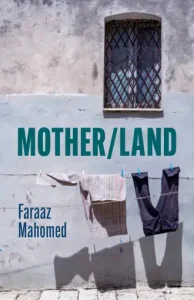
Mother/Land
Faraaz Mahomed
Catalyst Press, 2026
~~~
I took the train by myself—the Harlem line up to Westchester County—looking out at the verdant colors of spring, passing small towns and having small conversations with the conductor about the quietness that separated the city from the continual wilds of upstate. I imagined myself in a portal to the past, looking out at pastoral lands. The train made routine shunts every now and again—it sounded like a chest was being dragged along a hardwood floor.
Ma startled me with a repeat appearance—whatever she’d come to accomplish was not yet finished. She didn’t speak to me though; instead, she appeared in glassy reflections only, her cryptic expression surfacing and vanishing into thousands of stray rays of light. She wanted me to know that she was there but not close enough to ask her thousands of questions—not even just one unanswerable ‘why?’
Nahya didn’t want to make the journey to Bertha’s house. She wasn’t yet completely resolute in her disaffection for my ‘new family’, as she liked to call them, but she was on the precipice of that decision. She was waiting for confirmation that Bertha and her family—those who had profited from Malan and Lamprecht, and by the multiplicative properties of cruelty, Victor Emmanuel and Leopold and Felipe—were insincere and profligate. The suspicions she voiced roused misgiving in me too. When I left that morning, I asked her if she felt any twinge of guilt at the thought of depriving Aa’isha of cousins and an aunt and possibly uncles that she ought to know, for better or for worse. She cocked her eyes at me, wisdom and spite coiling into one another, and said to me, ‘We’ll see.’ What she meant was that we would soon see if her version of ‘these people’—the ‘ghuraba’ as she liked to call them, the strangers—was the right one. With her judgment suspended, she had taken Aa’isha and some of her friends from school to the Museum of Natural History, neither one of us mentioning where I was going.
I passed Chappaqua station, and thought of the Nation that had been removed to make way for the Chevron and the Rite Aid, of how the blood spilled here had probably met the blood spilled at the Cape somewhere in the bowels of the Atlantic—its redness diluted the way a moment dilutes into an age.
I got off the train at Bedford Hills, where a hive of young and beautiful people swarmed, and found Bertha standing in the parking lot beside her black SUV. She smiled timidly and invited me in. Our exchange remained wooden as she drove.
‘So glad you could come out all this way,’ Bertha said.
‘No problem. Thanks for the invitation.’
The drive was unscenic for a while—just a long, wide American road that signified wealth in its small shops and large houses, even in the quintessential stateliness of its Walgreens. After a few minutes, we passed a country club, large and spacious, its lawns polished like soft silk. The plots became bigger after that, with mansions sheltered behind high walls and an arcane sense of impenetrability. I had never been up here, but I’d understood that it was a place of untold wealth and generational riches. My mother’s diaphanous face was making rare appearances, jarring me each time. It was as if we were having a conversation, but then she would disperse again, playing a game with rules I didn’t know. Whatever she wanted to say, she was not yet ready to say it. We passed a few more homesteads; a body of silvery water began to reveal itself. It reached out for us, coming closer and then backing away each time Bertha took a turn.
Their house was on a quiet road, a large barn-style white edifice that looked like it had been transplanted from Massachusetts. It was perched on a cliff edge, overlooking the lake we’d seen earlier. There were large grass beds on either side of the building, skirted with bright fuchsias, tangerine-colored tulips, and an abundance of white lilies. As we drove through the gate, I heard the bark of a dog, its pitch calling me out as an intruder.
I followed Bertha in through the garage, past a very lived-in kitchen—with an assortment of recently used appliances for baking and mixing and homemaking—toward a lounge that was also empty, despite the TV being on. Someone had been watching basketball, and now pundits were undertaking their postmortem, discussing somebody’s form and so-and-so’s absence as a deciding factor. Next to the lounge was a passage, in the wall of which was a glass door that led outward, toward a deck. It was open and it forced the breeze in through the breach. It seemed as though everyone was outside, either in the pool or sitting beside it on a row of sunbeds. Even the dog—a dark brown terrier with a sour demeanor—had settled.
The most exquisite feature of the house was the other glass wall, at the outer perimeter of the deck. It looked out directly over the lake and was bounded only by brick walls on the sides. Were it not there, the terrier would have ample opportunity to fall into the water—becoming the drift itself.
‘Please … come,’ she said.
I thought of the moment when she came to the university, on the day of the debate about affirmative action and the foibles of America, and of the pallor that covered the face of the girl who talked about ‘today’s America.’ There was a similar shakiness about Bertha, as if she was standing on smoke and salt.
‘This is my husband, David.’
David stood up. He towered over me. He had a thick body, layered with muscle and bone and statuary. There was a vestige of the South in his greeting—Texas or Oklahoma or Tennessee painted over with a Northeastern venture-capitalist voice. He too was an immigrant to this place, displaced from whatever backwater that had produced him, but not nearly as outside of the world in which he existed now. He didn’t smile or insinuate pleasantry, but he wasn’t hostile either, offering just a perfunctory ‘hello.’
‘And these are my children,’ she told me, spreading her arm across the deck like a docent introducing an exhibit.
There were three girls—two blonde and one dark haired: one at the approach of her twenties, another pre-adolescent, with a smattering of breasts underneath her bathing suit and an awkwardness that implied her age. The third—the dark haired one—was the middle child. She looked about sixteen, with a blank expression that signified how discomfiting the world was. I recognized the look on her face, because it signified how I often felt in Grassy Park and Lentegeur and Capricorn.
The oldest was named Chloe. She drank water from a plastic bottle and squeezed the swimming pool out of her hair. She was distant, I supposed because the fog of self-awareness made it difficult for her to be fully present, especially around this supposed uncle of hers—this leaf from a nameless tree that by some gust of happenstance had landed on her parents’ deck. She mouthed a shy hello, then slipped back into the water.
‘Kerry, Charlotte, come and say hello.’
They were spraying water and paying no mind to me, but politely came to greet me, and to offer inklings of warmth. Thus far, the middle one—with the stoniness and solitude about her—was the most welcoming.
‘And that’s Shark,’ Bertha said, pointing to the now lazy dog. ‘We have a rabbit here somewhere too … Beatrix … but she comes and goes. She’s more friendly with the neighbors’ cat than with Shark. Anyway, you’ll meet her sometime.’
Bertha appeared to have a way of speaking in contiguous statements, and a way of neutralizing situations that might be fueled with emotion by adding on details that were plain or distracting. Subjects like her on-hold teaching career and Beatrix the bunny served the same purpose that Rosencrantz and Guildenstern did—they hinted at an attempt to lower the temperature purely with their meandering.
‘Can I get you anything? Would you like some tea or some water or a cooldrink?’
‘Maybe he wants a beer,’ David said. ‘At least offer him one.’
‘I’m so sorry … would you prefer a beer or a glass of wine?’
‘No, I think some tea would be really nice, thanks.’
David smiled for the first time, as though he’d warmed her up for me, and Bertha led me back inside to where ESPN was flashing across the screen. Beside the lounge was a long passageway that was lined with a few pictures, some portraits of Bertha’s daughters and a couple of still-lifes of suikerbossies and baobabs that suggested a longing for South Africa. I didn’t want to venture too far, in case Bertha thought I was snooping. There were blotches and marks on the walls, indents and holes that looked like bitemarks from frames that had been taken down.
‘They’re mine,’ she said, half-proud.
‘They’re good.’
‘Thanks, but there’s something about them that’s missing … I don’t know,’ she mused.
I didn’t reply, because she was right. There was a lifelessness in her renderings.
‘How do you like your tea?’
‘Black, please,’ I said as I walked back toward her.
On the other side of the lounge was a small dining room, where Wedgewood china was laid as though it had been untouched for a decade. It was like walking into the Hermitage. She set the tea down there. The dining room had no windows and was separated from the lounge by just a bare arch. Even so, it was the most secreted, most confidential of corners in what seemed to be a very leisurely and spacious house. The tablecloth was frilly and beaten by time, but still elegant. The room itself was too small for its contents—a farmhouse hutch and a similar buffet—but it seemed like a set, and perhaps they didn’t want to separate it.
Bertha sat with her back to the outside, while I was at one of the heads of the table, from where I could see David, in his shorts and golf shirt, peeping inward every now and again. Nahya would have done the same thing.
‘I’m glad you were able to come,’ she said. Her words felt like an appeal, asking me to forgo the mistrust and the fear, to walk into this relationship without any questions. I could feel myself wanting to, but I could also feel the burden of envy and malice sitting between us. There were very few right things for her to say.
‘I wasn’t sure if I should.’
‘I mean, if I was you, I would be hesitant too. I can understand why this might be uncomfortable,’ she said, brushing away a few stray hairs from the same head that had provided a DNA sample that later matched my own.
‘My wife thinks it’s foolish of me to be here.’
‘Oh, you’re married? But you don’t wear a ring?’
I hadn’t worn my ring in years, because the South African in me still prevailed when it came to matters of security. I still felt the need to hide my valuables and to lock the deadbolt on the door.
‘I don’t wear it—but yes, I’ve been married for nine years. Anyway, she thinks I’m making a mistake, that your father was the source of too much pain to recover from.’
She bowed her head. She hadn’t wished to be this man’s daughter any more than I’d wished to be his son.
David walked into the kitchen, his bare feet making swishing sounds on the tiles. He came to get a beer, and left as quickly as he’d entered. His feet swished even more as he hurried back out, as if to accentuate the fact that he was departing.
‘I wish that he had thought more about what he was doing. I’m really sorry for the pain he … they must have caused you.’
The same apology had been rising throughout the hills and passageways, whether here or there. The same sense of a rift requiring repair had been populating television studios and auditoriums, but the world had not altered on the back of semi-formed regrets and rudderless remorse. Rhodes, I thought to myself, might say sorry and stay perched atop his iron horse if offered the opportunity.
~~~
- Faraaz Mahomed is a researcher in the field of mental health and human rights, based between New York and his native South Africa. His short stories and travel writing have appeared in Granta, Boston Review, the Georgia Review, Sunday Times, and other publications. In 2016 he won the Commonwealth Short Story Prize for the African region with his story ‘The Pigeon’.
~~~
Publisher information
‘In this riveting novel, Faraaz Mahomed brings alive the emotional complexities of South Africa’s apartheid past and their ongoing legacies. He is a richly gifted writer; Mother/Land is an urgent and important book’.
—Claire Messud, author of The Emperor’s Children
An apparition of his deceased mother appears to law professor, Salim Bardien, in New York on the same day that a massive student protest movement erupts in Cape Town. She comes to foretell a revelation, an invisible stain for him to clean. The news itself—that Salim’s birth was the product of his mother’s illicit affair with a white politician in 1960s South Africa—comes from a newly found half-sister, Bertha. Yet more disorder follows when Bertha reveals that their brother is dying of cancer, and that Salim’s bone marrow may be the only hope of saving him.
How can one secret alter—or even redeem—a life? How strong are familial bonds across distances and generations? And how do the struggles of another era echo those of today? As Salim, now a husband and father, wrestles with these questions in the present, his mother Sawligha’s forbidden love story unfolds in the past.
Set between New York and Cape Town—across eras spanning apartheid’s forced removals and the rise of Black Lives Matter—and moving through lives, deaths, and the liminal spaces between, Mother/Land is the story of family, and of the world we inherit from those that came before us.