
The JRB presents an excerpt from So Long a Letter by Mariama Bâ, part of Apollo Africa’s new collection of 100 titles from the historic Heinemann African Writers Series.
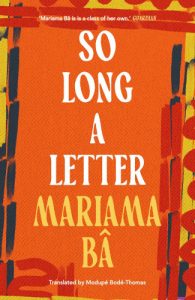
So Long a Letter
Mariama Bâ (translated by Modupé Bodé-Thomas)
Apollo Africa, 2024
I was surviving. In addition to my former duties, I took over Modou’s as well.
The purchase of basic foodstuffs kept me occupied at the end of every month; I made sure that I was never short of tomatoes or of oil, potatoes or onions during those periods when they became rare in the markets; I stored bags of ‘Siam’ rice, much loved by the Senegalese. My brain was taxed by new financial gymnastics.
The last date for payment of electricity bills and of water rates demanded my attention. I was often the only woman in the queue.
Replacing the locks and latches of broken doors, replacing broken windows was a bother, as well as looking for a plumber to deal with blocked sinks. My son Mawdo Fall complained about burnt-out bulbs that needed replacement.
I survived. I overcame my shyness at going alone to cinemas; I would take a seat with less and less embarrassment as the months went by. People stared at the middle-aged lady without a partner. I would feign indifference, while anger hammered against my nerves and the tears I held back welled up behind my eyes.
From the surprised looks, I gauged the slender liberty granted to women.
The early shows at the cinema filled me with delight. They gave me the courage to meet the curious gaze of various people. They did not keep me away for long from my children.
What a great distraction from distress is the cinema! Intellectual films, those with a message, sentimental films, detective films, comedies, thrillers, all these were my companions. I learned from them lessons of greatness, courage and perseverance. They deepened and widened my vision of the world, thanks to their cultural value. The cinema, an inexpensive means of recreation, can thus give healthy pleasure.
I survived. The more I thought about it, the more grateful I became to Modou for having cut off all contact. I had the solution my children wanted—the break without having taken the initiative. The lie had not taken root. Modou was excising me from his life and was proving it by his unequivocal attitude.
What do other husbands do? They wallow in indecision; they force themselves to be present where neither their feelings nor their interests continue to reside. Nothing impresses them in their home: the wife all dressed up, the son full of tenderness, the meal tastefully served. They remain stolid, like marble. They wish only that the hours may pass rapidly. At night, feigning fatigue or illness, they snore deeply. How quick they are to greet the liberating daybreak, which puts an end to their torment!
I was not deceived, therefore. I no longer interested Modou, and I knew it. I was abandoned: a fluttering leaf that no hand dares to pick up, as my grandmother would have said.
I faced up to the situation bravely. I carried out my duties; they filled the time and channelled my thoughts. But my loneliness would emerge at night, burdensome. One does not easily undo the tenuous ties that bind two people together during a journey fraught with hardship. I lived the proof of it, bringing back to life past scenes, past conversations. Our common habits sprang up at their usual times. I missed dreadfully our nightly conversation; I missed our bursts of refreshing or understanding laughter. Like opium, I missed our daily consultations. I pitted myself against shadows. The wanderings of my thoughts chased away all sleep. I side-stepped my pain in a refusal to fight it.
The continuity of radio broadcasts was a great relief. I gave the radio the role of comforter. At night the music lulled my anxiety. I heard the message of old and new songs, which awakened hope. My sadness dissolved.
With all the force I had, I called eagerly to ‘another man’ to replace Modou.
Distressing awakenings succeeded the nights. My love for my children sustained me. They were a pillar; I owed them help and affection.
Did Modou appreciate, in its full measure, the void created by his absence in this house? Did Modou attribute to me more energy than I had to shoulder the responsibility of my children?
I adopted a sprightly tone to rouse my battalion. The coffee warmed the atmosphere, exuding its sweet fragrance. Foaming baths, mutual teasing and laughter. A new day and increased efforts! A new day, and waiting …
Waiting for what? It would not be easy to get my children to accept a new masculine presence. Having condemned their father, could they be tolerant towards another man? Besides, what man would have the courage to face twelve pairs of hostile eyes, which openly tear you apart?
Waiting! But waiting for what? I was not divorced … I was abandoned: a fluttering leaf that no hand dares to pick up, as my grandmother would have said.
I survived. I experienced the inadequacy of public transport. My children laughed at themselves in making this harsh discovery. One day, I heard Daba advise them: ‘Above all, don’t let Mum know that it is stifling in those buses during the rush hours.’
I shed tears of joy and sadness together: joy in being loved by my children, the sadness of a mother who does not have the means to change the course of events.
I told you then, without any ulterior motive, of this painful aspect of our life, while Modou’s car drove Lady Mother-in-Law to the four corners of town and while Binetou streaked along the roads in an Alfa Romeo, sometimes white, sometimes red.
I shall never forget your response, you, my sister, nor my joy and my surprise when I was called to the Fiat agency and was told to choose a car which you had paid for, in full. My children gave cries of joy when they learned of the approaching end of their tribulations, which remain the daily lot of a good many other students.
Friendship has splendours that love knows not. It grows stronger when crossed, whereas obstacles kill love. Friendship resists time, which wearies and severs couples. It has heights unknown to love.
You, the goldsmith’s daughter, gave me your help while depriving yourself.
And I learned to drive, stifling my fear. The narrow space between the wheel and the seat was mine. The flattened clutch glided in the gears. The brake reduced the forward thrust and, to speed along, I had to step on the accelerator. I did not trust the accelerator. At the slightest pressure from my feet, the car lurched forward. My feet learned to dance over the pedals. Whenever I was discouraged, I would say: Why should Binetou sit behind a wheel and not I? I would tell myself: Don’t disappoint Aissatou. I won this battle of nerves and sang-froid. I obtained my driving licence and told you about it.
I told you: and now—my children on the backseat of the cream-coloured Fiat 125; thanks to you, my children can look the affluent mother-in-law and the fragile child in the eye in the streets of the town.
Modou surprised, unbelieving, enquired into the source of the car. He never accepted the true story. Like Mawdo’s mother, he too believed that a goldsmith’s daughter had no heart.
~~~
- Mariama Bâ was born in Dakar, Senegal in 1929. Brought up by her grandparents after the early death of her mother, Bâ’s father fought to continue her education past primary school. After winning the first prize in the entrance examination to train as a teacher at École Normale, Bâ taught in Dakar from 1947 until 1959 and later became an educational inspector. A vocal activist for women’s rights and class equality in Africa, her literary work often criticised the lack of educational opportunities offered to women as well as challenging the systems of polygamy and castes in Senegalese society. Mariama Bâ died in 1981. This edition translated from the French by Modupé Bodé-Thomas.
~~~
Publisher information
About Apollo Africa
The original Heinemann African Writers Series was launched in 1962 with the publication of Chinua Achebe’s Things Fall Apart, Cyprian Ekwensi’s Burning Grass and Kenneth Kaunda’s Zambia Shall Be Free, with Achebe himself acting as an editorial advisor. Over the next forty years, the series continued to publish the best writing from across the African continent.
One of the founding aims of the Heinemann series was to make books by African writers available to as wide a readership as possible. Apollo Africa—a collaboration between Black Star Books and Head of Zeus—is proud to continue this work, ensuring novels, essays, poetry and plays from the original series are once again made available to readers all over the world.
About the book
Mariama Bâ’s pioneering debut, So Long a Letter, captures the private lives of women in nineteen-seventies Senegal.
Recently widowed, Ramatoulaye is required to take sole responsibility for the long mourning process of her late husband. A husband she has not seen in over four years—not after he married his second wife. In a letter to her friend, Ramatoulaye recalls both of their experiences as students impatient to change the world, as wives suffering in the private sphere of marriage, and as mothers witnessing the dangers of Westernisation.
Undaunted by topics of polygamy, social castes, and religion, So Long a Letter is a novel rich with poetic prose and profound wisdom.
‘Mariama Bâ is in a class of her own, conveying with real power and poetry a subtle, changing world of female experience.’—Guardian
‘The most deeply felt presentation of the female condition in African fiction.’—Abiola Irele

With just that, I look forward to reading more!
I discovered from your exceptional biography on Nelson Mandela. Now I look forward to your fiction