The JRB presents an excerpt from Robert Lowell’s Imitations and the Cold War: Containment, Leakage, Anarchy, the new book by JRB Academic Editor Simon van Schalkwyk.
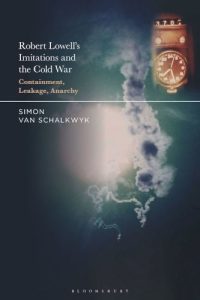
Robert Lowell’s Imitations and the Cold War: Containment, Leakage, Anarchy
Simon van Schalkwyk
Bloomsbury Publishing, 2025
Introduction: In His Own Voice, and in Translation
On May 18, 1967, the New York Times reported that Robert Lowell, “the Pulitzer Prize poet,” had told an audience gathered to hear “the Soviet poet,” Andrei Voznesensky, that “both the United States and the Soviet Union had ‘really terrible governments’.” The Times article, as Lowell’s biographer Ian Hamilton notes, suggested that the audience produced an “audible sharp intake of breath” in response to this remark, and to Lowell’s ensuing recommendation that the two superpowers “better do the best they can with each other or the world will cease to be here.” Lowell, writes Hamilton, assumed that “Russian writers loathe Mao and couldn’t care less about Ho and what we are doing in Vietnam,” and that Voznesensky, who “avoided mentioning the Soviet and United States governments during his tour, turned away when asked to comment” on Lowell’s remarks. “No one,” Hamilton concludes, “seems to have been much amused.”
Considering the broader Cold War climate framing Lowell’s introduction of Voznesensky and bearing in mind the litany of Cold War crises that had punctuated U.S. history since the end of the Second World War (from the Berlin Blockade, through the McCarthyist Red and Pink Scares and the Cuban Missile Crisis, to its ongoing involvement in Vietnam), it is hardly surprising that the Times should have focused on the more sensationalist and apocalyptic dimensions of Lowell’s public pronouncements. In doing so, however, the Times tends to overlook Lowell’s glancing commentary, at the outset of his speech, on the potential links between poetry, translation, and the transnational sweep of Cold War cultural and political affairs:
We have come here to listen to Andrei Voznesensky both in his own voice and in translation, because he is a good poet. We are here too because he is a Russian poet. In this chafing and often terrifying moment for his country and ours, a yearning is felt on both sides to break through. We are dissatisfied with the present lull, surly, torpid, distrustful. We wish to go beyond the tense stances and slump of the higher levels – the old bear and old Uncle Sam with his goatee and red-and-white-striped flag-waving trousers – two big powers with the power to hurt, disturbingly alike in their problems and temptations, disturbingly different in their ideological logic and idiom. Sometimes each country seems like an invention of the other, a blessed outlet for invective, an excuse to rally its citizens’ morale, until even the shyest and most unpolitical bristles with a fierce readiness, and each sentence of innocent recollection becomes an act of accusation. We long to meet another human being.
I quote these remarks at length because they make clear the complex intersection between Lowell’s work as a poet-translator and his post-First World War and Cold War political milieu. As his introduction of Voznesensky reveals, Lowell clearly felt that the ability to hear the poet “in his own voice and in translation” was imperative to the success of a more general “yearning to break through” or “wish to go beyond” the “chafing and often terrifying” circumstances of a “surly, torpid, and distrustful” Cold War lull. Translation, by this account, is central to Lowell’s interest in not simply sustaining transnational, trans-cultural, and “human” forms of contact and communion, but also of pressing to a point of active crisis the stultifying political and ideological imperatives and impediments of the Iron Curtain.
Lowell’s thoughts about translation’s potential to thaw the increasingly frigid transnational channels of Cold War communication and cultural exchange are far from optimistic and, as his surprising estimation of the similarity between the ostensibly polarized political and ideological poles of the U.S. and the U.S.S.R. suggests, they are also contradictory, puzzling, and paradoxical. When he describes Voznesensky as both a “good poet” and a “Russian poet,” for instance, is he suggesting that “good” poetry coincides with, or that it exceeds, horizons of limitation circumscribed by nationally mandated assumptions and expectations about language and culture? What does he mean when he describes Voznesensky “an emissary because he is not an emissary, representative because he represents no official dogma or policy”? How, moreover, are we to measure Voznesensky’s worth as poet, Russian, and emissary against Lowell’s assertion that he is “a difficult writer, who writes in a language that few of us, including all his translators tonight, can understand”?
The mercurial nature of Lowell’s remarks resists attempts to draw definitive conclusions, even as it invites further speculation about his perspective on poetry, translation, and the transnational circumstances of Cold War cultural exchange. It is nevertheless worth noting that, for Lowell, Voznesensky’s poetic “voice” appears to be curiously entangled with his Russian lingua franca, the many “voices” he finds in translation, and a third voice – the transnational voices of poetry, perhaps – detached from national moorings. It is similarly possible that Lowell wishes to acknowledge the Russian quiddity of Voznesensky’s voice while insisting that it retains a translational quotient that allows for its dissemination across increasingly insular and parochial national and cultural enclosures. Finally, it may be observed that Lowell is willing to admit the more pessimistic possibility that Voznesensky’s voice is in fact untranslatable: regardless of whether it is received in its original Russian or disseminated across languages and cultures by translation, some essential part of it escapes understanding, remains mysterious, secretive, and private.
Lowell’s observations about poetic translation’s Cold War potentialities and limitations – though glancing and suggestive – add a politically complex dimension to what Stephen James has elsewhere described as his “career-long imitations venture.” This venture’s relationship to America’s post-war emergence as a neo-imperialistic global superpower, and its response to the post-war and Cold War background of the mid-twentieth-century, is as contradictory, paradoxical, and puzzling as Lowell’s oblique remarks about translation and transnational forms of Cold War cultural exchange in his introduction of Voznesensky. Lowell’s imitations, as I contend throughout, are nevertheless both symptomatic of, and irreducible to, the broader discursive and ideological field anchoring and sustaining midcentury America’s political, economic, and cultural imperium. Invested with the peculiar transnational aura attending acts of translation, Lowell’s imitations are poetic sites at which America’s post-war and Cold War desires and anxieties – domestic, international, and institutional – are mapped, explored, performed, and subjected to self-reflexive poetic critique.
“Your local global brand”: The Bollingen Prize for Poetry in Translation
The controversy surrounding the Bollingen Prize for Poetry and the subsequent Bollingen Prize for Poetry in Translation is a good example of how Lowell’s thinking about translation and imitation were informed by post-war and Cold War cultural institutions and funding. In a letter dated June 4, 1947, Lowell informed Paul Engle of his decision to forego a teaching post at the Iowa Writers Workshop to accept a post at the Library of Congress (LOC). Noting that “the pay is $5700 and the work is nominal,” Lowell’s acceptance of the LOC position, as his letters during this time suggest, had much to do with his financial obligations to his first wife, Jean Stafford. Lowell informs his father of his intention to divorce Stafford in a letter dated December, 1946. In another letter to Peter Taylor dated January 20, 1947, he explains that he was paying a medical expenses amounting to “$125 a week” over three months for Stafford’s “psycho-alcoholic cure,” and that her alimony demands were “roughly 1/3 of my income until my father dies, then 1/3 of my trust fund $33,000.” Lowell repeats these figures in various letters to his mistress, Gertrude Buckman, noting that he will offer Stafford “$5,000, to be paid in ten years” and reporting, later, the “[b]ad news” that “Jean now wants $7000 in cash, next five years; $800 a year for life; and 1/3 interest in the trusts for life.”
Lowell’s role at the LOC arguably served to alleviate these pecuniary obligations, but it also invested him with a significant degree of poetic, political, and financial authority. As Ian Hamilton reports, “Lowell’s 1947 appointment […] coincided with the inauguration of a new scheme. The library wished to build up a collection of recordings of poets reading their work, and it was to be the new consultant’s responsibility to organize these recording sessions: to pick the poets, persuade them to take part and entertain them when they came to Washington.” Additionally, Lowell’s position meant that he was obliged to “survey existing collections and to recommend additions” to the national library. Lowell’s affiliation with the LOC invested him with significant institutional influence within the national ambit of mid-century American poetry, while the ensuing affiliation between the LOC and the Bollingen Foundation, a literary subsidiary of the Mellon Corporation, would allow him to experience and reflect upon the ways in which nationally sponsored forms of poetic creativity intersected with the flows of transnational poetic interests and financial capital.
The affiliation between Bollingen and the LOC owed a great deal to Lowell’s Fugitive mentor and friend, Allen Tate who, during his own tenure as the LOC’s Consultant in Poetry, played an active part in tendering support for the LOC from the Bollingen Foundation. Advancing a proposal aimed at the establishment of an annual prize in American Poetry to the Fellows of the Library of Congress, Tate lodged an appeal for funding with Huntington Cairns, an influential figure in American arts and letters who maintained close ties with Bollingen. It was on the strength of Cairns’ appeal that the Foundation agreed to act as financial backers of the Bollingen Prize. On March 4, 1948, it was announced that this award would grant $1,000 for the best book of verse by an American author published in the previous calendar year over the next decade. Lowell, in other words, was at the very center of a nexus of literary domain powerfully positioned between an organ of state devoted to the literary heritage and consciousness of the American nation, and the financial muscle of big business with transnational interests.
~~~
- Simon van Schalkwyk is the JRB Academic Editor. He is a senior lecturer in the Department of English Studies at Wits University. His debut collection of poems, Transcontinental Delay, was published by Dryad Press in 2022. His second collection will be published in 2026.
~~~
Publisher information
‘This highly original and even revolutionary reconception of Lowell’s art of imitation overturns several generations of conventional wisdom. It is the first advance in providing insight into the poet’s ‘imitational adaptions’ since Donald Carne Ross’s critique of 1968. Sweeping away the literalist obsession with apparent mistranslations (irrelevant in a genre that calls itself ‘imitation’), van Schalkwyk recasts ‘the area of greatest divergence’ as precisely the domain of ‘compelling uniqueness.’ He also refigures imitational adaption as Lowell’s go-to device and analyzes it with great sophistication, while convincingly embedding his reframing within a new theorization of containment culture. Van Schalkwyk uncovers Lowell’s ‘covert redeployment of the foreign at the heart of the American home.’ This is the Lowell book we have long needed without quite realizing it. It changes everything.’
—Steven Gould Axelrod, Distinguished Professor of English, University of California, Riverside, USA
The first book-length study focusing on Robert Lowell’s career-long preoccupation with the liberal mode of translational adaptation known as imitation.
Robert Lowell’s Imitations and the Cold War argues that Lowell’s imitations are simultaneously symptomatic of and critically responsive to familiar nodes of Cold War ideology such as containment and contamination, secrecy and security, post-imperial US expansion and Empire. It departs from studies focused solely on Imitations (1961), Lowell’s book-length collection of translational adaptations, by demonstrating how imitation shadows Lowell’s work from his earliest collections, Land of Unlikeness (1944) and Lord Weary’s Castle (1946), through his celebrated mid-career collections, Life Studies (1959) and For the Union Dead (1964), and to later works such as Near the Ocean (1969) and his contributions of adaptations from the Russian of Anna Akhmatova and Osip Mandelstam collected in Olga Carlisle’s anthology, Poets on Street Corners (1967).
Simon van Schalkwyk excavates the imitational substrate undergirding and informing Lowell’s compositional method and poetic imagination throughout the course of his career. In so doing, he shows how imitation enacts, at the level of form, Lowell’s restless investment in Cold War geopolitics and literary networks in ways that inform, develop, and complicate his more conventional canonization as an unquestionably ‘American’ poet preoccupied solely and simplistically with personal or autobiographical modes of poetic ‘confession’.
As literary sites at which containment’s dualities, porosities, leakages, and contaminants are most clearly displayed, Lowell’s imitations simultaneously challenge and develop our understanding of confession’s presumably strict preoccupation with the personal, regional and national frameworks through which Lowell has commonly been understood.