The JRB presents an excerpt from Morafe: Person, Family and Nation in Colonial Bechuanaland, 1880s–1950s by Khumisho Moguerane, winner of the 2025 Sunday Times Non-Fiction Prize.
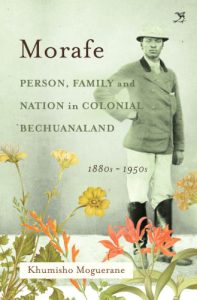
Morafe: Person, Family and Nation in Colonial Bechuanaland, 1880s–1950s
Khumisho Moguerane
Jacana Media, 2024
The best years of Silas Molema’s life were his thirties and early forties, which is to say the years of British rule before the South African War broke out in 1899. This does not mean they were easy years but he was doing well and growing a family. His line of business was transport. He owned probably the largest fleet of wagons and carts in Bechuanaland. The British administrative centre in colonial Bechuanaland was Mafeking, a town of mainly European settlement that adjoined the western border of the Molopo Reserve. The Molemas did some of their shopping here but there were many other centres of trade across the border in the Bechuanaland Protectorate. The invoices of the Molemas’ household purchases from the late 1880s have coffee, tea and chicory as staple purchases. Poor families rarely enjoyed these beverages. The Molemas’ list of purchases were long but they never included alcohol.
Modiri was born in 1891, just as his father’s transport business was expanding. At the age of seven, he met Solomon Plaatje who had come from Kimberley to take up work in Mafeking and stayed at the Molemas’ homestead. Plaatje was then twenty-two and an interpreter at the Resident Magistrate’s court. He made a very strong impression on the young man, ‘touched [his] heart in an unforgettable way’. Modiri marvelled at the lightness of Plaatje’s complexion. ‘He was even whiter than the light-skinned Molemas of Mafikeng or the Moswetes of Khunwane, the lightest among all the other Barolong’. Others thought Plaatje was ‘neither European nor an African but a Griqua’. His in-laws disapprovingly thought their daughter had married ‘a Hottentot or a San’.
Modiri was also spellbound by Plaatje’s polyglot genius and by how quickly and extensively he read – Shakespeare, Dumas, Ruskin and Keats, a ‘walking library’. Plaatje consumed current affairs ferociously, both local and overseas newspapers. He was born at Pniel, on a farm that belonged to Lutheran church ministers near Kimberley and had arrived in Mafikeng with news and information about many different parts of the world, and with the intention to travel. On the other hand, the seven-year-old’s father had a quiet, sedentary authority as an extension of the rock that had founded the chieftaincy at Mafikeng. Silas Molema had always to be here, an immovable rock living and ruling. Plaatje was like a sediment of this rock that rolled about and yet retained the characteristics of its origins. The little boy was drawn to the momentum of this motion. He was intrigued by the unknown possibilities of the traveller who yields to the road, especially those of the mind and imagination, but retained a faithfulness to this countryside as though he had never left home.
In the meantime, the transport business grew. In 1890, Molema spent £125 on a brand new wagon. Less than a year later, he exchanged fourteen oxen for two new carts. Molemas bought blankets, shawls, jackets, hats, shirts and trousers in addition to coffee, tea, sugar, powdered milk, cordial and golden syrup.
The tide of good fortune quickly receded. In April 1896, rinderpest crossed the Molopo from the north. The deadly disease killed tens of thousands of cattle. Riders had to abandon their wagons along the roads as their oxen died. Very quickly, donkeys replaced oxen in front of carts and wagons. Molema’s advantage was his longstanding relationships with big general dealers. Whiteley, Walker & Co. was a ready creditor and advanced him £190 in December of 1896. This seems to have gone towards the purchase of 38 donkeys. He also borrowed another £190 from C. de Clarke in February of the following year. The scarcity of oxen and his quick ability to convert to donkeys made him one of the few functioning wagon transporters. He expanded his business further. In that very year of rinderpest, Molema’s second daughter, Harriet, was born.
The amount of money that Molema had in hand to spend to respond to rinderpest, or could otherwise readily solicit from creditors who trusted him to pay, suggests that he was a relatively affluent man. As comparison, the highest paid civil servant in the colonial administration in Mafeking in 1897 was Civil Commissioner and Resident Magistrate GJ Boyes, who earned £550 a year. By the end of 1897, Whiteley, Walker & Co. alone owed Molema £900 for transport services. In the meantime, he had accumulated a debt of over £520 across Whiteley, Walker & Co.’s counter. The Molemas were spending a lot, mostly at Whiteley, Walker & Co. on credit, against the wagons’ potential earnings from the wholesaler that year. Perhaps Molema was making some purchases in order to resell those goods elsewhere.
Between May and November 1897, the household enjoyed luxuries like ‘French coffee’ when many were still reeling from the cattle plague. They bought jam, fruit salts, coffee, chicory, tea, sugar as well as blankets, aprons, a tablecloth and a sunshade. There was also new clothing, including a suit, ties, a jacket and a cap that were probably for Sebopioa as he proceeded to Lovedale Missionary Institute. In the younger Molema’s household, a considerable amount of expenditure was going on, but perhaps it was not extraordinary, only a life they knew well and had been living a long while. Besides, Silas Molema was exerting himself, working hard to expand his business. He continued to take every opportunity to purchase cheap donkeys. Unfortunately, the days of successful wagon transporters were already numbered.
In 1890, the Cape government started to construct a railway line from the north of Griqualand West to Mafikeng, intending that it would extend all the way north into Rhodesia. At the same time, the Cape administration was taking a new interest in the European settlers whose impoverishment and fragile livelihoods reflected economic disparities in the settler community. These emerged in official parlance as the ‘poor white’ problem, but the label is misleading. Settlers had not yet unified around a consciousness of ‘whiteness’. Differences in skin pigmentation were obvious, but they did not neatly consolidate into the social fact of ‘race’. There was not yet agreement about what ‘white’, for example, meant. A growing number of these ‘poor whites’ were taking up cart-driving. They pushed transport prices down to compete with ‘brown’ and ‘black’ wagon transporters. Still, the ox-wagon had a competitive advantage over rail because the transporter and merchant depended on one another through the credit cycles that Molema’s accounts reflect. To break the attachment, the government offered large traders incentives to dissolve such arrangements. Whiteley, Walker & Co. did not hire Molema’s transport services in 1898. Instead, he transported goods for Loosely & McLaren General Merchants, a smaller wholesaler.
The other expense was school fees. At the beginning of 1898, there were at least four young Molemas at Lovedale, including Sebopioa and Seleje. There was also Officer Molema, the son of Molema’s late brother, Israel. Silas Molema paid for all of them. Until Loosely & McLaren paid him for transport services rendered at the end of the year, he found himself with very little money in hand and relied on rents from his tenants. By September, Sebopioa and Officer’s fees were in arrears. Lovedale warned that ‘all boys whose fees are not paid by the end of this month cannot be allowed to attend classes beyond this date’. He had to ask for an advance of payment from Loosely & McLaren. The severity of his financial trouble was now in full presentation. His savings at Standard Bank were exhausted. So little remained that his attorney, Spencer Minchin, notified him that there was no provision for a small bill of £1-1-10. Spending in the household appears to have spiralled out of control considering the bill accrued at Whiteley, Walker & Co. for over £400. Joshua’s spending at the same store over the same period was just under £35. Returns from wagon services to Loosely & McLaren amounted only to about £18. Molema had overstretched himself in his business and the family was spending too much. His prospects were bleak, and he teetered on the verge of bankruptcy.
In October 1899, the mostly European town of Mafeking fell under siege. Mafeking, the stadt in the Molopo Reserve, was the boundary that sheltered the European town’s residences and business district from Boer commandos. Chiefs and their subjects had to defend themselves and their property. Hence, across the handful of Barolong reserves along the Molopo River, hereditary rulers refused to accept the South African War as a ‘white man’s war’, which is how the British administrations and Boer Republics described it. Silas Molema and others also saw the siege as a war against their empire, to which they felt an attachment forged by providence. They defended themselves against Boer fighters and marauders who took advantage of war conditions. The stadt’s population was about five thousand. On the holding called Kromdraai in the reserve, which was under Molema’s control, the Boers burnt down two large houses, each of three rooms. They destroyed a stable for six horses. They carried away building material, including almost 80 large sheets of iron, 9 to 10 feet long, half of which were new, 18 rolls of barbed wire, and 30 bags of lime. Most of this property probably belonged to tenants on Kromdraai. The war also destroyed the iron house, which had been the Mafeking Market House before Molema bought it in 1898. Molema lost eight ploughs, five of them brand new, a ‘good’ wagon, three wheelbarrows and a new saddle. Raiders razed two fields of sorghum and fruit trees to the ground and took away eight bags of wheat and four of oats. The war worsened the financial disaster unfolding on the home front.
Children’s fees at Lovedale were outstanding. In fact, there were food shortages in the reserves. There was too little money even to chip away at the debt accumulated the previous year. It helped a little that British troops needed carts and wagons to transport supplies. The rate of hire was low, about £1 a day per wagon, but as many as 30 wagons were necessary at one time to carry arms and supplies between various camps. Molema invested in more wagons and carts. He bid for them at auctions. More generally auctioneers, especially Dennison & Cranswick, soon replaced wholesalers like Whiteley, Walker & Co. as a place for domestic purchases, which is why it is difficult to explain the elaborate purchases at Whiteley, Walker & Co. at the end of October 1900, including a suit, ribbon, lace, camphor and scent. They amounted to over £72 and brought the outstanding balance to over £550.
The family could not afford such indulgent slips from thrift, not during the war, and not when children’s fees at Lovedale were in arrears. School fees were in fact rising. According to Lovedale’s principal, the increase in fees at the end of 1900 was ‘absolutely necessary’ due to a steep rise in food costs but also a ‘greatly increased requirement of Native Education’. By the end of 1900, Molema’s account at Standard Bank had a negative balance of over £210. In the New Year, whatever small amount the transport business and tenants’ rents brought, bought cows and calves at Dennison & Cranswick auctioneers. Molema was now borrowing money from friends in town. The creditors noose was narrowing around his neck. Minchin paid £100 into the account at Whiteley, Walker & Co., but even then almost £400 was outstanding. Two months into 1901 the wholesaler complained that Molema had ‘made not the slightest attempt to reduce the account’ for many months. A month later, Lovedale’s headmaster also sent a letter that Lovedale was ‘under very great expense’ to run a boarding school with ‘a large amount of fees still unpaid’. At about this time, Molema received £617 as war compensation from the Cape government. He paid school fees and parts of his major debts, including at Whiteley, Walker & Co. Auctions remained the place to purchase clothing and other items. The family still rang up debt at Whiteley, Walker & Co. – jam, lemon squash, tobacco, trousers and shawls. The amount he received from the government was significant. As comparison, the highest paid civil servant in the colonial administration in Mafeking in 1902 was Civil Commissioner and Resident Magistrate, Charles Bell, who earned £650 a year.
Molema was short of money but not of credit. As a businessman, he had a great capacity for risk. In 1901, he became the first person of colour to own a newspaper in southern Africa. This was Koranta ea Becoana. If it became a success, it would pay the initial investors and make some money. However, this was not why he took the risk. His political power had risen as his liquidity declined. In 1896, after Montsioa died, his son Wessels Montsioa, became the paramount chief, but Molema’s literate following saw no hope of moving forward with a polygamous, barely literate man who enjoyed his drink and who spent money only on himself. Solomon Plaatje and others were on the lookout for a different calibre of leadership, and none was more attractive than Silas Molema.
Even his children’s precociousness, ambition and claim to distinction set them apart like eager branded stock. Modiri Molema was ten years old. He was observant and pondered the worlds of the fathers. He saw that his father was also a traveller, indeed a determined one. His father carried himself to many places by virtue of his moral reputation, not by rail and not through the ordinary rituals and ceremonies of departure. At home, the family was adjusting to privation and learning to do without familiar comforts. Modiri was already a boy playing and herding and schooling in Mafikeng when the money troubles had crept up on them, and with them his many little doubts about whether home was the place to keep his treasured things and stave off loss.
~~~
- Khumisho Moguerane is a historian of European empire in southern Africa. She is based at the University of Johannesburg.
~~~
Publisher information
In Morafe, Khumisho Moguerane has written a luminous exploration of two generations of the prominent Molema family. They were ‘border people’, who straddled what would become present-day South Africa and Botswana.
Beginning in the 1880s at the frontier of the new British territories of British Bechuanaland (North West and Northern Cape provinces) and the Bechuanaland Protectorate (Botswana), where the political boundary between these two territories is negligible and where skin colouring did not yet necessarily connect with a particular social or political status, nor did it yet really affect economic opportunity.
Morafe ends in the 1950s, where the political boundary matters profoundly, dividing two very different colonial dispensations of colonial racial ordering and classification, and two separate traditions of nationalist politics.
With this landmark publication, Moguerane reveals that the ‘nation’ is less ‘out there’ in public institutions and political struggles, but ‘in here’, in the everyday drama of personal and ordinary lives.