Kevin Goddard reviews What is Owed? by Kelwyn Sole—a poet’s summing up of a life dedicated both to verse and to activism in South Africa.
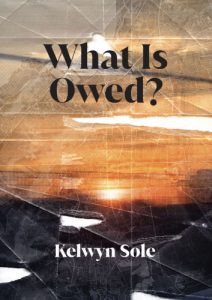
What is Owed?
Kelwyn Sole
Botsotso, 2025
In ‘How to Live. What to Do’, published in Ideas of Order in 1936, Wallace Stevens offered a kind of solution to the questions people were undoubtedly asking in a world soon to be overcome by fascism. His cryptic response presented his poetic avatars, ‘the man and his companion’, with a seemingly unconquerable mountain, towards which they had climbed, ‘away from the muck of the land’. In the sound of the cold wind around them, they hear something mystical, something ‘joyous and jubilant and sure’. That is all, it seems, Stevens gives us to hold on to. Writing around the same time, WB Yeats placed his poetic avatars in ‘Lapis Lazuli’—two old Chinese men, behind them a third—on a mountain, also climbing and also looking back. Their ‘ancient, glittering eyes’ seem to perceive a world beyond the quotidian and the painful, beyond which they have climbed. Their climbing, their age, the musical instrument their serving man carries, the vision of a world that is meant to be as it is—again, in some mystical way—is left as our only answer about where they have arrived at the end of their own journeys. Art can transform.
Kelwyn Sole’s latest volume of poems, his ninth, feels to me like it is engaging both these earlier poetic moments, at a time when we as humans appear to be returning to similar political desperation, as if in a Yeatsian gyre. Can art transform? Has his poetry transformed others, or himself, over the years? His approach and attitude are very different from his Modernist forebears. He does not offer the certitude of a statement, but rather the tenuousness of a question: ‘What is Owed?’ We would expect no less from a poet whose work over the years has come to make its mark on South African literature as one of political and social commitment, always in search of uncompromising honesty in a compromised and compromising world. The question situates him within society, not above or outside it. It is not looking back, but around and within.
What is Owed? does feel, at times, like a poet’s summing up of a life dedicated both to verse and to activism in South Africa. What does the individual owe society? What does society owe the individual? What does the poet owe poetry? The closing poem, ‘What is (ode)’, is the culmination of this questioning. It is suggestively Wordsworthian, like a Prelude that encapsulates the development of the poet’s mind, and is almost a response to other Romantic odes, not least ‘Intimation of Immortality’. Sole, however, stamps his particular questioning weight on the Romantic impulse to find the otherworldly in the present or in nature. To be in a relationship with the world is to owe it something, he suggests. But what? In that uncertainty, boundaries become uncomfortably present in the mind. ‘I seldom walk on the edge of the sea these days, / venture on it even less’, his speaker says. Like one might expect of a Romantic, he is ‘an atom that longs’, looking for an ‘escape to all / that’s undefined and distant’, annoyed while sitting alone in a café by Eliotesque ‘relentless teaspoons’, but nevertheless finding a kind of comfort in the ‘distraction with no purpose’. He seems to be a poet reluctant to speak, who escapes within himself, but is still caught up in the flow of society. How did he become so disenchanted? ‘[T]he clever words I’d penned for years lift their upstrokes / like alarmed warthog tails, / and disappear over time’s horizon’, he writes. He feels he is left ‘with only my trove of past failures’.
What value does poetry, especially socially engaged poetry, have in a world overcome with ‘droughts and in winds / of hopeless poverty’? His ‘chosen words no longer stride out of now-barricaded doors / to face oppression’ because the ‘“revolution” ignorant of all community primps / by on tottering Gucci steps, eructates from every shop and fashion / website, pretends …’ We hear TS Eliot’s voice from ‘Burnt Norton’, the ‘place of disaffection’, where there is ‘the eructation of unhealthy souls / into the faded air’. Eructation means emitting gas from the stomach, as in belching, and this post-apartheid South Africa seems to be just such a place. Is there any possibility of transformation, in a world ‘of disparity and disillusion’, where we might ‘find what was promised’?
The only answer Sole can find, unlike the mystical ones of the Romantics and of the later Eliot, is to look for it in the real, broken world in front of us, no matter how hard it might be to see. It is to look among ‘the tender-minded thieves [who] feed upon / the corpses of / a rotten State’, even though we berate ourselves for not seeing ‘this future coming’. It is to look ‘beyond the aching in our flesh’, ‘beyond the habitual’, and, more than anything, to look in poetry itself:
Still I feel my anger rise up as language to haemorrhage
my smile, snipe from
my lips, in hope what comes out may seem close to true.
The poetry is found in the streets, on cold nights, at dusk, among the poor, in a burning shack: ‘from a nearby fire [where] figures in despair /… gyrate around its centre … trying to save something … / of their dispossession’. The gyre of poverty is unending. This is the measure against which the poet must judge himself: ‘As for me, I live in error yet, not knowing what I owe. / I still toil’. What is left? ‘To live must mean to think, / What is owed? / Then risk oneself for others’.
The conclusion about the role of the poet reached here comes from years of writing and activism. However, in this volume, it is also the culmination of many of the questions asked in other poems—the role of poetry; the poet’s place in nature and in a colonial world (‘Groot Constantia’); the experience of love and tenderness with a beloved (‘Touching dawn’); the struggle to let go of those literal and metaphorical crutches that prevent us from experiencing the world openly (‘Clunkerfoot’). There is nothing neat and clean about poetry, as the poem ‘Poetry’ suggests. It is a version of ‘need’, like ‘sodden / kittens / abandoned in rain’, but kittens with claws. It is also a weed, uncontrollable, ‘its source is in the soil’, and the soil is inside you, a place of pain and darkness. Only there does it germinate.
For Sole, those places have been an uncomfortable, socially aloof childhood (‘The House’ and ‘Those Teenage Years’), the discomfort of ‘How We Live’ in the divided city of Cape Town, place of slums and of the plush apartment blocks of rich foreigners. And poetry is a beast, too: the beasts come to the poet’s dreams, like moths to light, like a rumour of stone, of water on land not to be cultivated, beasts that snare the dreamer, even after he has woken, an uncontrollable, slithering shape bringing both dread and ardour. Poetry breaks into the Edenic garden of the poet’s sense of control, and disrupts it—’it may bear / some passing truth, or not— / but never comfort’.
That discomfort is almost always both personal and political. The ‘Drosters’ (fugitives from early Cape colonialism) are given voices in the first person: ‘I fled the slave bell, but was captured’. Or ‘I killed the farmer who had my woman, but was burnt with her / after we were captured’. We are all, in a sense, slaves to Capital and to Power: ‘I fled the glitter of brand names, but was captured and branded / on that wheel’. How, then, to find freedom, how to become ‘Word Perfect’? ‘The poet scratches his head: / thinking too often / of the bell-bodied woman / gone barefoot to the well’. The well is literal, the poverty literal, but it is also the well of inspiration, a bucket ‘soon to become heavy’, from which ‘the surprised words … have shimmied in rapture / right off the page’.
And there are poems in this volume that approach this kind of rapture. For the most part, they do not, as the poet seems to feel that the material he works with is too painful, too serious, to be addressed with rapturous lyricism. Occasionally, however, we do encounter it, almost emblematic in form and rhythm to the emotion and sound being rendered. ‘Monk, dancing’ imitates with alluring ease the sliding, back-and-forth movement of a Thelonius Monk and Charlie Parker jazz tune:
[…] his grey suit’s shining his brown beanie bobbing—ah
Charlie steps up to Rouse the audience
tilts his horn
that clears its throat until
the sound waxes gibbous and drifts down
into this dive’s dim lighting strikes gold
off the glitterball to spasm
into a flurry of winking stars, briefly dazzling
Perhaps this was the iconic ‘Round Midnight’, but whatever it was, the jazz, the quintessential music of resistance and the declaration of freedom from the chords of classical restraint, breaks the chains by joining opposites: ‘white keys twinkling among the black / … / precise on the white bones of the world: / … / and now / Monk too / is off his chair / and dancing …’
This rapturous alignment of black and white, rich and poor may be possible in brief moments, what Wordsworth might call ‘spots of time’. But they are not the general experience of the poet. Even in America, supposed land of the free, where the poet seems to have spent some time, the Laureates are ‘at sea’ and writers are caught in their ‘Brand’ of cliches, their Harvards, Yales and Cornells, stuck in ‘salad days of privilege’. How to break the ‘brand’? With a laconic humour, the speaker of ‘Massachusetts in Review’ suggests one might transpose onto an Emily Dickinson poem the rhythm of ‘House of the Rising Sun’: ‘(Becoz … I could … not stop … for death)‘. Dickinson was right to remain reclusive in a world so tainted. If she were to be reincarnated, she might ‘write like Charles Bukowski’.
To close this brief review of this very fine, very carefully crafted and important collection, it seems important to say that while poetry in South Africa is very much burgeoning, with an urgency perhaps not seen since the dark days of apartheid, what poets are trying to say needs to be carefully considered. Many are asking what poetry’s relevance may be in this moment, whether it should offer some form of transcendence, or personal affirmation, or social commentary. Much contemporary local fiction has taken what might be called the ‘easy option’ of writing about crime, keeping a reasonable distance from the world, where those who are ‘good’ and ‘not so good’ seem to be readily identifiable. Poets mostly don’t have this luxury. They are inevitably involved in their own readings of the world around them because they must read themselves reading, watch themselves watching, as it were. But this does leave them with an uncomfortable choice, especially the white (male) poet writing in South Africa. They must choose between two approaches: to see the world and art through their own private lens, or to attempt to locate themselves in the mire of human struggle, to see through multiple lenses, social, political and even spiritual. The former leaves the poet a recluse (Emily Dickinson? Sylvia Plath?) concerned with their own privacies, however universal they may be. The latter demands a wider engagement, which can be fraught, contentious, raw, even ugly. No alluring lyricism will satisfy.
At this historical juncture in South Africa, it could be argued that the latter of these two approaches is more important if we are to try to repair our broken society. While there is no simple answer to the poet’s role in this repairing, Sole’s work, including this volume and his entire body of work, undoubtedly stands at the forefront of any such attempt.
~~~
- Kevin Goddard grew up in the mining town of Welkom in the Free State. After studying, first theology, then literature, in what was then Grahamstown, now Makhanda, he began lecturing at Vista university in Gqeberha in the early nineteen-nineties. He migrated to Nelson Mandela Metropolitan University (now Nelson Mandela University) in 2004 and then left to take up work in Saudi Arabia in 2010. He and his wife Sheena both taught there for 12 years, and have now returned to Gqeberha. He is a research fellow at the Centre for Gender and African Studies, University of the Free State. He has published a number of poems in South African magazines, and a number of academic articles locally and internationally. His narrative poem Notes from the Dream Kingdom was published by Botsotso in 2025.