
Barbara Boswell reviews Elleke Boehmer’s Ice Shock, a novel saturated with extremes of love and increasingly calamitous climate events.
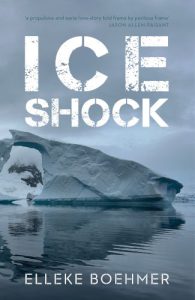
Ice Shock
Elleke Boehmer
Karavan Press, 2025
When Leah and Niall meet on a coach to central London in Elleke Boehmer’s Ice Shock, their relationship seems fated and their ensuing love story inevitable. Leah wakes, having fallen asleep on the shoulder of a stranger, Niall, forging an accelerated intimacy. For Leah, on her way to taking up a prestigious fellowship, the ‘magic’ that sweeps them into its current is unasked for, unwanted; not part of the course she has meticulously plotted for her life and her writing career. Slowly she sways, under Niall’s adoration. So begins a reluctant, complicated love story spanning the globe and a myriad natural disasters.
Their tentative exploration of long-distance love, meeting up at various locations across England, solidifies their commitment even as they stand on the cusp of the most brutal separation. As Leah settles into university life in England, winning the fellowship that allows her to pursue her writing dreams, Niall’s career takes him to the Antarctic, where he will live at a polar station as part of an international research team.
Their separation of fourteen months drives the novel, an extended exploration of sustaining love against extreme odds. The reader witnesses both characters’ experiences of love, their longings, the secrets they keep from each other, and their constant striving to remain central to the other’s life, even though simple acts of communication, like sending emails or making phone calls, are fraught with difficulty.
Ice Shock is a novel saturated with extremes: the extremity of the distance between the two lovers, the extreme difficulties of communication, given the lack of taken-for-granted communication infrastructure at the Antarctic, and the extreme climate conditions Niall endures.
It is also a novel about increasingly calamitous climate events, which encroach in big and small ways on the characters, shaping their love story and their lives. Climate shapes destiny. Leah ends up on the bus from Edinburgh to London, in which she meets Niall, because the train she was meant to take is cancelled due to flooding. For the interview that secures her the coveted fellowship, Leah is one of only a few locals able to attend, as an Icelandic volcano spews ash, grounding planes across Europe.
During a special celebratory trip to Brighton, they share a tender moment on the beach under the shadow of the dust spreading across the globe following the Fukushima nuclear accident in Japan, caused by a tsunami. They bathe in the particles, conscious that they are inhaling them, as they pledge to stay connected while Niall is stationed in the Antarctic. Under a radioactive plume, they promise to find a way back to each other.
These climate catastrophes crowd the frame of Leah and Niall’s growing relationship, casting a gloom over them as they try to sustain their relationship. This backdrop plays out in the first of three sections of the novel, titled ‘Here’.
In the second section, ‘There’, Niall sets off on his journey to the polar station on the icebreaker the Aurora, traversing the South Atlantic Ocean. This part of the narrative highlights their greatest relationship difficulties—the challenges of staying in touch, of sustaining, of loving each other from afar. The lovers’ lives run on parallel tracks, in which Leah’s story also develops into a künstlerroman. The processes by which she develops her writing voice are beautifully and evocatively brought to life, showing the arduous invisible labour of crafting worlds with words.
Both characters are communicators in their professional lives, Leah being a writer focused on the art of the essay, while Niall initially works for a radio station. Yet, despite their vocations, this aspect of their relationship becomes weighted with extreme challenges. They are only able to contact each other through occasional satellite calls, fax machines and unstable email connections, and these sparse exchanges are often bedevilled by inclement weather, leading to apathy and frustration. The reader has a palpable sense of lovers wanting to let go of the tenuous strands that bind them, and of wanting them to succeed in their respective and joint quests.
The irony of their situation, of one lover journeying ‘to the ultimate farthest place’ from the other, is that while the space between them expands to a giant chasm, the climate events intruding on them expose the lie of the planetary idea of a ‘Here’ and ‘There’. While they feel the distance intensely, pining for each other, a nuclear disaster in Japan, volcanic ash over Iceland, or a melting ice sheet in Antarctica cannot be isolated or contained. Within hours, any given environmental catastrophe sets off a chain of events that traverse the globe with lethal speed: the tsunami birthing a radioactive plume, ash particles that ground planes for weeks, the rising sea level creeping inexorably higher against coastlines. While ‘Here’ and ‘There’ produce visceral pain for two people who wish to spend their lives together, for the rest of the planet, they are two spatial markers of a deadly fiction—a lie that enables human beings to continue polluting, depleting and destroying what is needed for the survival of our species. Boehmer’s gift is the subtlety with which she highlights the paradoxes, tensions and complexities between ‘Here’ and ‘There’ as constructs.
Boehmer’s prose is sparse and precise; in the first part of the novel, this is the perfect register for the tentative nature of the characters’ feelings for each other. They are, in turns, ambivalent, delighted, unsure; yet desiring subjects wanting love and connection. Boehmer exquisitely captures, in ‘Here’, the early stages of romance, when risk and viability are weighed against the possible ‘returns’ of love. Will it be worth it? This is the question both lovers grapple with, and one of Boehmer’s gifts is the understatement with which she renders their hesitancy. Their interior worlds ring to life at the perfect pitch.
Leah and Niall are often out of sync in their depth and level of commitment to each other, performing an intimate dance of stepping forward and withdrawing, disappointing each other at key moments. Portraying this prevarication plausibly is another of the novel’s strengths.
In ‘There’, Boehmer’s prose changes register, taking on an otherworldly lustre as she brings the Antarctic to life: its colours, moods and treacherous nature, the ever-changing quality of light refracted through endless plains of snow, and the months-long night driving Niall to the brink of insanity. The Antarctic takes on an unyielding character against which the researchers at the polar station pit themselves existentially, and Boehmer’s gift for evoking place through deep descriptions of landscape takes the reader all the way ‘There’.
- Barbara Boswell is a writer and scholar from Cape Town, a city which inspires much of her fiction. An Associate Professor of English Literary Studies at the University of Cape Town, Boswell is the author of Grace (2017), winner of the UJ Debut Prize for South African Writing in English, And Wrote My Story Anyway: Black South African Women’s Novels as Feminism (2020), Lauretta Ngcobo: Writing as the Practice of Freedom (2022) and The Comrade’s Wife (2024), winner of the UJ Main Prize.



Need a custom logo or address seal? stamp online maker free lets you design and order in minutes.
Customer reviews and sample images often reveal the true quality of a maker’s work.
Very cheap offers can sometimes indicate inferior rubber material or low-resolution engraving.
Different online stamp makers offer varying lead times depending on workload and shipping methods.
Choose providers that explicitly offer corrective actions if the delivered stamp does not match the order.
Selecting the right rubber stamp maker online guarantees precise impressions and reliable service.
Clear pricing structures make it easier to compare different rubber stamp makers online.
Confirm the expected delivery date before ordering to avoid last-minute surprises.
Choose providers that explicitly offer corrective actions if the delivered stamp does not match the order.