
The JRB presents an excerpt from Werner Pretorius’s debut collection of short fiction, Lone Wolf Living.
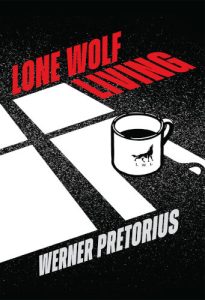
Lone Wolf Living
Werner Pretorius, illustrated by Dawn Bolton
Karavan Press, 2025
The Nazi Insurgence Reaches Blairgowrie
It is after nine p.m. when Doron arrives at the house in Blairgowrie. The sensor triggers the floodlight and the driveway is bathed in a sterile glow as he parks the Volvo in front of the garage door. He sits in the car for a while, unable to bring himself to reach for the door handle. His legs feel heavy, immovable. At times, this heavy feeling is very real, and at other times, like now, there’s also a tightening in his chest that makes him nervous. For a moment, he considers simply starting the car and driving away. But, then, of course, he stays … Of course.
This is the house where Doron grew up. The lawns are big and take a lot of mowing. In autumn, the leaves from the syringa trees would cover the yellowing grass like a blanket. They’re doing that now. The gutters filled up quickly and waterfalls cascaded down in front of his bedroom window when the freakishly late summer rains fell, as they always did. The house stretches like a centipede in the middle of the property, dividing it into front and back.
He sits in the car for a while longer, studying his reflection in the rearview mirror. The lines around his eyes are no longer just lines. He shaves his head every three days, but it still sprouts more grey hairs than black ones when he neglects his schedule.
It’s the thought of Maria that eventually gets him going. So very impolite to keep her waiting after everything she’s done for them. He lets himself in and finds her in the kitchen, hurriedly zipping up travel bags.
‘Good evening, Mr Howie,’ Maria says. ‘Thank you for coming. I am so sorry to have to go, but I am grateful for you letting me go.’
Doron leans against the edge of the kitchen counter, as far away from Maria as the room allows. He clears his throat, a stuck word turning into a cough. ‘Of course, Maria. Of course. You must take care of your family. I mean, obviously. I could … Do you need a ride somewhere? I could drop you off. It’s the very least I can do.’
Maria is putting on lipstick, using her reflection in the oven door. It’s the caramel-coloured lipstick she always wore, the one that he kept telling her does not suit her complexion, not like the bright red L’Oréal that he bought her. Once she’s satisfied with her appearance, she stands up and looks at him. ‘No, Mr Howie. You can’t leave him here alone. You need to stay with him.’
Doron looks at his own reflection, elongated and disproportionate, in his shiny shoes. He had yet to change out of his office clothes when Maria had telephoned with the news that her mother had died. She drops the lipstick in a bag and zips it up. She comes over and gives Doron a peck on the cheek. ‘I’ll take a taxi, Mr Howie. I’ll be fine. Your taking care of him is a big help.’
‘Look,’ Doron says. He runs his hand along his bald scalp, composing his thoughts. That dull, uncomfortable feeling in his chest bleeps again like a submarine’s sonar from the deep. He feels compelled by Maria’s sweet presence – her perfume in his nostrils, her breath so close to him – to be clear with her, to make it right.
‘I know we haven’t spoken since what happened. And I’m sorry, I don’t really know what to say or do. You must allow me to help in some way.’
‘I’ll take the taxi, Mr Howie. I’ll be fine. You look after him. We don’t need to talk about it now. We both have more important things to deal with.’
‘How is he tonight?’
‘He’s bad, Mr Howie. Not going to lie to you; he’s not having his best night. He’s out in the garden.’
Then she picks up her bags and leaves. And as the kitchen door slams behind her, Doron says, ‘I’m sorry to hear about your mother. You take care. Good luck.’
But she’s gone and he can hear the electric gate that leads onto the street rumble along its rails as it opens, and as it closes again behind her.
He looks in the cupboard above the fridge. He finds the bottle of Three Ships and pours himself three fingers of it. It’s the bedtime drink. Even now, the old man can’t do without his nightcap. Maria insists on giving it to him. After a long day, that old Howie energy that has nauseated Doron all his life, a big wagging finger pointing straight at his own inadequacy, was best averted by a shot of Three Ships. After the old man nodded off would be the only peace Maria would be afforded in a day. Doron’s wife, Lindsay, didn’t know about the whisky. She’s seen it before but assumed it was for guests, or something left over from the old days. Or maybe she thought it was Maria’s. Doron didn’t know what that woman was thinking most of the time. The nightcaps were Doron and Maria’s little secret. The whisky burns as it washes down his gullet.
In the back yard, he finds the old man sitting on one of the garden chairs, engrossed in picking at bits of the peeling paint. In the far left corner of the garden, a spade is leaning against the wall. There are piles of earth everywhere. This afternoon must have seen a ferocious period of activity. The chairs are relics from the seventies, things they should have thrown out years ago – only, every time they touched anything in the house, the old man looked at them like they were setting fire to puppies. He would notice if the tiniest thing was out of place, and yet, asking him what happened five minutes ago was pointless. The doctors advised Doron to leave everything as it was. They could renovate and refurnish once the old man was gone.
‘Cherish him while you have him,’ the doctor had said. ‘Believe me, so many people sit afterwards and cry about not having used the time they’d been given, how every second should have been precious.’
It had been six years since that conversation.
‘Good evening,’ Doron says, taking a seat opposite his father. ‘Busy afternoon?’ He gestures at the upturned earth.
As always, some recognition flutters in his eyes for a moment and then he looks furtively around the garden before returning to his paint-picking.
‘How you doing, old man? What are you up to?’ Doron found it easier to speak to his dad since the stroke, now that nothing he said needed to carry weight or was, as in the past, simply input to be measured on the Howie Barometer of Expectation.
‘I’m tired. I’ve had a hard day. By the sweat of your visage, young man. Toil. That’s life for you. It’s not every day a man has to bury his wife in the back garden because the enemy is at the door. And no one offered me any help.’
Doron looked around.
‘Dad …’
‘Don’t Dad me, boy. My wife is dead. I had to put her in the ground myself. And a good thing, too. At least she will be spared this humiliation. The Krauts should have been stopped at Normandy. Now the world lies at their feet, ready to be trampled.’ He stops scratching at the paint and points a long, twisted finger at Doron.
‘Make no mistake, boy. They are coming. It pays to be prepared.’
‘Mother died twelve years ago, Dad. You made a speech at the funeral and everyone spoke about how brave you were and how well you were taking it. Lindsay and I stayed over with you that night. Lindsay fell asleep putting Graham to bed – he was eighteen months old – and you and I sat up and drank whisky until two in the morning. I turned on the radio and you asked me to turn it off, said you preferred the silence.’
‘Yes,’ his father said. ‘Quite right.’
Doron waits. This kind of remark was the most frustrating. The flash of hope that flickered whenever he responded appropriately to something that was said was actually painful. Why keep waiting for him to remember something? But still he waited, his heart galloping as he hoped for the clouds to clear, his father to smile and say something like, My son, where have you been? Instead of some foreboding remark concerning the imminent Nazi invasion. Doron’s father had been a boy in London during the Blitz. And now, in his final, confused years, he wandered this childhood realm of everpresent threat.
For all Doron knew, this was the most appropriate response to being trapped inside a decaying mind. The doctors had said there might be moments of clarity. Doron had certainly never experienced one, but perhaps here it was now.
‘Quite right. Quite right. Can’t have radios playing when my wife’s in the ground right over there. Had to put her there myself, too. No one helped me. No one lifted a finger or even offered me a drop of water. That a man has to bury his own wife, the love of his life and be ridiculed while doing so. What has this world come to? It’s that Hitler. They should have seen this coming. Ever since the Beer Hall Putsch they should have known that man would lead this world into dark places. But the Germans were too busy rejoicing that there was a way out, an answer at last to the embarrassment of Versailles. Now, look what it’s come to! A man burying his wife so he can protect her lifeless body from the unspeakable vilifications these devils have in mind.’
‘I hear you, Dad. We need to get out of the city before the Stormtroopers arrive. You’re right.’ Doron got up and held out his hand. ‘Let’s get you inside. It’s getting cold out here.’ His father looked around wildly again.
‘A nightcap.’
He got up and held out his arm, so Doron could lead him into the house. ‘That Three Ships goes down well, boy,’ he said. ‘And be liberal with those three fingers, hey?’
‘Sure, Dad.’ And now the two of them walked into the house, arm in arm.
‘Another thing, boy,’ his father said, leaning in close to him.
‘Don’t let on you’re my son. I’m having some trouble getting all the papers together to prove I’m not Jewish. These labour camps sound like atrocious places to me.’
Doron helps the old man into his nappy, his pyjamas and slippers. He leads him through to the lounge and turns on the television. The old man enjoys the news and the cartoon channels. Doron finds the appropriate one and then pours the nightcap. He pours himself one too and sits down next to his father. They’re watching CNN together, sipping whisky, when his cellphone rings. He has to dig in his trouser pockets for it.
‘How are you, dear? How’s it going?’
Lindsay chose this weekend to take the kids to her mother’s – of all the weekends! And Doron had sat at home, cellphone in hand, deliberating with his conscience whether he should call Maria and come over. And then his phone had rung, in his hand, and it was Maria, telling him about her family crisis. Her personal life had never occurred to him. He didn’t know whether she had siblings or what they did for a living. All he knew was the shape of her breasts, and that her thighs were strong. He had first properly noticed her seeing those muscles work under her white nurse’s uniform when she heaved his father onto the double bed.
‘Are you there?’
‘I’m here. I’m here.’
‘How’s it going?’
‘It’s going fine. We’re watching television. He’s having some milk; it seems to make him sleepy. And then I’ll try and put him to bed.’
She breathes into the phone. And it strikes Doron again, as it does more and more often these days, how hard they have to work at keeping a conversation going.
‘How are the kids?’
‘They’re fine. We rented DVDs. Lily passed out on the couch and Graham’s playing cards with Grandpa. Oh, they send their love, by the way.’
‘Thanks. DVDs? Wasn’t the point to see the grandparents? The kids are lucky to have one set of sane relatives. They should try and make the most of it.’
‘Don’t start that again. You know what it’s like. They get bored. Did you see Maria before she left?’
‘Briefly – on her way out.’
‘How does she look?’
‘She looks fine.’
‘Send my love to your dad.’
‘He’s right here on the couch next to me. Would you like to speak to him?’
‘What would be the point …? All right, I’ve got to go. Good luck.’
Doron clinks the ice against the rim of his whisky glass before he takes a sip and rubs absently at his chest. The muscles above his right breast have been stiff lately and he’s been wondering whether it might be something he should be concerned about.
‘I know you’re fucking the maid.’ The old man chews on his ice after he says it.
‘She’s a nurse, not a maid,’ Doron says, not taking his eyes off the television.
‘You know, the circuitry might be a bit faulty up here these days but don’t think there’s anything wrong with my eyes or ears.
‘Get your act together, son. You’re a Howie. No more of this fooling around. You’ve got a family to take care of. You have responsibilities. Keep your penis out of the help and do your duty as a husband and a father.’
And there he is, his eyes clear and his jaw set. Old-school, oldfashioned: Hubert Howie.
‘Take some responsibility for your life, son. Don’t just go bumbling around. You were raised to be better than this.’ He finishes the last few drops in his glass. ‘I’m going to bed.’
Doron sits on the couch. All the things he’d imagined saying to his father given one more chance come crashing in.
He stands up and walks to his father’s room. The old man is punching up his pillows.
‘Dad,’ Doron blurts, ‘I don’t love Lindsay. I’m beginning to wonder if I ever did. And I don’t mean that I love Maria, but how did you and Mom do it?’
Hubert stops fussing with the pillows. He pulls himself up to his full height and breathes in deeply once or twice.
Doron waits. Hubert looks at his son.
Doron can feel his eyes welling up. He doesn’t want to cry, has never cried in front of his father as an adult.
‘You must help me turn over the mattress,’ Hubert whispers.
‘They’re planting microphones in all the houses. There’s no telling who might be listening.’
Doron wakes up on the couch in the early hours of the morning. It’s still dark outside. The bottle of Three Ships is empty – he’ll have to replace it. On the television, CNN shows the silhouettes of buildings: a raging inferno consumes the world beyond. The early-morning bird chorus is loud in this leafy Johannesburg suburb.
Doron stumbles to the bathroom for some painkillers. He has to pass his father’s room on the way and leans his head in. The old man isn’t snoring. His face, so often twisted into a mask of suspicion, is now lax and vulnerable, cradled by sleep. Doron moves to the bathroom, where he finds a container of Compral in the medicine cabinet and takes three tablets. In the kitchen, he starts preparing a breakfast of eggs, toast, fried tomato and mushroom. He doesn’t do any bacon, promising himself to start watching what he eats. He puts out two plates, one of them in the spot of morning sunshine Hubert prefers.
As Doron walks down the hall to his father’s bedroom, his chest begins to hum. At first, he’s sure it’s some emotional affectation brought on by everything. The corridor seems impossibly long. He stumbles. The walls shimmer and wobble. His knees collapse. He hits his head hard on the wall. Then he’s on the floor, the carpet itchy on his sweaty skin. His hand is clutching his chest, the way he’s been clutching at it more and more often lately. Doron wants to laugh. It won’t be the imminent Nazi invasion that will get him, but the weak hearts on his mother’s side of the family.
His father appears in the corridor, shuffling towards him.
He tries to say something to the old man, but his throat is filled with fire.
His father stands there watching him.
Doron writhes.
Hubert says: ‘This war will be fought even in our own homes. It will be unlike anything the world has ever seen.’
~~~
- Werner Pretorius holds degrees in Publishing and English from the University of Pretoria and a Master’s in Creative Writing from the University of Cape Town. His stories and short fiction have appeared in various magazines and anthologies. Lone Wolf Living is his first collection. He lives and works in Cape Town.
~~~
Publisher information
Introducing Lone Wolf Living™
Sign up for the programme today and your life will be instantly more rewarding and less miserable. Take a look at our Platinum Package starring James Bond, who, as it turns out, is from Pretoria West, and Bernie de Villiers, who is falling in love with all the wrong things for all the wrong reasons. Our Gold Package offers UFOs over Jansenville and sinister nightly encounters in Cape Town. Don’t miss the exodus to Mars or get stuck at an outpost left to fend for yourself while, on a distant planet, betrayals and a betrothal take place. Buy now and avoid disappointment!
Werner Pretorius lands with this collection of lost loves and eerie worlds. Broken hearts and peril combine in these stories that scratch beneath the surface of the mundane to find the crawling things that keep us up at night.



Great writing. Thank you.