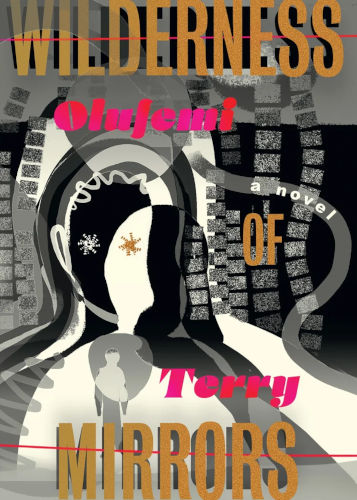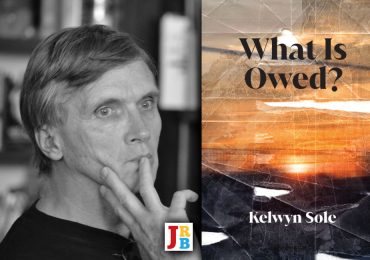
The JRB presents an excerpt from Olufemi Terry’s debut novel, Wilderness of Mirrors.
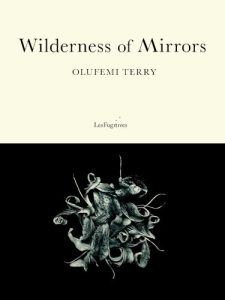
Wilderness of Mirrors
Olufemi Terry
Les Fugitives (UK), March 2026
Restless Books (USA), 2025
One o’clock in the morning. The fuel needle at half and sleep an undertow tugging at him. He catches himself nodding a third time and pulls over onto the road’s dirt shoulder and leans across to retrieve the thermos from where it has rolled beneath the glove compartment. The chill air of the hinterland steppe sends him ducking back inside the car for a sweater.
Out beyond the road shoulder is a blind darkness. Little by little, he makes out the forms of things: the livestock fence—three strands of fletching wire strung across plastic posts—and after the fence, unrelieved scrubland.
In the palm of his hand the lines are faint and silvery, catching he knows not what refracted light. His father had said once that men carry in them the seeds of their destiny. He snorts a grim half-laugh. The coffee is little better than tepid and tastes oily, but it revives him. As he downs a second cupful, his night vision, only just attuned to the gradations of darkness, fails, and he is again squinting just to make out the three-line fence.
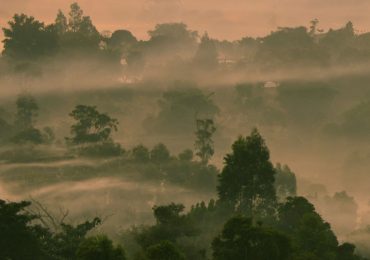
With the dawn there is a view, toward the west, of foothills: a mountain range Emil is unable to identify, the ridge faces covered in a brown gorse resembling billiard-table baize.
A few kilometers beyond the village of Three Sisters are obsidian hillsides—vestiges of some drowned volcano—polished to a dim shimmer by wind and prairie sand. In a shallow depression, an antelope grazes among goats, its racer stripes faded in the distance.
In this place, neither winter nor summer bring adequate rain. The wadis—sand gullies left after streams have evaporated— are littered with man’s plastic detritus. There are oases too which he cannot see: the desert trees crowding so closely over the rills and springs where water surfaces as to seem greedy.
A little before noon, he slows the car to a crawl and then a sharp stop; the tires kick up tall wavering wraiths of dust. Two boys scramble out from their tarpaulin shelter and give chase. They lug wooden crates with arms stiffly outstretched, protecting their wares from jostling. While he finishes pissing next to the car, they wait unmoving and discreet in the wailing silence.
They are jungen, these fruit sellers, but their faces are wizened from long days beneath the austral sun. Much of their liquid intake likely comes from the oranges and grapes they cannot sell; most of the water in these parts goes to irrigate the orchards. The faint bulge of their eyelids and the younger boy’s upturned, staring nostrils are proof of the indigenous blood they carry. It is in Emil too, if less so.
Emil hawks to expel grit from his throat, and spits. He’s unable to account for his high-handed manner toward the jungen, which cannot be explained away by fatigue. He is not Vivian, in important ways is very unlike her, but in his present brusqueness is an echo of her. The jungen are in fact his father’s people, in more than one sense. Errol had been born not more than 150 kilometers from this place, had grown up in roughly similar conditions to these boys, by his own accounts.
Were he here now, Errol Silva would not go stiff and uptight but instead slip into the role of uncle (a persona Vivian finds irksome). Errol would demand of the youths whether they were still in school, what they planned to do after matriculating, perhaps even pressing as to whether they had considered two-year college.
Emil shakes his head at an offer of strawberries—too prone to bruise and weep in the heat—and gestures an interest in the mandarins, nodding as the taller boy counts out a handful. For a great distance after he has left the fruit sellers, there is no one. Human traces, though, are everywhere: man releases his beasts, his castoffs, into the wildlands he has emptied of other creatures. A very few ancient place names are preserved: Mbazo, Umleni. After so long a solitude, the glare of a goat driver’s red parasol—the striding figure is well behind his herd—is a kind of intrusion.
Near Worcester Town he passes a great dark-green steam train: an engine and five carriages running north even while seeming to remain motionless until vanishing from the terrain with startling speed. It is the luxury service, very popular with overseas tourists, which has stopped somewhere not far from Worcester to take on supplies for the final stretch to eGeld.
His eyes are fixed in a squint; he has wearied of the journey, of the confining car with its accumulating squalor of wrappings and rinds and spilled coffee. He steers now with one hand, now the other, to relieve overextended tendons in his wrists.
Still, he has crossed now into Cabo Province: the road signs tell him the coast is 120 kilometers distant. The late-afternoon traffic has begun to clot the suburban roads. If these are commuters, it seems to him they are going in the wrong direction. A mounting impatience to arrive, to sleep, causes him to become aggressive, even careless in his driving. Crabbing from lane to lane, he slips into spaces between cars, prompting furious honks from drivers. He is anxious too about what will meet him at Aunt Celeste’s house.
Driving in this way, he does not immediately notice a mountain that is almost dead ahead. The mountain. Godsetafel, the Gods’ Table: a red plateau with that now-familiar baize texture, looming over foothills. In the moment he recognizes it, a bank of gauzy cloud wafts across, concealing the mountaintop, and recalling for him a line of verse memorized in English class when he was maybe thirteen or fourteen: Godsetafel, in her dream nimbus mantled. He can recall now neither the poem nor the author’s name. And he is not done remembering his old lessons. The aboriginals of the peninsula—the indigenous Boesvolk, or bush folk, pious of sea and earth and air, had revered the mountain as the meeting place of the deities and demiurges that ruled their universe. The old animism has mostly been abandoned, but the Gods’ Table remains Stadmutter’s numen.
He is near enough now to see houses in the highest quarter on the slopes below Godsetafel. He has the feeling of entering a fortress: Godsetafel and other peaks, less high, arrayed like ramparts. Within its encirclement of mountains and gelid sea, Muttie is iconoclastic: mystical and remote, pagan and yet modern.
The city’s reactionary outlook is, in Errol’s view, a result of its defensive geography. In Muttie, it is the AD—the Alliance for Democracy—rather than Errol’s Movement Party that controls the government. In the most recent election for Stadmutter’s governor, the Movement had stood a candidate—a Black woman, entrepreneur and ex-management consultant with a successful three-year stint in the national finance ministry behind her—who would have been irresistible in eGeld. After she lost the Stadmutter race badly, Errol remarked over family dinner that ‘Our folk down there are still fixated on shade and hair, sadly,’ and Emil had been surprised that Vivian nodded in agreement. Remembering the exchange, Emil wonders if Errol’s fretting about Creole animus toward Black people might be linked in some obscure way to his preoccupations about roots.
A fork in the highway. Guided by the navigation app on his phone, Emil cuts left, sidestepping the city. His eye is drawn upward by the apparition of two tall blooms of smoke rising off the rounded brow of a peak alongside Godsetafel. Forest fire. A helicopter darts in close to the mountain face and discharges a sweep of snowy powder. Sand or some artificial flame retardant. He will learn later that this is the first forest fire of the summer season, the blaze a small one, as forest fires go. And then he is surrounded by the industrial parks of the city’s port: the garment factories, warehouses. Industrial sprawl.
Celeste Wilson lives in the flatlands far outside the bowl of the city. Her street is a cul-de-sac of small two-storey brick houses. The front yards are separated by buchu hedgerows. Emil supposes the area had been built for integration, but the Whites that had once lived here side by side with Creoles have since migrated to Australia or Brazil. He imagines the residents find ways to resist encroachment, to keep the division brown. The Whites that remain in the province are tiblancs—‘small Whites’ working as freeholder farmers, orchard keepers, tenders of bees—as opposed to Whites in eGeld, who are real people.
Number 9, Celeste’s house, is the second-to-last one on Noel Road. Emil rings the front doorbell twice. Viewed from the front stoep of this maisonette south of the city proper, Godsetafel seems very far away, very high. Emil considers and discards the idea of peering in at one of the front windows. Self-conscious, he returns to his car to telephone his aunt, who answers on the first ring. ‘Emil, pet. Where are you? Just one sec, love.’ And she hangs up.
The front door opens and Andres, unmistakably him, steps out onto the stoep. ‘E, wat is aan?’ he hollers as Emil gets out of the car. Andres comes to the curb and takes his cousin’s hand in his own crushing grasp—no malice in it—clasping Emil’s shoulder at the same time. Andres has the look of a rugby tighthead prop. ‘E,’ he says again, in unexpected wonder, and then coining a nickname Emil supposes is meant affectionately, he adds, ‘E-larnie.’ Gesturing back toward the house, he tells his cousin, ‘I didn’t hear you buzz the door, you know. I was playing Mortal.’
‘It’s fine. I got here just a few minutes ago.’
Andres fetches Emil’s case from the car trunk and, showing off, hoists it onto his shoulder. ‘Come on, E-larnie. You must want something to eat.’ Larnie means posh, pampered. Emil trails him into the house and up a flight of stairs. ‘You’re in here, Torrance’s old room,’ Andres tells him, shoving a door ajar with the ball of his foot.
~~~
- Olufemi Terry is a Sierra Leone-born writer, essayist and journalist. His short fiction has been published in Guernica, The Georgia Review, Chimurenga and The Granta Book of the African Short Story, and translated into French and German. His nonfiction essays have appeared in The American Scholar, Africa is a Country and The Guardian. He was an International Writer-in-Residence at Cove Park, Scotland, and a Writer-in-Residence at Georgetown University’s Lannan Center for Poetics and Social Practice in Washington, DC, US. In 2019, he received a grant from the DC Commission on the Arts and Humanities. He was the 2010 winner of the Caine Prize for his story ‘Stickfighting Days’. He lives in Germany and Côte d’Ivoire.
~~~
Publisher information
‘An unsentimental portrait of young adulthood in a city both beguiling and perilous, and which reflects Africans as they are too rarely depicted: hybrid, modern, and shaped by their own profound contradictions. Terry’s pared but illuminating prose captures the weight of its protagonists’ search for their place in the world.’
—Lola Shoneyin, author of The Secret Lives of Baba Segi’s Wives
Exquisitely written, absorbing and original, Wilderness of Mirrors is Caine Prize winner Olufemi Terry’s transfixing fiction debut. A prescient political novel set in a parallel, contemporary South of Africa still reeling from the effects of racial Partition.
To satisfy his father’s request that he rescue his drifting cousin, Emil—a young Creole from a wealthy background—sets aside his medical studies to move in with his working-class relatives in the unfamiliar city of Stadmutter —the mother city. Among his indifferent kin Emil is first disquieted by days of aimlessness and then diverted by his sexual and intellectual encounters with Bolling, a rich, Haitian-German autodidact with preternatural charisma. Emil begins an ambiguous relationship with Tamsin, a graduate student obsessed with Sigmund Freud’s theories and with her place in a society marked by shifting cultural hierarchies.
Beneath its veneer of indolence, Stadmutter seethes. Through his relationships with Bolling and Tamsin, Emil is pulled into the orbit of Braeem Shaka—the leader of a Creole movement that is threatening the country’s fragile racial progress with its demands for reparations—and ever further from the possibility of a return to his earlier life as a promising neurosurgeon.
UK cover above; USA cover here: