The JRB presents an excerpt from Bosadi, the new novel by Kopano Matlwa.
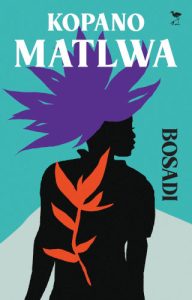
Bosadi
Kopano Matlwa
Jacana Media, 2025
Naledi
I killed him.
I sliced his neck open early on Christmas morning, while he slept with that pathetic look on his face.
I used the knife Rakgadi had given me the night of her niece Mumsy’s funeral, when she shoved me into a corner with a crate of tomatoes and told me to take care of her favourite knife.
‘This mmabogajana, Matlakala, take it everywhere you go. It cuts like a hot knife to butter.’
And so, I did. Took it everywhere I went – had it in my apron when he staggered home drunk on Christmas Eve, threw the plate of dinner I had made for him onto the floor, put his hand into the lemon cake I’d baked for Christmas Day and ripped out a piece with his dirty paw.
Just like Rakgadi said, the mmabogajana cut like a hot knife to butter. I was surprised at how easily the tissues split, did not resist being separated. First epidermis, then dermis, then subcutaneous tissue, then muscles, then blood vessels, that poured and poured and poured. I remembered all the names from his Atlas of Human Anatomy textbook, from when I used to help him study. I was a good girlfriend, a great wife.
I called the police station right after, of course nobody answered the phone. They never do. You must take yourself there, which is what I did. Locked our bedroom door where he lay on the bed, looking like the fool he has always been. I drove myself to the station and spent the night. Well, let me rephrase that, they kept me overnight.
They are charging me with murder, asked me if I want a lawyer.
‘For what? I told you I killed him mos. He is on the bed, in our main bedroom, here is the key.’
I think they think I am not of sound mind.
If only they knew, my head has never been clearer.
Aunty
Ma’am interviewed me to be a nanny. The agency ad said: ‘New parents expecting a little boy October 10.’ She explained she wanted someone who could start early, learn the baby together, ‘like a co-pilot’ she said, laughing. October came and went. I don’t know what happened to the baby other than that they left in a hurry for the hospital in the middle of one night and she didn’t come out of the main bedroom for days after that.
That was over a year ago.
I held my breath, waiting to be fired.
But nobody said anything to me, and I asked no questions.
I’d go into the nursery every day, air the room, vacuum the carpet, wipe the changing table and dust the baby mobile, just like she taught me to when I started. I was afraid to stop in case they suddenly remembered why they had brought me there in the first place and realised that I was no longer needed.
It was a small flat. A kitchen, lounge and guest bedroom downstairs where I stayed, and their main bedroom and the nursery upstairs. With no baby, there was really not too much to do, but I’d try. Help Ma’am with her baking, request to get the winter blankets down from their room so I can wash them ahead of the coming cold months, polish and shine her woollined boots, just in case.
Still, the days would drag. One day blurred into the next. I’d wake up, brush my teeth, shower. I always started with the dishes. Sir was an untidy man, and you’d find evidence of his late-night snacking throughout the house. A mug and crumbs on the TV stand, a packet of half-eaten chips on the veranda, even a banana peel on the floor next to their toilet.
After the dishes, I’d sweep the house and mop the floors. When they were out, I’d quickly make their bed and tidy their bathroom while I was alone in the house so that I did not bother them when they returned. Sometimes it would be difficult to do the main bedroom when it was one of those days when Ma’am did not come down and Sir said not to disturb her.
Once a week I vacuumed and scrubbed the carpets, washed the windows, cleaned the fridge, cupboards and oven. The microwave though I cleaned daily.
I took pride in my work. I wasn’t perfect but I did my best. There is peace to be had in a clean and orderly house. You learn that in this life you cannot control all of the things, but those that you can, you must do your utmost best.
Naledi
We’d planned a long weekend away to Mozambique, to celebrate our anniversary, take a break, reconnect. One of the psychologists we’d seen last year had suggested it. We didn’t have the money at the time, but then I got a performance bonus, and thought, well, it’s now or never. I, of course, had to make all of the arrangements, airport transfers, hotel booking, itinerary for the three days we were to be there. Paid everything too, didn’t want to aggravate him with his business struggling and all.
Rakgadi was over the moon when she heard, like it was her travelling, like it was her going to Mozambique. Rocked up at our house uninvited, apparently to help us pack.
‘Sedi is such a romantic. Yoh! Aren’t you just so blessed my girl,’ she said beaming as she ironed his underwear and folded them into the suitcase.
Romantic? These days Lesedi can’t even be bothered to buy me a Chomp for my birthday, let alone plan a weekend away.
But instead of correcting her, I took a deep breath, handed her another set of underpants and smiled.
‘Yes, Rakgadi, blessed beyond measure.’
And then COVID-19 started spreading across Europe, killing people, white people mostly but the experts said we were next. All news channels were covering it, people struggling to breathe, hospitals filling up.
When that started I thought, goodness, God must just end this whole creation thing, once and for all. Just bring it to a finish, right here, right now – there is too much suffering in this world.
Lesedi’s cousin Vusi called and advised us to stay home, stop going to the shops, stock up on food and toilet paper, drink Vitamin C, D and Zinc daily. Steam. He said the hospitals were filling up. Things were getting bad and they would soon reach a point where they were struggling for beds.
Lesedi was furious, said that Vusi was exaggerating, looking for relevance as always, jealous we were going overseas and he was not. I wanted to remind him that Mozambique does not count as overseas but I could see what kind of mood he was in, so I just nodded.
He’s always struggled – Lesedi – with Vusi being a doctor and he a dropout. Never quite recovered from that, always trying to overcompensate for not being as accomplished as his baby cousin.
Not that I am a fan of Vusi either, who married an intelligent girl that he insists stay at home. He likes to tell people that Cecilia was top of their BSc class and that he’s lucky she opted not to pursue a medical degree otherwise he’d be outperformed in the market. Only a man thinks it’s flattering that the world is better off with a mediocre doctor so his ego is protected.
Still, it became clear that our Mozambique trip wouldn’t happen. Vusi was right, flights were being grounded the world over, borders closed, and as he predicted, South Africa soon followed.
Aunty agreed to stay.
I was so relieved, I knew I could not cope without her.
‘Why do we have a full-time live-in nanny when there is no baby, Naledi?’ Lesedi would say snidely from time to time whenever Aunty did something that irritated him.
‘But there will be a baby,’ I would retort, always taking the bait.
‘Then we will get a nanny when there is a baby, Naledi.’
‘Good nannies are hard to find, Lesedi. They don’t just fall out of the sky when you are ready to have them. Aunty is perfect for our child.’
‘There is no child, Naledi.’
‘Fuck you Lesedi, there will be.’
And so it would go, over and over again, our recurring fight. The soundtrack to the movie of our lives. Sometimes I would throw something at him, sometimes he’d grab me, too hard, shake me until I stopped. Sometimes worse.
~~~
Kopano Matlwa won the 2006/2007 European Union Award for her first novel, Coconut, which went on to become a bestseller and a classic South African novel, and subsequently jointly won the Wole Soyinka Prize for Literature in Africa in 2010. Her successive novels, Spilt Milk and Period Pain, were also published to great acclaim, with Period Pain shortlisted for the Sunday Times Fiction Prize. Her novels have been translated to close to a dozen languages. When she is not writing, Matlwa works as a public health physician. She holds a medical degree from the University of Cape Town, a Master’s in Global Health Science and DPhil (PhD) in Population Health, both from Oxford University, where she attended as a Rhodes Scholar. Matlwa lives in Johannesburg with her husband and three children.
~~~
Publisher information
Naledi is a woman unravelling slowly, painfully, purposefully. Once full of promise, her life has shrunk into the claustrophobic walls of a home that no longer feels safe, with a husband whose love has curdled into something dark and dangerous. Between Instagrammable scones, lockdown picnics and a nursery that remains heartbreakingly empty, Naledi wages a quiet war against erasure of her name, her dreams, her body and her sanity.
Aunty, the quiet force in the shadows of Naledi’s crumbling marriage, carries her own scars. A Zimbabwean domestic worker with a fierce devotion to the children she left behind, Aunty watches, waits and bears witness. Between the two women, a fragile sisterhood grows—tender, complicated and not without its betrayals.
Told in alternating voices, Bosadi is a devastating exploration of gender, grief, immigration, violence and the impossible expectations that swallow Black women whole.