
The JRB presents an excerpt from Tanya Zack’s new book The Chaos Precinct: Johannesburg as a Port City.
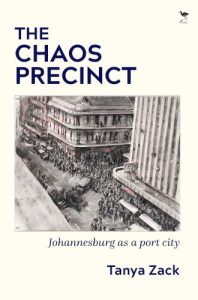
The Chaos Precinct: Johannesburg as a Port City
Tanya Zack
Jacana Media, 2025
1
‘Jeppe’ is Southern Africa’s retail mecca, yielding higher rentals than anywhere else in the inner city.
‘Jeppe’ has moods. It is oppressively sullen on days when the roller shutters are clamped down and the boom boxes silent. But at month’s end, when the sun dazzles the windows of the mothballed Johannesburg Sun and Towers hotel, when no police raid is expected, and the touts are out in their flamboyant drag, with false breasts, dresses and wigs, dancing on the doorsteps of the new malls – then Jeppe is Africa’s shopping mecca.
The bright-coloured clothes that spill out of cupboard-sized shops are destined for all parts of Southern Africa. Both local hawkers and cross-border traders from Botswana, Malawi, Mozambique, Zimbabwe and Zambia have little time to linger as they shop with single-minded determination for designer-label jeans, colourful dresses, jackets and shirts, handbags, blankets or small household goods ranging from locks, nail clippers or rat poison to facecloths and clothes pegs. The calls of street traders selling underpants and belts beat against the air: ‘Sorry ten-rand, ten-rand. Sorry. Sorry’, they call as if apologising for interrupting you. But interruption is the order of the day in Jeppe. Walking is interrupted. Language is interrupted. Views are interrupted.
On such a day in May 2012, I decided to try a new route into my favourite part of town, this so-called ‘Ethiopian Quarter’ that traders have labelled ‘Jeppe’ because it centres on that bustling street. I walked along the pedestrianised shopping strip of Smal Street Mall, which crosses Jeppe Street. It’s a buoyant conduit bustling with shoppers and merchandise. In the words of Solomon Birhane – who I met in 2009 and who has been my interpreter in Jeppe ever since – ‘You can only understand Jeppe if you understand Smal Street.’ He laughingly presented it as ‘the big brother of Jeppe, what all other streets in Jeppe want to be when they grow up.’ It’s a grand ambition. The dazzling shopfronts that flank this mall boast the highest quality shoes and clothes in the area. These jam-packed boutique-like stores pressed against one another yield rentals higher than anywhere in this city.
2
In the late 1990s Ethiopian migrants began to trade in this area and to open shops. I met the three men who are recognised by many as the pioneer traders of Jeppe. They started the first shops inside the redundant office spaces of these erstwhile medical buildings. Yerga was the first.
As Yerga walked along Bree Street with his wife, he noticed a shop selling clothes, caps, and other small items. Yerga stepped inside. He wanted to buy a cap. ‘My wife said, “You don’t even like caps!” But I said, “Let me buy it.”’ He decided there and then to start his own wholesale business and asked the shopkeeper for 10,000 hats. His wife was shocked. She started laughing. Yerga said, ‘We can just try.’ But he didn’t know where they would sell the stock. The Chinese shopkeeper offered to sell the hats to him at R5 a piece. Yerga wanted to borrow the money. His wife refused. He said, ‘Let’s pray about it.’ All week long Yerga couldn’t let go of the idea. He felt he had to try. He borrowed R15,000 and bought 3000 caps. ‘My wife was not happy when I brought the caps to the flat. And I was also uncertain. Where would I sell them?’ He went back to where he had bought the caps and looked around. He was scoping the competition. There were only two Chinese retailers selling caps in the vicinity.
There may have been only a few shops in Jeppe Street in 1998, but the informal trade on the sidewalks was flourishing. There were more and more hawkers’ stands, and many more hawkers were walking the streets with caps and belts and wallets dangling from their arms. Yerga contacted Ethiopians who were arriving in small groups and were looking for work. Some of them were selling on the busier pedestrian streets and a few had opened textile and fashion shops – around Pritchard and Market Streets. Others were selling at train stations and taxi ranks or door-to-door in townships. A few plied their trade on Jeppe Street.
Yerga said he didn’t want to follow suit. Before he moved on to telling me his plans, he paused to sip from his third cappuccino. ‘I drink more than ten coffees a day,’ he grinned confessionally. He continued, ‘I thought, let me speak to some of these Ethiopians. I can supply them.’ He devised a strategy. He would give Ethiopians credit. They could pay him only when they had sold their quota and restocked. He negotiated for good prices and hand-delivered goods to hawkers. The credit system worked well in a community in which he could leverage relationships stretching all the way back to Addis. No one would want to be shamed in their hometown for not being honourable in the host city of Johannesburg. ‘I bought more caps, and some belts from the Chinese shops and started selling them to hawkers in town, especially around Jeppe Street,’ he told me. ‘I would sell any number of items they wanted, five or ten pieces or even a whole plastic bag.’
He had become the first Ethiopian wholesale-broker in this part of town.
3
The policing of trade in this area is often brutal. And trade continues despite heavy police crackdowns
At first, I didn’t notice the man in the suit. He was holding an iPad and he watched me before he stepped closer and said, ‘Do you want to know what’s happening? Come with me.’ I asked who he was, whether he was a policeman, but he said, ‘Never mind who I am.’ It was too surreal and intimidating and I turned from him. Instead, I walked swiftly towards the roadside where JMPD officers and SAPS officers were surrounding a group of Ethiopian men who were sitting on the tarmac with their hands behind their heads. I asked a young policeman what was going on. He said, ‘I am not in charge.’ Another officer frowned at me. ‘What are you doing here?’ he asked. He added, ‘It’s the Mayor’s instruction. We are removing street traders. We are doing our work and people are going to get hurt.’ Then he raised his voice and pointed across the street, ‘Get out of here!’ I followed the direction of his forefinger and ran across the road as a teargas canister was fired. A man followed me. Halfway across the street he opened the flap of his jacket. It was lined with small bottles. ‘Do want to buy perfume?’ he asked.
4
Operation Cleansweep, in 2013, was a particularly brutal crackdown. The authorities forcibly removed 6000 traders off the inner city streets. Jeppe was one of the centres of massive force.
‘Do you know me?’ the policeman asked. ‘No,’ said the young man. ‘Then what are you looking at?’ ‘I am not looking.’ ‘Get away from my car,’ the policeman growled. The young man obliged and disappeared quickly. The policeman and I looked up. Where the young man had been standing, a sanitary pad was now fixed to the vehicle door.
It was a mid-October morning in 2013. Ordinarily this would be a regular shopping day with traders and shoppers filling the sidewalks and trucks, taxis and vans choking the roads of Jeppe. But today Jeppe Street was filled with vans and sedans belonging to the national police force, the revenue services and the Metro police. The soundtrack of touts and hooters and bargaining was replaced by sirens and the loud orders being issued by officers. Uniformed men and women representing regular and specialist divisions of these forces were moving in and out of buildings and street-facing shops. They were armed with sidearms, rifles or batons. Groups of officers were breaking open the locks of roller-shuttered doors and removing goods from shops. Others were keeping guard or chasing shopkeepers away from their shops and traders from their stalls. Some were cracking sjamboks on the road surface or across the backs of traders who were not moving away quickly enough. The most intense action was happening around Delvers Street, but every building for as far as I could see along Jeppe Street was under siege. Boxes and bags and piles of clothing were being tossed into panelled trucks. And the cage-like hawker stalls were being thrown onto flatbed trucks by JMPD officers.
I tried to take a photo of police on Delvers Street wielding batons. But an Ethiopian man stepped in front of my camera and said, ‘Don’t! Please be careful, don’t take photos. The police will arrest you.’
5
Survival in the competitive and brutally policed environment of Jeppe is stressful. For some the longer they stay in Joburg, the more they have to break the law.
But there were days when Yosef put his head in his hands. On one such day I sat across a table from him. He had not entered the apartment with his usual big smile and deep breath. Instead, he sat quietly for a long time. Every now and again he shook his head in distress. Then he looked up at me with none of the cheerful glee I associated with him. I heard how tormented he was. And I heard the plea he would repeat again and again, ‘Take me out of this country. Please. Any way you can. It is too bad. We are not properly protected as refugees; we do not get our basic needs met. Whatever we do we have to be bad. I have only been here for a few months, but I hate myself already. Everything in this country is bad work and bad things. You have to do bad things to survive.’
6
The municipality struggles to uphold building codes in this overcrowded and perplexing environment where new shops are being carved into every nook and cranny on a daily basis.
[Stefan] had seen first-hand how adaptable the modernist architecture in this part of town was. How the slabs and columns that enclosed vast open areas could be calibrated and recalibrated in multiple different ways to create storerooms and tiny shops. ‘Take Lancet Hall’, he said, referring to the original name of the building that was now known in Jeppe as Medical Two. ‘It’s been put to illegal uses, and it is overcrowded. And from the fourth floor up it has warehousing. You need the right building structure for that kind of storage. You also need fire equipment. These places were offices. They are not designed for warehousing.’ They were also not designed for the level of security people had installed to protect brand-copy goods from the crowbars of investigators who were sent by patent attorneys. Regular roll-up iron grills were not sufficient. More and more shops in the high-rise shopping malls were being secured with double metal doors filled with concrete. I heard it took ten men to lift one door.He became irate as he continued to describe landlords’ flagrant disregard for laws in this area. He was pacing up and down and throwing his hands in the air. He raised his voice, ‘When we confront them, they plead innocence. They say they don’t know the laws. That makes me angry.’ The lax attitude to laws was an affront to an official whose daily task concerns securing the safety of buildings and spaces in town. He took it personally. He walked closer to where I was sitting and demonstrated his performance of his duty on the street. Wagging a finger in front of my face he said, ‘I would say to a guy, “Your country where you come from, are there laws?” He would say, “Yes.” I would say, “Can you just break those laws?” He would say, “No, No.” Then I would say, “Well why do you want to come and fuck up my country?”’
7
The story of migration to South Africa is not purely a story of success. It is fraught with danger and death. In Ethiopia I was confronted about the risk Ethiopian migrants face in South Africa.
The man was now rigid. ‘People are dying. Every week ten to fifteen bodies are coming back here. What are you going to do? In Ethiopia, one killing is punished, but in South Africa no deaths are punished. Every day people are dying. Your government, your police, are doing nothing to protect us.’ He dropped his head low between his knees. He lowered his voice. ‘All of us in this room have buried our blood brothers who were killed in South Africa.’
….
‘I want to say something about South Africa. South Africa is a big and beautiful country. It is much better than Hosanna. Much better than Addis. I have seen things there that I only saw on TV here. But it is a lawless society. Our villages in Hosanna receive dead bodies from there every month, every week, every day. Our brothers are going there to do business. They are not going there to cause terror. But they are killed as if they are soldiers who went to war.’
8
Men who return to Addis from Johannesburg and who take with them habits, dress codes and ways of living learnt in the host country are often referred to as ‘Joburg Boys’. It is as if they can give full flight to a Joburg identity that they might hide in Joburg – for fear of standing out as successful – when back in Addis.
Abdisa was now a ‘Joburg Boy’. With their low-slung jeans, their stylish shirts, brand-name sneakers or patent-leather shoes, signature sunglasses and confident swagger, Joburg Boys were easy to spot in Addis. As if he could read my mind, Abdisa said, ‘We bring our Joburg styles with us. I have been gone for one generation. Twelve years is a long time. Can you believe I was there that long, Tanya?’ For Abdisa, there was the person he was in Joburg and the person he was in Addis. He reminded me that I knew a different person – the thin, exhausted one who was under the command of his older brother, Assefa. Now his reflective sunglasses, designer shirt and pointed shoes were more in keeping with the persona he wished to project, glass in hand, on Facebook, on a daily basis. These were the same men who hid the evidence of their success in Jeppe. But in Addis they gave full flight to their cutting-edge Joburg selves.
A year after returning to Addis, Abdisa was still very connected to his friends in Joburg. ‘I am online every day with my friends in Jeppe. I only have three friends here, but I chat all day to Ethiopian and South African friends in “SA”. My Ethiopian friends there are always asking me if they should come home. I tell them it’s hard to come back because you have to start over.’ And what would he say to those who wanted to go? ‘I say, ‘No. It’s a bad place.’
9
I met with a few ‘Joburg Boys’ in a home in Addis that looked like an apartment in Johannesburg’s suburbs.
As we entered the lounge, it was easy to forget we were 4000 kilometres from Johannesburg. Negash confirmed that this setting – with its soft vinyl couches squaring off in front of the flat-screened TV screen and plush patterned rug (complete with the orange vase on the corner cabinet) was a mirror image of the apartment he’d stayed in, in Bedfordview, that neighbourhood east of Johannesburg, which was home to many Jeppe shopkeepers. Polite introductions were dispensed with. The men all talked and gestured and laughed at once. They were talking about Joburg, about who they knew and about life there. I couldn’t follow the conversation, but I picked out the familiar words and place names: ‘Nando’s’, ‘milkshake’, ‘Ponte’, ‘Ivory Park’, ‘Tembisa’, ‘Montecasino’, ‘Sun City’ and ‘Rosebank’. They chortled at the Zulu swearwords they knew and at the names they were called in South Africa – ‘Cooloo Cooloo’ and ‘Makwerekwere’.
10
I lost contact with a dear young man whose story I followed closely over a number of years.
Yosef was smart but powerless. He had to tolerate the unbearable exploitation he endured to stay in a country he now despised. ‘I have been here for two-and-a-half years now. I work for free. I work for free,’ he repeated. ‘Don’t you know it?’ He laughed mockingly, ‘To be rich in Jeppe you have to be a thief. So, must I stay here? Must I stay in your country? Tell me? There is no life here. It’s just work. Every day it’s Jeppe, Jeppe, Jeppe. If you live at home, you have time to upgrade your mind. But here you can’t. What is my benefit of these two-and-a-half years? I want to grow my mind, but I am losing it. I have lost what I knew. I can’t go back to Ethiopia. You can never go back because those who were around you are expecting something from you. It would be better to die here than to go back with nothing. Now my plan is to go to the USA to study. If I get asylum there, they will let me study.’
On a Thursday night in August 2014, Yosef sent me a message. Again, he wanted to meet urgently. We met in a steakhouse at a shopping mall east of the city centre. He summarised the difficulty of his life here. ‘I work seven days a week. I have never had time to try to get my qualifications sorted here. If I had family here, someone could have supported me so that I could have studied. But I am alone. I am 28 now. I have given physically, and I have given psychologically. It’s been two years of punishment. It’s as if my body is physically beaten. I am a graduate of medical laboratory science. But I am selling shoes. I work like a slave. I cannot accept that. It’s psychological punishment. But I had no choice. God helped me to come here. At least I had a job from The Brothers. I am a nice guy for them. But they think if they have money, they know everything. They can undermine you because they have money.’ He paused. ‘This is not my calling.’ He straightened his shoulders and said, ‘I am leaving on Monday. I will fly to Bolivia.’ He showed me the Bolivian visa in his passport and continued, ‘After Bolivia I will go to a country next to Mexico.’ ‘Which country?’ I asked. ‘I don’t know the name. I will have to look on a map,’ he said.
‘I want you to know my plan,’ he said. But the details he offered were vague. He would travel to a city in Bolivia and then travel by bus for a day and a half to La Paz. There he would go to the embassy of ‘the other country’ whose name he couldn’t remember right now. He would fly to that country and then cross the Mexican border. ‘When I cross from that country into Mexico, I will hand myself over to the Mexican police. They will arrest me. They will give me a paper to leave Mexico within so many days. Then I will cross to America and hand myself over to the American police. I will apply for political asylum for myself as a member of the opposition party,’ he said. He showed me papers that proved his membership of an opposition party in Ethiopia and established that he was at risk of persecution in his home country.
As always, he concluded on a positive note, ‘I have wasted two-and-a-half years. But I have also worked out the systems.’
A week later I heard from Yosef. He texted.
‘Hi Tanya. How are you doing and your family? I am fine! Thanks to God! Now I am in Bolivia, and I got a visa to Honduras, and I will travel at 12 pm. After that I will apply for a visa to Guatemala from Honduras and then I will pass the border to Mexico … Finally, I will hand myself over to the USA police. Pray for me that it will all be good Tanya? Yosef.’
I tried to contact him. I visited the shop in Jeppe often to ask his bosses if they had heard from him. I called his cousin in Addis. I kept asking for more than a year. But no one had heard from him or knew what had happened to him.
11
Johannesburg is a hostile place, even as it is a place of hope for migrants seeking to make a living
Several interviewees echoed a sentiment that was often expressed in Jeppe – that Johannesburg has a ‘bad spirit’. Addisalem remarked, ‘They say there is a bad spirit here. I don’t know if it’s money or demons, or crime or corruption, but it has a bad spirit.’ She wondered if some problems had lingered for so long and then transformed into a bad spirit across the area. Another respondent made this point more directly: ‘This is a devil’s place.’
10
In Ethiopia I met returnees. Each one carried a story of violence in South Africa
Every man I met who had worked in South Africa lifted his shirt or his trouser leg to show me the scars of a gunshot or knife wound. Teshome had one of each. He didn’t waste time telling me why he fled South Africa. He said his shop had faced the stalls run by Nigerian traders. He’d worked there for six years. One day he was taking his stash of money from his shop. He was in his car. He had just turned out of the building and onto Delvers Street. Men opened his car door. He said, ‘One guy had a gun, and another had a knife. I saw the Nigerian trader, John, standing there. He was showing them my car. I shouted, “John, please don’t let them kill me!” But he shouted, “Shoot him! Take his car!” And they did. They shot and they stabbed me.’
12
Jeppe offers an exciting view of a city being remade at rapid speed
We walked out onto the rooftop, gleaming silver from the newly applied waterproofing. No barriers existed around the roof edge, and I squatted and shuffled closer to the precipitous edge. Assefa gestured across the rooftops and said, ‘Look at the city.’ And I did.
…..
On both sides of the human traffic jam that propelled me, low-cost jeans, sports shoes, caps and name-brand T-shirts were not so much displayed as spilling out of multiple doorways and hawker stalls. I joined the crowds weaving past mobile hawkers peddling flash drives and plastic balls and bubble guns and suitcases and was funnelled alongside men and women carrying bags on their backs or on their heads into another avenue of fast fashion. I wondered how anyone transacted in this mayhem. I thought it must be impossible for customers who hailed from surrounding countries to navigate this complexity – there seemed little time to linger to choose amongst the shoes, hats, socks, T-shirts and bags.
…..
This sidewalk skirts the twin high-rises that encase floors and floors of shops and warehousing. The memory of their original names – Medical Centre and Lancet Hall – remain on a plaque in the first building’s entrance hall and in brass lettering underfoot in the other. A vestige – these buildings are now known as Medical One and Medical Two. Other buildings around here that were transformed into internalised shopping centres acquired names such as Lotto, Arat Killo, Pan Africa, Abyssinia, Majesty and Joburg Mall. And ground-floor shopfronts sport names such as Ethio Blessings, Axum Fashion and Lalibela Trading alongside the more local Bafana Bafana Fashion and the decidedly international Philadelphia Mini Mall.
13
This is a centre of fast fashion. Goods flow in and out at rapid speed
Even with four shops running in town, we don’t need storage. It’s very intense and we move things very fast. We buy as we need, and we pay as we sell. Today I may buy a big bale of jeans, tomorrow a bale of tops. But the shop will never be full. There are more and more customers coming every day. You cannot keep one item for more than a week. One week! We sell out in a few days! If not, that means stuff is not moving. Sometimes I decide within one day to put things on sale and we drop the price immediately, otherwise my money will be held up there. We put the price down immediately. The maximum time I would give an item is a week.
14
It is an enclave that started ‘from nothing’, from people selling small items on the street
Jeppe is a beautiful area. It’s beautiful. I know it started small – I remember it, I used to buy belts from Jeppe when I was selling off the streets – from small shops and hawkers. And what makes it beautiful is it started from scratch, and it grew and grew and grew.
15
In Jeppe the arcade of tiny shops was pioneered – Johannesburg had not known this type of retail before
Ayelech was also a pioneer. Hers was the first street-facing shop in Jeppe.
Ayelech increased the visibility of her wares and she drew even more customers. She pioneered what would become the common defining practice in Jeppe – a small shopfront accessible directly from the street. Jeppe was going public. This arcade architecture of mini shops lining outdoor and even indoor streets would be a fundamental retail shift in Johannesburg, a city where big-box retail with large glass frontages was previously widespread. The city had never seen the like – tiny shops fronting onto the street in the style common in Asian market towns. It taunted monopoly-capital retail, which had cornered the clothing market for so long. Ayelech had set a trend and hundreds followed. Landlords were offered key money to break doorways in redundant walls. The inward-facing ground floors of buildings began to fan out in multiple shopfronts and invite consumers to press up against them and buy from seemingly endless stock.
~~~
Tanya Zack is a South African planner specialising in urban policy, regeneration, informality and sustainable development. She has been an adviser and consultant in the development arena for over 25 years, working locally and internationally. Her projects in the Johannesburg inner city have influenced city strategy and are recognised as groundbreaking interventions. She is the author of Wake Up, This Is Joburg, an acclaimed series of photo books.
~~~
Publisher information
The Chaos Precinct: Johannesburg as a Port City by Tanya Zack presents a compelling, brave–at times, lyrical–narrative of how migrant Ethiopians have shaped a trading post in Johannesburg’s inner city.
On maps it is defined as the eastern edge of the original administrative area of Johannesburg. Those of us who have encountered the area of the city centre roughly bounded by Plein, Troye, Pritchard and Von Brandis streets have coined various names for it. The Ethiopian Quarter, Little Ethiopia and Little Addis are phrases we exchange in animated conversations about this unique entrepreneurial explosion. This exoticises a booming makeshift shopping hub that emerged without any formal planning intention or support. Municipal officials speak informally of the area as the ‘Chaos Precinct’. But the traders in the area call it by the hallmark road—Jeppe. For them it is a place of opportunity and fevered trade—in which the annual revenue generated is twice that of Africa’s wealthiest shopping mall. Jeppe is a dynamic, exuberant nerve centre that fosters entrepreneurship.
Fortunes are made, loved ones back home are supported and commodities flow across Southern Africa – particularly fast fashion. Local and cross border traders arrive on buses and taxis to buy shoes, T-shirts, dresses, underwear, jeans, suits, wallets, belts, nail clippers and cosmetics. Though situated on the dry Highveld, Jeppe is an entrepôt which bears a close resemblance to major port cities.




One thought on “‘They say there is a bad spirit here.’—Read an excerpt from The Chaos Precinct: Johannesburg as a Port City by Tanya Zack”