The JRB presents an excerpt from Making a Life: Young Men on Johannesburg’s Urban Margins by Hannah J Dawson.
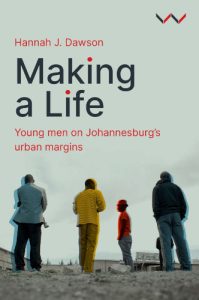
Making a Life: Young Men on Johannesburg’s Urban Margins
Hannah J Dawson
Wits University Press, 2025
Introduction: Making a Life on the Urban Periphery
I first visit Zandspruit in July 2011, a week after a string of protests that shake the community. The protestors’ main gripe is the lack of service delivery and the inaction of their local ward councillor, whom they hold responsible for their deplorable living conditions and the missing basic services. On this July morning, I park my car at the petrol station opposite the settlement and phone Lawrence, who has agreed to meet me. Lawrence is a community development worker, a public servant deployed in communities ostensibly to help residents access government services. But Lawrence is stuck in a meeting and cannot meet me as planned. ‘Sello is coming,’ he says over the phone. ‘He knows everything around here.’ The phone cuts. Five minutes later, a short, broad-shouldered man sporting white Superga trainers, a Nike shirt, and a large diamond earring in his left ear approaches me. This is Sello.
Standing next to my car, I explain to Sello that I am here to understand what motivates young people’s involvement in the protests that are becoming a frequent occurrence in townships and informal settlements across South Africa. Sello, not particularly enthusiastic but without hesitation, agrees to show me around. ‘Let’s go to my place first,’ he says, remarking that I will soon comprehend why people are on the streets. We cross the main road and walk along a sidewalk dotted with car repair shops, makeshift hair salons, and a variety of small stalls peddling everything from cellphone chargers to cigarettes and brightly coloured fruit stacked in plastic bowls. We pass by the local primary school, the clinic, and a massive dumpsite with waste piled three metres high. At a T-junction we veer right up a dirt path. Sello’s shack sits at the fork of two more footpaths that lead into a maze of narrow alleys between densely packed shacks in the settlement’s most crowded and under-serviced area. His shack is painted red with Vodacom signage on one side and pictures of various hairstyles on the other. It is divided into the living space he shares with his girlfriend and the area where he runs a barbershop.
On that day, and in the weeks and months that follow, I spend time with Sello and the mix of friends, neighbours, and occasional customers who gather at the barbershop to exchange gossip and discuss local politics. Sello never readily divulges how he makes his money. On some occasions, he refers to himself as unemployed; on others, he claims he is ‘hustling’ or ‘working in politics’. It is only after observing the ebb and flow of people at his shack—often a site of lengthy negotiations and disputes over payments—that I start to grasp the various sources of Sello’s income and understand why almost everyone I meet in Zandspruit knows him. Sello operates as a local mashonisa (unregistered loan shark) and plays a prominent role in the informal governance structures that patrol the streets at night. I later learn that he played a significant role in orchestrating the recent protests, something I was unaware of when we initially met. Sello’s barbershop is not primarily a commercial enterprise. It serves as a nexus for social networks and a legitimate income source, shielding him from potential allegations of corruption from his political adversaries. He makes money through various means, including managing informal land transactions, mediating disputes between landlords and tenants, and lending money to local residents at a hefty 50 per cent interest rate, regardless of the loan size. ‘There is a lot of money revolving around here,’ he tells me, ‘but it requires a sharp mind to see it and to take advantage of it.’
Sello’s barbershop, and the interactions that took place there, sparked my interest in people’s everyday economic strategies amid widespread wagelessness and increasing inequality. It was here that I began to reckon with the dynamics of incorporation within the formal labour market and observed the connections between those earning money as security guards, gardeners, and domestic workers outside the settlement and those, like Sello, generating income within it. This exploration of the complex connections between wage and non-wage economic activities, and their entanglement within the sociopolitical dynamics of the settlement, forms the foundation of this book.
Making a Life explores the interplay of young men’s everyday life-making strategies amid widespread joblessness and the making and remaking of Zandspruit, a sprawling informal settlement on the outskirts of Johannesburg, South Africa. It draws on research I conducted there between 2011 and 2023. In 2015, I returned to Zandspruit with a focus on understanding how young men without wage employment make a living. Initially, my inquiries centred on individual men’s work histories and economic decisions. I aimed to grasp the factors shaping their choices and trajectories and, more specifically, their decision to engage in, or reject, the available low-wage jobs. Over time, it became evident that comprehending men’s economic endeavours and their evolution over time not only challenges a narrow emphasis on wage employment but also necessitates a broader perspective that sees men’s livelihoods as only one aspect of what it means to make a life. This is because making a living is not simply about securing sustenance and shelter. A living is also a life. It encompasses forms of social connection, identity, and belonging; claims to place; and the pursuit of dignity and recognition. This book takes the different domains of men’s lives—their livelihoods, identities, aspirations, and political practices—and their relationship to each other as the building blocks for understanding Zandspruit as a multifaceted sociopolitical terrain.
Making a Life combines a relational understanding of urban space, shaped by everyday practices and contested social relations, with an anthropological approach to the economy. It takes a distinctive route by prioritising distribution over production and emphasising how men’s embeddedness or outsiderness within the settlement mediates their economic strategies and work-related decisions. This approach unveils the intricate link between men’s everyday choices and practices and the emerging sociopolitical order in the settlement. It sheds light on the politics of belonging in Zandspruit and provides fresh perspective on the processes shaping social differentiation on the urban margins.
Sello’s barbershop not only offered insight into residents’ everyday life-making strategies and the sociopolitical dynamics of the settlement. It also provided a convergence of individuals—spanning neighbours, local leaders, clients, girlfriends, family, and peers—that allowed me to forge personal connections and gain the confidence to navigate the area independently. I will always be indebted to Sello for that. The relational networks discussed in this book, often tied to specific spaces such as Sello’s barbershop, represent an invisible form of ‘infrastructure’ that produces and reproduces the settlement. These networks of relations not only form the core focus of this book, providing insights into the distribution of resources and the generation of social inequalities within the community, but also inform its methodology.
The book examines the fundamental components of men’s efforts to establish a life in the settlement. This reveals the multifaceted sociopolitical complexity of informal settlements and sheds light on Zandspruit as an integrated entity. These core components are, first, the varied ways men secure a livelihood that unsettle the formal/informal divide and challenge economic dualism; second, the distinctions in local citizenship marked by having rooted connections and a political claim to belonging; third, men’s aspirations and their embrace of momentary forms of enjoyment and pleasure amid the challenges of everyday life; and fourth, the significant role of collective action and political agency. This approach debunks the notion of these areas as mere repositories for ‘surplus humanity’, as suggested by Mike Davis, and questions the increasingly prevalent perspective that romanticises the adaptive survival strategies of the urban poor.
Everyday life making: Studying livelihoods within lives
With South Africa’s official unemployment rate of 33 per cent and an expanded rate of 43 per cent, soaring to over 60 per cent for individuals aged 15 to 34, mass joblessness is frequently labelled the country’s most pressing crisis. Politicians and commentators frequently depict young people excluded from wage employment as inactive, aimless, and alienated from mainstream society. This perpetuates the notion of a ‘lost generation’. The prevailing narrative expresses widespread concerns that the consequences of unemployment are detrimental not only to individuals but also to communities and society at large.
For instance, at the 2016 Economic Indaba, hosted by Gauteng province, David Makhura, then premier of Gauteng, labelled growing youth unemployment a ‘ticking time bomb’ and suggested it be declared a ‘state of emergency’. ‘Drugs are destroying the next generation of South African workers and leaders, and crime is destroying the fabric of the existing society, reversing the gains of democracy,’ said Makhura. Four years earlier, in 2012, Zwelinzima Vavi, then general secretary of the Congress of South African Trade Unions (COSATU), warned about the consequences of growing unemployment. ‘This is a crisis,’ he said. ‘If we look at lots of our cities, they are all surrounded by a ring of fire,’ he added, referring to the steady rise in protests on the outskirts of many urban centres. Media coverage of these political struggles regularly focuses on the figure of the unemployed man who is portrayed as aimless, disillusioned, and available for direct action. This portrayal reinforces the assumption that those without wage employment are disconnected from society and inevitably on a path towards political unrest. This book challenges this framing by highlighting how young men without wage employment are not idle or disconnected from society. Instead, their engagement in political action is integral to their everyday struggles to make a life in a context of structural precarity and profound inequality.
The moral panic surrounding youth unemployment is not new or unique to South Africa. The official concern with ‘idle youth’ was prevalent among colonial regimes and during apartheid and frequently used to justify various control and disciplining measures. The apartheid pass laws, for instance, designed to push black South Africans into the labour force or force them out of cities, were motivated by concerns about idleness, particularly among young men in townships, and the underutilisation of urban labour, which undermined the government’s urban labour preference policy.
The prevailing narrative, laden with moral panic and condemnation, fails to tell us much about the everyday lives and economic endeavours of young men in places like Zandspruit. Instead of portraying the social world as it is, it focuses on what is absent, specifically the lack of wage employment. Moreover, journalists and scholars often present contemporary unemployment as a relatively recent problem, emerging primarily in the post-apartheid period, and overlook its historical roots. Historical data shows that South Africa’s shift from labour shortages to widespread unemployment dates back to the recession of the mid-1970s, preceding the economic liberalisation and financialisation of the 1990s. The establishment of the Bantustans, apartheid-era territories demarcated for black South Africans according to ethnic groups, essentially created warehouses for a growing surplus population whose labour the apartheid economy no longer required.
South Africa exemplifies global trends in which growing numbers of young people are considered ‘surplus people’ in a macroeconomic context. These individuals are capable of labour that global capitalism does not require for economic growth, which can occur without an expansion of formal employment. Scholars attribute the acceleration of surplus populations to a multifaceted process marked by ‘simultaneous monetisation, de-agrarianisation and de-industrialisation’. The result is a growing exodus of people from agrarian rural livelihoods to urban centres, with limited opportunities for integration into wage employment. Consequently, there has been a proliferation of informal economic practices characteristic of contemporary urban Africa, a trend observed in South Africa despite its relatively small informal economy.
The increasing scarcity and insecurity of wage employment has come to symbolise a generation of young people unable to attain the means to transition into adulthood—a predicament Alcinda Honwana describes as ‘waithood’. Other scholars characterise young people in conditions of economic uncertainty as being stuck in a state of ‘limbo’ or ‘timepass’. The consequence of exclusion from wage work is particularly challenging for young men who struggle to meet the societal expectations of respectable manhood, long associated with building a home and providing financially for family and dependants. Unlike men, women’s femininity is not questioned because of their inability to provide for their family, although they also face challenges in attaining the markers of adulthood.
A global literature has emerged to challenge the notion that young people are indiscriminately and indefinitely deprived of agency and personal maturation. These studies emphasise the unviability of unemployment for most young people, who instead carve out alternative economic opportunities outside of wage employment. This viewpoint highlights the futility of the notion of ‘waithood’ and emphasises young people’s diverse economic strategies in what Tatiana Thieme calls the ‘hustle economy’.26 It also brings attention to young people’s adaption of social relationships and the reconfiguration, albeit provisionally, of gendered norms and ideals.
While encompassing diverse perspectives and experiences, including those of both men and women, this book focuses on the experiences of young black South African men. This methodological choice, discussed in detail below, shapes but also imposes a limit on my analysis of life making in Zandspruit. During the writing of this book, I grappled with the question of how to ethically portray the everyday lives of black men under conditions of structural precarity. This challenge is shaped not only by me as a white woman (something I discuss in greater detail shortly) but also by the imperative to do sufficient justice to the macroeconomic forces and the positioning of men like Sello within global capital relations. Making a Life recognises the legacies of racial dispossession and the enduring influence of racial capitalism on the social contexts, experiences, and prospects of the black men it examines while refraining from reducing their strategies for creating lives to mere acts of survival or resistance. While recognising that mass unemployment severely limits the prospects of life and life making, this book underscores that these limits prompt—even necessitate—the emergence of new socio-economic collaborations and practices. This requires a holistic understanding that views livelihood as only one aspect of what it means to make a life. In addition, it necessitates a conceptual framework that sees men’s economic strategies not as separate from but as closely integrated into the fabric of their lives and the sociopolitical dynamics of Zandspruit. For this reason, the interplay between men’s everyday practices and the production of the informal settlement takes centre stage in this book.
My approach to examining men’s livelihoods within a broader framework of life making takes its cue from Henrik Vigh, who urges us to see social contexts, particularly those marked by chronic instability and economic adversity, not as an exceptional occurrence but rather as the prevailing backdrop, or what Vigh calls the ‘frame of action’, against which everyday life unfolds. My focus on everyday life making considers everyday practice as a dynamic social process. This perspective not only regards men’s pursuit of livelihood as intertwined with their endeavours to establish connection and belonging in the city but also encompasses their aspirations for improved lives. It highlights the dynamic interplay between men’s capacity to make lives under conditions of material insecurity and the shaping, maintenance, and contestation of the social spaces they occupy.
This resonates with Vigh’s notion of ‘social navigation’ that sees agency as a dynamic process that is neither predetermined by one’s social position or social context nor entirely independent of it. Social navigation, likened to everyday practice, is defined as the ‘attempted construction, plotting, and actualisation of a social trajectory not on a defined and demarcated stable ground, but in a moving and fluctuating sociopolitical environment’. I view men’s life-making strategies not merely as survival tactics or a form of resistance but as a dynamic interaction rooted in time and place. This perspective emphasises the provisional character of men’s individual and collective modes of living and offers insight into a global literature on how we understand life making in a time of mass wagelessness.
~~~
- Hannah J Dawson is a senior lecturer in the Anthropology and Development Studies department at the University of Johannesburg and a visiting researcher at the Southern Centre for Inequality Studies at Wits University, Johannesburg.
~~~
Publisher information
Making a Life: Young Men on Johannesburg’s Urban Margins explores the dynamic everyday life-making strategies of young men in Zandspruit, a sprawling informal settlement on the outskirts of Johannesburg.
In many ways Zandspruit typifies the precariousness of life within South Africa, where two-thirds of young people lack waged employment. However, rather than seeing Zandspruit as a dumping ground, Hannah J Dawson calls for an integrated understanding of the complex linkages between people’s lives and livelihoods, and the multifaceted sociopolitical landscape of urban settlements.
Based on fourteen months of ethnographic research, Dawson investigates how social belonging, identity and economic realities intertwine in places such as Zandspruit. This approach not only challenges conventional approaches to studying work, it also questions the increasingly prevalent perspective that romanticises the adaptive survival strategies of the urban poor. By exploring the intricate connections between those with and without wages, the author shows how young men manage complex social, political and economic conditions.
Making a Life offers insights into issues such as urban work, citizenship, un(der)employment and inequality in South Africa. At the same time, it contributes to a global understanding of how young people—men especially—manage economic uncertainty.