The JRB presents an excerpt from Johannesburg from the Riverbanks: Navigating the Jukskei, edited by Mehita Iqani and Renugan Raidoo.
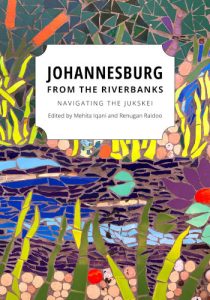
Johannesburg from the Riverbanks: Navigating the Jukskei
Mehita Iqani and Renugan Raidoo
HSRC Press, 2025
Riparian urbanism: Thinking Johannesburg with the Jukskei
Mehita Iqani and Renugan Raidoo
Introduction
Johannesburg is often referred to as the largest major city that was established with no major water source to serve it. Along with the urban myth of Johannesburg being the largest man-made forest in the world (it isn’t) is the myth that the city lacks a notable river, lake, or seafront. To some extent, this characterisation is not unfounded. Drinking water is piped in from the Lesotho Highlands and the Vaal Dam to service the growing population of the city. Although it is true that landlocked Johannesburg has no navigable rivers or lakes that provide connections useful to industry and other capital (the products of the city of gold were moved to market by other means), the small rivers and spruits that run through it are very much a part of the city’s past, present, and future. And, from the heart of the city flows the Jukskei, a notable part of the system of spruits and streams that testify to Johannesburg’s historical mix of grassland and wetland.
This book takes as its primary object Joburg’s biggest river, and its most charismatic (for better or worse): the Jukskei. Prone to violent flooding, emitting unpleasant odours and carrying litter, this river is often in the news for negative reasons (not least the loss of life during summer thunderstorm floods). When it receives media attention in positive ways, it is often due to activist efforts to rejuvenate the river and to integrate it more effectively into the everyday life of the city. Although it is non-navigable until it reaches the Crocodile River and Hartbeespoort Dam, the river runs through or past virtually every kind of urban form Johannesburg has produced. Despite its abundant presence in the city, the Jukskei has attracted scant attention from policymakers, the public at large, and researchers.
There doesn’t appear to be a clear origin for the name of this river. Indeed, for many South Africans the term might more readily recall sports. Jukskei is the name of an Afrikaner game still played in some parts of the country that involves throwing a pin at a stake planted in the ground. For fans of more widespread sports, the Trans-Jukskei Derby or Jukskei Derby recalls rugby games between the Blue Bulls and the Lions, or cricket matches between the Titans and the Lions, as the Jukskei historically divided teams into what were formerly called Northern Transvaal and Transvaal. The name itself comes from the Afrikaans words juk and skei, meaning ‘yoke’ and ‘divide/separate/divorce,’ respectively. Indeed, mentions of the river in English from the 19th and early 20th century refer to it as the ‘Yokeskei.’ Under that name it was mentioned, among other things, for being unpredictable to cross, for the presence of alluvial gold, as home to interesting fauna, and as a site of interethnic violence. A 1917 issue of the Agricultural Journal of South Africa notes: ‘The name of the Witwatersrand given to this region by the Voortrekkers means in the Dutch tongue the ‘Range of White Waters,’ and was so-called because the waters flowing from the hills were peculiarly white and clear, owing to the presence of limestone, and also in contrast to the dark waters of the Yokeskei and the Crocodile.’ This comparison is perhaps an enduringly apt one, contrasting the ebullient aspirations of the early settlers with the prosaic but enduring ‘darkwater’ realities of the Jukskei.
Despite the Jukskei’s centrality in (and to) the geography of Johannesburg, there has been little sustained effort to document and interpret the river’s significance to the city. Such a reckoning is long overdue.
This book offers an interdisciplinary set of conversations from and between those researching, archiving, and analysing the various cultural, social, and scientific aspects of Johannesburg’s only perennial river. It is intended as a first step in an ongoing exploration of how the river has made the city, and the city has made the river. It includes, of course, academic contributions from a variety of disciplines, and also the products and reflections of the many activists, journalists, and artists who have grappled with this river. The collection of writings assembled here is diverse, and includes scientific work presented clearly for the lay reader, analysis of fine art, journalistic writing, memoirs of activists, and cultural analysis. This volume collects work on, in, about, and alongside the Jukskei for the benefit of the public and policymakers. It also, we hope, demonstrates a viable example of accessible, interdisciplinary engagement for those who live with rivers (and other natural features) in cities around the world.
There is a wealth of critical urban literature on Johannesburg. This literature explores a wide range of social, cultural and political aspects of this compelling city. These include the ravages of its enduring social inequalities, the social semiotics of its branded skyline, the cultural politics of its gated communities and its emotional landscape, the enduring legacy of apartheid spatial planning on its townships, the boom in luxury malls, the multiple and scattered ways in which its histories have been archived, and the startling, brutal yet often beautiful aesthetics of its architecture. These are just a few key topics that have captured researchers’ attention. Although the Johannesburg literature covers many aspects of this enthralling, and enthrallingly unequal, city—from its urban disenfranchised to its urban elites, its joys to its anxieties—to date little scholarship has addressed the place of the Jukskei River in the city. This book changes that.
Johannesburg’s river
We commissioned artist Io Makandal to draw a map of the Jukskei River (see pages xiv–xv) for use as a reference for the content of this book. The various locations along the course of the river mentioned in this book are indicated on this map and serve as a visual orientation device for the river and its geographical relation to the city of Johannesburg. The map foregrounds the river, de-emphasising the terrestrial geographies of municipal/provincial boundaries, land use, and relative wealth that dominate discussions of Johannesburg’s urban environment. While such geographies remain undeniably important in understanding the city, one argument of this book is that centring the river as an orientating device helps us think urbanity anew. On the right-hand side of Makandal’s work appears a ‘strip map,’ a now-obsolete cartographic form designed to help those navigating roads and rivers by organising other geographical features in relation to the route being navigated. The chapters in this book offer a kind of narrative strip map, re-visioning Johannesburg in relation to the vital artery that is the Jukskei.
The journey of the river was narrated by journalist Sean Christie (whose work also features in this book), who walked its length almost a decade ago. The Jukskei springs most likely from several eyes in the wetlands that used to comprise the eastern valley of what became the city of Johannesburg. The high-density neighbourhoods of Hillbrow and Doornfontein were built on top of these wetlands and eyes, effectively concreting over the natural springs that converged into the river. The source of the Jukskei has thus become integrated—due to environmentally unsound colonial, apartheid, and post-apartheid urban planning—into storm water and sewerage systems that are ageing and poorly maintained. It is now impossible to differentiate the source of the river from the city’s sewerage systems. The eco-artist Hannelie Coetzee, exploring underground along with Christie and city officials, located one pure spring deep below street level, but it trickles immediately into the maze of sewerage drains and storm water pipes below Ellis Park and Hillbrow. Her evocative photographs (available on her website, and also discussed in Chapter 8 of this volume) of the source of uncontaminated water, in the dark tangle of sewerage pipes, capture the extent to which the natural resource has become indistinguishable from the concrete realities of modern urban life.
The river then runs under the city for many blocks, through underground sewerage and storm water systems, most of them neglected for decades. The daylight point of the Jukskei is at Queen Street, near the corner with Thames Street, in Lorentzville, a deprived neighbourhood with high unemployment, poor public services, large migrant communities, and limited economic opportunity. Both street names underscore the colonial past of the city, with the Jukskei implied as match, albeit inadequate, to London’s Thames. Until very recently this point where the river first enters the above-ground life of the city was identifiable only by a graffitied bridge, piles of dumped refuse, and its use as a shelter for the urban underclass, including the unhoused, those struggling with problematic substance use, and purportedly others engaged in criminal activity. It is now marked by a beautiful mosaic artwork, made collaboratively between the NGO Water for the Future and artists from the Spaza Gallery in Troyeville. The cover of this book features a detail from this mosaic.
From the newly beautified daylight point, the river runs in deep culverts above and below concrete through semi-industrial areas (including through the creative hub of Victoria Yards), before joining a suburban corridor through Bezhuidenhout Valley into Bruma. Although the neighbourhoods along this early stretch are neglected and underserviced, the riverbanks are largely natural and the riparian zones include large, though uncared-for, green spaces, including sports fields and parks. After passing the erstwhile man-made lake (now filled in) at Bruma, the Jukskei River turns northeast to flow past Oriental City China Mall, and the genteel upper class suburbs of Morninghill and Gilloolly’s, before following the N3 north, gathering pace, trash, toxins and flooding potential as it works its way past townhouse complexes in Sandringham on its way under London Road into Alexandra, the oldest township in the city. There it flows past many densely populated sections of Alex, including the steep and treacherous banks of the informal settlement at Stjwetla, before finding green space after crossing under Marlboro Road, near the newly built eastern suburbs of greater Sandton.
Passing through patches of open veld and past the high walls of housing complexes, the Jukskei River continues to run northwest, entering elite gated communities like Waterfall Estate. As well as these more prosaic walls, the river also passes those of Leeuwkop Prison where many of Gauteng’s prisoners and people awaiting trial are locked away, tucked between Lonehill and Kyalami, the incarceration facility sitting on the upper riverbank. The Jukskei then passes many more lifestyle estates and gated communities, including those in the Dainfern Valley which straddles it, before crossing through the ostentatious Steyn City, and traversing the increasingly built-up quasi-farmlands of Lanseria. By this point, the water carries with it smells, toxins, litter and other jetsam from the city before it merges with the Crocodile River around 50 kilometres away from greater Johannesburg. The Crocodile eventually spills into the Hartbeespoort Dam.
The Jukskei’s course betrays the material conditions of diverse socio-economic layers of the city, as well as the complex social relationships implied by the inherent inequality that continues to define Johannesburg life. As much as the existence of the Jukskei River says something about the history of Johannesburg, the Jukskei also flows through the city’s future. In 2021 the South African government released its vision for the development of a ‘smart city’ around Lanseria Airport, in the form of the Greater Lanseria Masterplan, slated for proposed completion by 2030. In the maps illustrating this vision, the blue thread of the Jukskei glows, hinting at urban futures in the greater Johannesburg region that integrate the high-tech with the riparian: indeed, one of the key recommendations for the future development is ‘embedding the status of the Crocodile River Nature Reserve’.
River rejuvenation and urban sustainability
The Jukskei has changed Johannesburg as much as Johannesburg has changed it.
What do rivers do for cities, and how do city residents, in turn, make them part of urban life? Rivers used to be seen quite simply as resources that could be exploited to serve economic and urban development, but that thinking has shifted: ‘Features that were once considered expendable in order to ensure human assets […] are now considered assets in their own right. These include stream ecology, stream hydrology, stream geomorphology and water quality.’ The health of societies and rivers are connected. Indeed, the South African Human Rights Commission has recently reported that the Vaal River is polluted to unacceptable levels and that this has a direct impact on the human rights of those who live alongside it. Similarly, in a recent study of the social life of the Ganges, as it runs through Varanasi, India (though it should be noted that this study was conducted before the devastating Delta wave of the COVID-19 pandemic in India), the author unsurprisingly concludes that the pollution of the Ganges in that city directly contributes to ill health amongst its population. Similar studies have taken place regarding the Jukskei, with a specific focus on pollution and toxicity levels (see the chapters in the first section of this book). There is no doubt that the Jukskei is terribly polluted, right from its very source. This raises questions not only about how pollution can be eradicated, for the safety of all creatures engaging rivers, including the humans who live alongside them, but also about what that pollution means to cities, and vice versa. Urban rivers produce ‘social connectivity,’ that is, ‘the communication and movement of people, goods, ideas, and culture along and across rivers, recognising longitudinal, lateral, and vertical connectivity.’ Although in the context of the Jukskei the river does not literally provide transport and trade, there are multiple movements of items, both visible and invisible, along its course, including toxins, pollution and trash, and of course the other, less tangible discourses about the city and the huge diversity of people who live in it.
There is growing concern about the pollution of urban rivers, especially in the Global South. Evidence from around the world shows that rivers can add significant value to the urban economy when they are not poisoned and polluted. In other words, investment in rejuvenation pays off.
Healthy and functioning river systems are appealing and attractive to residents and businesses. A society engaged in enjoying riverfront features and activities also cares about the long-term sustainability of river systems. Communities have started to understand the appeal of a more natural riverfront for residents and visitors. Apart from touristic advantages, there are some other benefits as well, including cost-effective flood control, improved water quality, reduced infrastructure costs and increased property values and tax base.
River rejuvenation is a complex, interdisciplinary scientific field. One key challenge that has been identified by experts in the science of river restoration is: a lack of scientific knowledge of watershed-scale process dynamics, institutional structures that are poorly suited to large-scale adaptive management, and a lack of political support to re-establish delivery of the ecosystem amenities lost through river degradation.
Public engagement, and the nurturing of a deliberative process, is central to effective river rejuvenation attempts. Communities living with and along rivers need to have the chance to learn through engagement, and have their own perspectives integrated into policymaking and the implementation of the scientific recommendations. This holds true for Johannesburg as much as any other city.
At the Jukskei’s source, a project to rejuvenate and remediate the Jukskei River at its daylight point is being driven by a public-private partnership forged by the NGO Water for the Future (WFTF) (discussed in Chapter 21). Original Soweto Highveld Grassland (a vegetation type native to the highveld and able to contribute positively to rejuvenating areas overrun with alien species, including along the banks of the Jukskei), that thrived before urbanisation, is being reintroduced to try and create a green corridor from the daylight point through to the borders of the City of Johannesburg. The aim is to build a resilient infrastructure along with an informed pro-active community, and to offer replicable rejuvenation models that can be scaled up all along the pathway of the river. Along the course of the river, specifically in Alexandra, crucial work is being done by the Alexandra Water Warriors (see Chapters 16 and 18), who are creating jobs through river cleanup efforts. These types of community organisation are increasingly being recognised as a leading resource on river cleanups, and deserve ongoing public and private sector support.
Climate change is a major global challenge, with specific implications for South Africa in general and water security specifically. One key framework for humanities-driven research into climate change is to consider how cities can be more resilient, as they are likely to face an influx of migration when climate change-related disasters force people away from coastal areas and other areas negatively affected by anthropogenic climate change. Environmental communication is one way to explore the question of how the science of climate change and river rejuvenation and their social consequences come into public discourse in South Africa. Water security, including the health of perennial rivers, is a key part of this bigger picture. Building climate resilience needs to be based on a dialogic and collaborative ethic, seeking to push forward an agenda that moves from ‘“deficit” to “dialogue” ’ by bringing relevant, issues-driven science into ‘greater proximity to the public’ through a ‘democratised relationship.’ This is just as true for the bigger picture issues (climate change in general) and more focused areas of ecological rejuvenation, such as work on the Jukskei. New forms of climate resilient sustainable development in urban settings, particularly in South Africa’s economic hub and most densely populated city, Johannesburg, are needed to gain deeper insight into narratives about urbanism and the climate emergency.
Riparian urbanism
In ecology, the term ‘riparian’ most simply refers to ‘the ecosystems adjacent to the river.’ Riparian areas are those that are situated at the interface of terrestrial and aquatic ecosystems, most obviously along the banks of rivers, which expand and contract when flooding or during droughts, but also around the edges of other bodies of water. The riparian zone includes more than just a river’s floodplain. It also includes narrow strips along river courses that cut deeply into landscapes, and islands in river courses, thereby integrating multiple ecosystems and landscapes. Ecologists and hydrologists who study riparian zones are typically interested in water flow, hydrologic linkages, sediment movement, channel dynamics, soil characteristics and ecosystem functioning—all of which can be affected by human activity.
In the Anthropocene, there is barely any natural feature on the earth that has not been touched or affected by human activity, usually to the detriment of the other species living there. Almost every landscape and body of water has been irrevocably changed for the worse, directly or indirectly, by humanity. For the rivers that have historically hosted human settlement and facilitated human development, that influence is as old as history. The centrality of big rivers to the economic and cultural life of many major cities is testament to this. Many rivers have been urbanised and are integrated into the complexities and lived experiences of the cities and towns through which they flow. It is to this complex relation between the urban and the riparian that we gesture with the term, ‘riparian urbanism.’ As a working definition for the concept of riparian urbanism, we point out that it is impossible to imagine certain cities without their rivers, or fully restore the same rivers to their pre-citied condition. Riparian urbanism describes the inseparable condition of rivers and cities, where the human and the non-human have co-created, and continue to co-create, the urban condition. Humans, other-than-human life, and nonliving elements of the environment all depend on one another. If we are to imagine a viable place for humans on a future Earth, it can only be as part of an interconnected more-than-human social.
In Johannesburg, we argue that there is a uniquely complex relationship between ecology and economy, hydrology and sociology, that is attendant to the riparian urbanism of the Jukskei River. Because the source of the river has been subsumed into the underbelly of the city itself and has been largely ignored by the majority of the populace as well as the city and provincial governments, the Jukskei has been urbanised (in a pejorative sense poisoned and polluted) more thoroughly than many other rivers, for example those that arise in remote mountain headwaters before flowing through or past towns and cities. Johannesburg is beset with multiple social challenges, already acute in this dense urban setting, and heightened by the COVID-19 pandemic, the looting of 2021, and the persistently devastating socio-economic legacies of apartheid. But so too does Johannesburg always find a way to thrive and live up to its moniker as a city of gold, where many flock to seek their fortunes, and creative entrepreneurs and business tycoons rub shoulders with the destitute, where glittering skyscrapers keep being built even while inner-city buildings crumble, or burn, out of neglect by both property owners and city managers.
That the river’s significance is primarily not as conduit for or generator of capital further stresses our riparian framing, drawing attention to those humans and non-humans who live on and near its banks, whether by choice or necessity. These riparian citizens’ wellbeing depends in part on the behaviours of other riparian citizens upstream (historically and geographically), with the waters of the river serving to connect the citizenry of a famously divided city.
The confluence of the terms riparian and urbanism offers an assessment of Johannesburg’s history, development, and culture from the banks of the river that runs through it. Riparian refers to the interface between the river and the banks that define, direct and are eroded by it. Urbanism calls attention to those beings—human and non-human—who live at the aquatic-terrestrial boundary, how they use and manage the capricious river, and the city and urban landscapes that frame those interactions.
The river travels through, and carries with it, many of the features of the city and its socio-economic contradictions. Johannesburg’s fractured and fractious urbanity has been forced into the Jukskei’s riparian condition. Before the city was built, the river was there, bubbling up from the Highveld wetlands and winding its way to join other rivers until the Indian Ocean. Yet, now that the city is here, exhibiting both an inertial permanence and entropic signs of deterioration, deeply unequal yet still the throbbing economic heart of the country, unsound development at the source of the river means that it now emerges into fresh air and daylight from a storm drain. While it is entirely changed by the presence of the city and its people, the river also does something to the urbanity of the city.
It starts in, runs past, and flows through parts of Johannesburg that although in the same city are worlds apart. What does it tell us about this metropolis? How does the urbanism of Johannesburg affect the Jukskei, and how can the pollution and other ecological damage caused by the city to the river be better understood, and even reversed, with the help of multidisciplinary research? How, in turn, does the river affect the city in specific ways, offering both challenges and opportunities for linking spaces and communities that were intentionally segregated by apartheid spatial planning? This book offers some answers to these questions, and a starting point for future multi- and interdisciplinary research into the urban environment.
~~~
Publisher information
It is often remarked that Johannesburg is exceptional as a major city in that it has no large body of water. While it may be true that the city does not boast commercial harbours, busy canals, or navigable rivers, spruits and wetlands saturate the city, and are home to many of its non-human inhabitants. These have largely been overlooked as participants in the urbanization of Johannesburg despite shaping, and being shaped by, the city’s development. This book’s focus on the Jukskei river—in which some of the first gold was found on the Witwatersrand—invites a re-centering of waterways as a device to organize how we think about this baffling city.
As humanity faces impending global environmental challenges and intensifying inequality in cities around the world, the task of assessing our relationships to urban rivers like the Jukskei, and the nonhumans that inhabit it, takes on renewed urgency. Johannesburg from the Riverbanks: Navigating the Jukskei is the first book to look critically at the role of the Jukskei River in the cultural, social, political and scientific life of the city of Johannesburg.
This unique book brings together a wide range of disciplinary perspectives to examine the multiple, and sometimes conflicting, relationships that Johannesburg has to one of its key rivers.
‘This treasure trove of a book tells stories of how Johannesburg and the Jukskei River make each other. A sparkling compendium of chapters and images by artists, activists, scientists, urban planners and historians will make you think about the river in new ways.’—Isabel Hofmeyr, Professor Emeritus, University of the Witwatersrand
‘Johannesburg from the Riverbanks is a fine example of the power of critical interdisciplinary studies, not only of the Jukskei river itself, but also how we are able to see and understand Johannesburg in refreshing ways. This book is a critical intervention in the increasing importance of studies on the preservation, restoration and sustainability of rivers as important sinews of urban, social, artistic and environmental cultures as well as existence. An invigorating read for anyone interested in understanding the nature-urban interaction.’—Mucha Musemwa, Professor of History and the Executive Dean of the Faculty of Humanities, University of the Witwatersrand
‘The authors of this book expose how the processes of modernisation—mining, industry and urbanisation—have poisoned this historic waterway, and highlight how its banks, from the inner city to the plush northern suburbs, reflect the city’s stark inequalities. Johannesburg from the Riverbanks also offers hope: artists, activists and ordinary citizens are shown to work tirelessly and imaginatively to reconfigure people’s interaction with the river. By centering the well-being of the Jukskei, this important and timely book makes a crucial contribution to current conversations about the environmental crisis, especially Johannesburg’s water catastrophe.’—Noor Nieftagodien, Head of the History Workshop, University of the Witwatersrand