This is the tenth in a series of long-form interviews by Patron Makhosazana Xaba to be hosted on The JRB, which focus on contemporary collections by Black women and non-binary poets. The others can be read here: Thabile Makue, Maneo Refiloe Mohale, Katleho Kano Shoro, Sarah Lubala, vangile gantsho, danai mupotsa, Busisiwe Mahlangu, Tariro Ndoro and Saaleha Idrees Bamjee.
In opening up a space for wide-ranging, erudite and graceful conversations, Xaba aims to correct the misdeeds of the past by engaging black women and non-binary poets seriously on their ideas and on their work.
Two previous long-form interviews, with Mthunzikazi A Mbungwana on her isiXhosa volume Unam Wena, and with Athambile Masola on her debut collection Ilifa, were published in New Coin in 2022.
~
Makhosazana Xaba (MX): Let us begin with the second stanza to the poem ‘Issie myne nie, issie joune nie’ from your second collection Thicker than Sorrow (2020) published by Modjaji Books:
Krotoa, Aushamato, Gorinhaikona, Hessequa, Chocoqua Lydia Williams, Amoesyn Claas van de Caab, Anna Dapoer van de Caeb, Katie Jacobs, Rebecca, Khoi Izaak, 174 Angolan children—first slaves, 43 men and women—Nigerian slaves at the Cape, Willem Meij, Louis van Mauritius, Mange en Motte van Tranquebare, Massavana van Betisboka, hottentot Rooi, Cupido van Padang, Helen Sua van de Caab, Groot Katrijn van Pulicat
The next stanza opens with: ‘This is the Cape of Ghosts and unanswered questions in the wind.’ This line begins to answer the question that came into my mind when I read this poem. There is something immensely powerful about this list, which made me imagine a roll-call in a history class. What was your writing process for this poem as a whole? And what were your goals with this list?
Khadija Tracey Heeger (KTH): The process, I think, is something that has been moving inside of me since I became aware of what the word ‘coloured’ meant to those around me. What its meaning meant to humans born outside of this community, rootless, landless, essentially non-citizens, as well as to those born into this group. Many of us ‘coloureds’ (a term I despise) believe that we are non-citizens, experience dispossession in a country that narrows identity to a single bloodline. This process of naming humans who came from far and wide, as well as from within the fiction of our borders and greater Africa, is me piecing myself together and claiming space, not just for myself.
MX: The ‘unanswered questions in the wind’ reminded me of Malika Ndlovu’s poem ‘Lydia in the Wind’, with its memorable opening line ‘This wind is a wounded witness’. Thank you for initiating me to Lydia’s first name, Chococqua. Were there any memorable moments during your research journeys into the names in this stanza, or any stories you’d like readers to know?
KTH: I think, for me, connecting to 43 Nigerian men and women, though nameless, and 174 Angola children, in fact connecting to all of those names, confirmed for me my deep belief, sacred belief, in our connection as Africans and humans to each other across man-made borders and boundaries. The science of separation and the need to subtract from myself to fit lifted its weight off me a little.
MX: Aryan Kaganof writes in Thicker than Sorrow:
Khadija Heeger fetches her people, scattered in the country of their dispossession, back from their untidy histories, and shows them the unmarked grave on her tongue. Her blood and their blood. One blood. Her poems come from this.
What would you add to these thoughts? Put differently, where else do your poems come from?
KTH: The statement is a very true one for me. I would add that the ultimate end to this journey of fetching and sifting is to understand that worth and value are the birthright of everyone—including other species on this planet. Moreover, if we are to allocate stereotypical nonsense to one community, and I specifically mean the notion and often verbalised statement, ‘coloured people are racist’, then we should be applying this to all communities who do this. I’ve heard it said of me, on many occasions, the word ‘Malaw’. I am clear that it was not a compliment by the tone. Divide and rule has made concubines of us all in the palace of its self-hate. This too is part of my intention and purpose: to eradicate the notion that one community is racist and the other not. Justice in perspective.
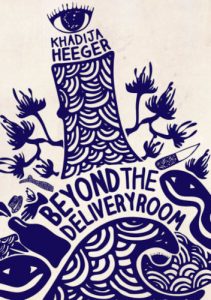
MX: The poem ‘Black Label introduction’, from your debut collection Beyond the Delivery Room, runs over four-and-a-half pages as it delivers a message that is captured in two words: ‘internalised oppression’. A deeply political and challenging poem:
“Wake up from that victim mentality
that’s the control
you see.”
I share this sentiment, as it has been disturbing to me to witness just how many Black people continue to wear victimhood like a cloak. Have you received any feedback on this poem? If so, what have the readers said?
KTH: Yes, from many young people, when I first performed it at the Baxter Theatre. They felt the same way you and I did about that constricting mantle. The latter denies our power. Some older activists were a little reticent, but most of the feedback has been very positive. I was, however, concerned that Caucasians would think this lets them off the hook. [laughs]
MX: ‘About human’ opens with this stanza:
Manvrou, lettie, bulldyke, moffie, stabanie, queer, faggot!
Corrective rape
vain hetero-normative dogma
more right-wing dick mentality dictating the anatomy of my sexuality
my right to be
The poem is a commentary on heteronormativity; in it are interesting rhetorical questions. ‘Lettie’ is new to me, thanks for the lesson. I was intrigued by the two lines in the last-but-one stanza: ‘We have that sacred cow / a new constitution, in need of execution.’ Please write a poem that opens with these two lines and elaborates on them.
KTH:
We have that sacred cow a new constitution,
Desperately in need of execution
the ten commandments of state, an unpracticed philosophy, feigned equality
pressure at the lectern for the well intentioned to turn
profit over peace, over people, over progress
come let us speak in all the correct tones, use words that frame and accentuate the light
while the hands in our pockets fail in blood at Vlakplaas
here, here’s to Wouter Basson for the win, all that killing no longer a sin
now we too swig blue label and gold leaf gin
Another sacred cow worn thin.
MX: Wow, those horrendous memories of Vlakplaas!
From ‘A storypoem of imperfection’, I was reminded of your ‘fallibility’ comment on the work of art, and kept returning to these lines:
We both love another
a haunting her and a hunting there
Chasing the tail of a dragon we fall on the spear, twist on the wire
false lips resurrect the same old game
Oh lover, such a sad, tired, almost over-lying shame.
In the ‘a haunting her’, I kept thinking that wasn’t meant to be, and then I would think, maybe it also works as ‘her’; in this heavily layered poem—the speaker quoting someone else and themselves. I am curious about your process of writing this poem, because it strikes me as a poem that would take a long time to feel ‘done’.
KTH: You are quite right, that is a typo. The book was not proofread well, unfortunately. I am going to have a reprint done because post publication I discovered so many typos.
I actually wrote this poem in one sitting. It poured out of me like tar on a road. I had lived this experience deeply with someone and processed it for many years. It was one of those relationships that burns within and uses up all the oxygen in the room while at the same time feeling like an addiction mistaken for love.
MX: Not many performance poets choose to publish books. Why was it important to you to publish your poetry in book format?
KTH: It wasn’t. Malika actually submitted my poems to Colleen [Higgs, founder of Modjaji Books] a few years prior and eventually Colleen approached me. Same for Thicker than Sorrow.
MX: Napo Masheane, Malika Ndlovu, Koleka Putuma and Phillippa Yaa de Villiers are also poets who started out as theatre practitioners. What’s common among them is that they have each subsequently published a minimum of three poetry collections. How prolific and profound! Is there something about performance that makes the transition to writing and publishing one’s poetry easy?
KTH: I really don’t know. I think for many humans it is a natural progression or the done thing. A case of, if it’s not published it’s not important. That old colonial lie, about what is written is valuable and more true. And, as I say, for many it’s a natural progression. If one is passionate about the work and the message one is attempting to put out into the world, I suppose publishing is noteworthy on some level. Maybe a status symbol. Now that I’ve published two, I will do a third, who knows, maybe a fourth. But I am also very interested in the video archive because I believe in my message, as I am sure all of the poets you mention do. On a personal note, I love their work, all of them.
MX: A video archive would be great. There’s something special about hearing the poet’s voice. You have manifested it, it’s now a question of time.
In 2007 you were commissioned to write and perform a multimedia poetic/theatre piece, ‘Stone Words’, for Spier. What was your process, and how was the work received by the public?
KTH: I already had the work and knew what I wanted to say. The process was selecting the poems that spoke clearly to my intention. I found the right director, after I had selected the poems, by sending the work off to them and then awaiting a response. I knew that I would know who the right person was by the response, and I did. Jaqueline Dommisse directed the piece and really got it on so many levels—in fact, she named it. This was an intensely healing piece for me. The process is truly embedded in the symbolism used on the stage, including the soundscape. We let spirit speak.
MX: Toni Stuart’s words in Thicker than Sorrow read: ‘Her voice is that of the griot, and the sage [..] And through it all, the soft caress of a Cape wind blows, saying: and still we are here, and still we love.’ Annel Pieterse calls the collection ‘an emotional whirlwind’. What were your reasons for choosing Stuart and Pieterse to write blurbs for this collection?
KTH: Toni and I have come a long way together in poetry. I think we both share the belief that poetry can be more than the sum of rhyme, meter and metaphor. I have always loved Toni’s desire to dig deep, to fetch herself from the burial grounds of patriarchy, femicide, racism and dehumanisation, but especially rootlessness.
Annel Pieterse offered a different vantage point, a different cultural, social background from which to view my work, and added to that an academic tone. I wanted someone outside of my community, removed, almost. Yet someone who still had a creative eye.
MX: There is something distinctly surreal about the cover image of Thicker than Sorrow. My eyes are glued to it each time I return to the book and it feels as if I have spotted a new detail every time. This image is a poem. I googled the artist, Graeme Arendse, so I could familiarise myself with his work. What was the process of arriving at this cover? Had you worked with Arendse before? To what extent was the publisher engaged in the conversations on the design?
KTH: I had not worked with Graeme before but I have known him for many years. I trusted that however he interpreted TTS it would come from a place that would access what the book needed. All the images he uses come from inside the pages and are a unification of what he found there, and also a unification on some level of how we journey to ourselves and are always journeying to ourselves. It didn’t take much for me to settle on what he had chosen to do.
MX: You worked with Rustum Kozain as an editor for Beyond the Delivery Room and Thicker than Sorrow. What were your key takeaways from working with Kozain?
KTH: Mainly that he asks the right questions of a poet. It’s not easy to edit poetry. I also discovered that Rustum is actually fluent in Afrikaans, in fact I think it’s his mother-tongue. [laughs] But I did ask him not to touch the Kaaps in Beyond the Delivery Room.
MX: I suspect that historians and literary scholars have found your poetry very suitable for their students. Has academia in South Africa engaged with your work?
KTH: I’ve been used outside of the curriculum quite a bit. The Department of Education doesn’t seem too interested in work that raises discomfort, despite our being thirty years into the so-called new dispensation. The more things change, the more they stay the same. Academics have written me into their theses. Most recently, Karin Benjamin, originally of the Netherlands. I can’t remember too many of the other incidents, I’m afraid. My life has, for the most part, been as the covers of both my collections depict: a whirlpool of mad events that I enthusiastically felt the desire to escape from for a long time. Recently, in the last eight years, this has changed.
MX: Beyond the Delivery Room, your debut, is described on the cover as ‘the first part in a trilogy called Separation Anxiety’. The description says you were writing a second, ‘following the crooked lines of DNA’. Can you share a bit more on your conceptualisation of a trilogy.
KTH: I had an idea and it changed. The trilogy was a thought. But I soon realised I did not want to be locked into an idea.
What is meant to be unique with each collection? I don’t know that there is anything unique about either of them. It’s a human’s search for herself, her place, her own eyes, ears, tongue, feelings, outside of the descriptions foisted on her, in both. BtDR is perhaps angry, hence more painful—the open wound—than TTS. TTS is rooted and accepting of mutability, intangible while sometimes being afraid of it, calmer, older. I’m not trying to be unique, in fact I’m not trying to be anything other than what I find through my searching and writing.
MX: What was the decision process that led to the change of title of the second part? And can we expect a third part?
KTH: ‘Separation Anxiety’ as a title spoke to how we struggled to separate ourselves from the old ways of being. Nicely tied up in separate race groups, complete with finite identities, cultural idioms—but in the case of so-called coloured people, none of that. It may still happen, I’m not sure at this point. Trilogy, three major race groups, three parts, an infinite number of root systems. I suppose the ridiculousness of acknowledging that struck me, and an attempt to place these ideas in three collections … it felt like a journey I wanted to embark on at the time, but I realised I needed to know myself better first. It’s on hold for now.
MX: The provisional title for Thicker than Sorrow was ‘Blood Words’. What led to the change of title? Please walk us through your process of selecting titles.
KTH: It’s a line from one of the poems in the collection. I grew so tired of Africans only being viewed in one way. To the world around us we are the sum of our sorrows, that’s the outer circle. Here in my country, because of my multiple identities, I am viewed in one way, uncouth coloured, no roots, front teeth missing, drunkard, and so on. It is a hand reaching up and out and saying ‘No!’ My blood is thicker than my sorrows, my blood is thicker than the ink in those history books that slanders the truth about me and decks the tables of my children with lies about themselves. Cheche za Afrika.
MX: Both of your collections were published by Modjaji Books. What were your reasons for choosing Modjaji? Or did Modjaji pick you?
KTH: I was not focused on publishing anything. I was content to perform my work.
MX: You move from one language to the next in interesting ways. To what extent are the switches dictated by the content of the poem? What are your processes for undertaking these switches? Is there a pattern you have observed?
KTH: There are simply pictures that are more vivid in each language. Some things can only be spoken in Kaaps Afrikaans, others in ‘official’ Afrikaans, and then there are parts that are better served by English. Kaaps connects me to my community on the Cape Flats, Afrikaans is official to my community in other parts, and English … I’m also acknowledging that Kaaps Afrikaans is a legitimate language! But they each interrogate and validate different places in the poems. To explain the former, I would need to quote from my poems, that’s going to be a much longer answer. Perhaps even a paper, as I interrogate my intention beyond the obvious.
MX: Oh, that’s a paper I would be excited to read.
I enjoyed ‘Cheche za Afrika (Sparks of Africa)’ because of the specifics that make up the poem: riches of the earth from various countries, names of leaders in politics, culture, literature, and more. I get bored and irritated by poems on Africa that merely sing the praises of the continent without any specifics.
KTH: This was a commissioned work. Like you, I had had my fill of paper-thin clichés on Africa and who she is and why. I was to perform it at the World Economic Forum on Africa.
MX: While reading and working on these questions I have learnt about the death of James Matthews, anti-apartheid activist, journalist, novelist, poet, publisher and short story writer, at the age of 95! Did you have any personal experiences with James, or do you have any favourite poems by him?
KTH: I was privileged enough to participate in the James Matthews tribute show at the Artscape Theatre many years ago. A group of younger poets put together a production of his poetry. Two of his poems that I love are ‘The Midnight Hour’ and ‘Age is a Beautiful Phase’. There are more, I think it’s impossible simply to have one favourite of anything.
MX: In ‘Cheche za Afrika’ you open a list-stanza of names of artists and creatives with the phenomenal Nandipha Mntambo, whose cowhide artwork blows my mind. You have also mentioned Mntambo as an artist who has significantly inspired you. Please pick one of her artworks and write an ekphrastic poem.
KTH:
bent in the softness of fur-fold the hide catches, the site of hips rocking
short-sharp back and forth
now ghostly dangling from a tie, the hide unbounds a lie
so many hides to hide
so many ways to bend and fold so many ways to disappear, now here not here
then there,
bare and milked.
MX: ‘Where has the girl gone’ is ‘for those who suffer Anorexia’. Similarly, ‘Any other planet but here’ is ‘for victims of Human Trafficking’. I have no memory of reading poetry on these topics before. What were the specific inspirations for these two works?
KTH: Invisibility, I think, was my main motivation. I am always struck by stories of women forced (directly or indirectly) to prostitute themselves, waiting for the ships, and how women in general are still in so many ways caught in the pattern and mire of the thousands of heads and incarnations of sexism and patriarchy.
MX: I smiled for the first time when reading Beyond the Delivery Room when I read the 28th poem, ‘A love poem for Africa’:
We could dance a moment,
kiss the ground with urgent feet
that spell our names for the moon and the sun
These opening lines set the scene for a gentle, comforting and evocative connection with the continent. The metaphors are wide ranging, the similes are curious. Having read it numerous times I still do not think that I get it, fully. I know for sure that I love it, completely, because of how it makes me feel. The suggestive and soothing ‘we could dance a moment’ appearing in four of the six stanzas felt like a pillar I could hold on to as I read. Please share your process of writing this poem.
KTH: There are few things in life that awaken and set us on the same plane, as it were. Dancing is at once immediate and body and soul-bound, freeing. If we could simply find the time, more moments, make more space, we would remember in the dance that we are everything and everyone and much, much more and nothing but beautiful, all of us. And, it is also a love poem to a lover.
MX: I looked everywhere in the poems for the words ‘beyond the delivery room’ as I tried to contextualise the book’s title. Did I miss it? How did you arrive at the title for the book?
KTH: The title simply means us, me, beyond the birth of this new South Africa.
MX: When asked in a recent interview what is art’s most important function, you responded:
To stimulate conversation. To remind us of beauty. To mediate the political and social landscape. To be a scalpel. To say the thing that needs saying. To rail against the inane, cruel establishment. To remind us of our fallibility. And again, to remind of beauty, love, compassion, mercy, grace.
You have given me words I will be quoting into eternity. While apt, this response is also poetic. Railing against the inane and being a scalpel were my favourites. You ended your response by saying ‘all these and more’. What more would you like to add to these?
KTH: Art is everything we need to be and everything we are. It can save us from ourselves, if we let it.
MX: How would you describe the dance between performing poetry and acting before a pupil in a high school?
KTH: Acting is pretending to be a character. Poetry is telling and revealing (sometimes inadvertently) the truth in the individual. Sometimes the actor uses truths from the poet to give credibility to the character.
MX: When I read the final poem, ‘Menonpause’, I laughed out loud. Humour on steroids! The first six lines read:
I could cogitate, masturbate
get a tax rebate, fraternise with yet another ingrate
or possibly negotiate
the relativity of love in my mid-life heightened sexual state
but which country is that in?
Do you know?
While these opening lines are humorous and surprisingly rhythmic, in this poem the speaker is in a deep meditation on sexual arousal while being in company with the self. It ends with the stanza:
so I pull down my panties
while my cupboard stares back at my crack
and I switch on my humming vibrator
whom I’ve affectionately named Jack
at least I know next Saturday
he’ll be back
Well, I suppose: ‘We could dance a moment / Massage the keyboard with vibrant hands / That speak our presence to the seas and the lands.’ But let us end with those humming words of that erotic last stanza of the 30th, final poem in Beyond the Delivery Room. Thank you for agreeing to be interviewed. Might there be something else you wish to share with the readers? If yes, please go ahead.
KTH: Writing is poetry, performing poetry is a naked affair, but I’d rather be naked than take up residence behind a mask. This is the only way beauty, true beauty, can be rescued from its grave. Self-acceptance. Everything else is …
This was such a stimulating exercise. Thank you for giving such attention to my work, Khosi. I feel so honoured and seen. Bless you abundantly.
- Makhosazana Xaba is a Patron. Xaba is an author, translator, and poet. She has written four poetry collections, these hands, Tongues of their Mothers, The Alkalinity of Bottled Water and The Art of Waiting for Tales. Her debut short story collection, Running and other stories, was a joint winner of the 2014 South African Literary Awards and Nadine Gordimer Short Story Award. Xaba has edited several books, including Our Word, Our Worlds: Writing on Black South African Women Poets, 2000–2015, Queer Africa: Selected Stories (with Karen Martin) and Noni Jabavu: A Stranger at Home (with Athambile Masola). Her latest book is Izimpabanga Zomhlaba, an isiZulu translation of The Wretched of the Earth by Frantz Fanon.