
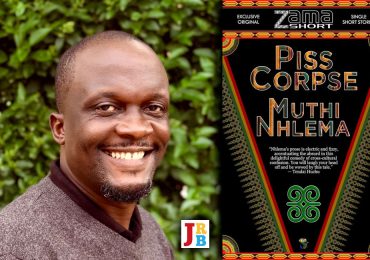
The JRB presents an excerpt from Muthi Nhlema’s ‘Piss Corpse’, the debut short story of the ZamaShort imprint series of single short stories.

~~~
‘Piss Corpse’ by Muthi Nhlema
ZamaShort #1
Charlotte was an expat volunteer first introduced to Mbumba a few days after her arrival in Malawi—on a US Peace Corps assignment helping primary school pupils improve their command of English. Mbumba was her work-appointed chaperone from the US Peace Corps office whose role, despite a litany of official-sounding words, could be summarised as ‘keep the mzungu out of trouble’. A simple task that had grown in importance following the recent high jinks of visiting volunteers from years past. The classic being the Lake of Stars weekend pictorial spread of a Peace Corps volunteer, piss-drunk in an unlined ditch, wearing a t-shirt with an unflattering caricature of the country’s President with a Hitler moustache, all in the sharpened undeniability of high-definition colour. American efficiency guaranteed the volunteer’s swift deportation that same afternoon, accompanied with a quiet apology that never made the front page. This was an incident the US Peace Corps wished not to repeat, with the help of chaperones like Mbumba.
‘Welcome to the piss corpse,’ Mbumba said with a heavy accent, on their first encounter in the busy office lobby. The lobby was a hive of clumsy conversation between other volunteers and their chaperones who politely smiled, pretending to find the butchered Chewa greetings endearing.
Piss corpse? ‘I’m sorry?’ replied Charlotte, straining not to come across as rude or, worse, condescending.
‘Welcome to the piss corpse,’ Mbumba repeated, unfazed.
Charlotte’s face became a nodding mask of comprehension. ‘Ahhh! You mean Peace Corps?’ she exclaimed, placing strong emphasis on Peace while giving Mbumba’s shoulder a gentle squeeze.
‘Ah eh! Piss Corpse,’ Mbumba repeated, oblivious to the correction. Charlotte smirked, less at Mbumba’s innocent persistence, and more to a bizarre contemplation.
What the hell is a piss corpse?
They left the crowded lobby of first encounters and stepped onto the threshold of a country which to Charlotte, until a few weeks ago, was where the Material Girl kidnapped her children, and legend had it, had the best cannabis this side of the pond, allegedly. While she was mentally prepared for certain afrosyncrasies, African time prominent among them, nothing prepared her for the cultural whiplash that was to come, a constant reminder that she wasn’t in Iowa anymore.
Fahrenheit became Celsius.
Gas was fuel.
Directory was a phone book.
Fries were chips and chips were crisps.
Telephone poles were papered over with tattered posters promising the return of long-lost lovers in 24 hours.
Rush hour traffic was often worsened, if not by the hungry-looking (yet well-fed) traffic police, then usually by crowds of saggy-trousered vendors glistening from the midday swelter blocking the carriageway to mock two yelping dogs locked in a copulatory tie.
Malawian men often jay-walked with hands locked in pinkie-finger holds, in public.
Weekends were for weddings and, apparently, one’s knowledge of the occasion constituted an invitation.
Strangely, other azungu she did not even know, would give her nods of acknowledgement like a covert greeting of a secret society she was not aware she was a member of.
People used kilometres instead of miles, trousers instead of pants, and shrubbed their Rs into Ls and vice versa.
‘Pubric toirets are for sorids not riquids’, was a particular tongue-twisting favourite for the expat volunteers and never failed to tickle Charlotte’s funny bone to no end, to the bewilderment of Mbumba who genuinely failed to see the humour.
‘C’mon! That was funny,’ a red-faced Charlotte assured Mbumba.
‘Learry?’ Mbumba replied before slightly sucking her teeth.
Disorienting as all this was initially, there was one particular Malawian quirk Charlotte instantly welcomed with open arms; she did not have to worry about the judging eyes of emaciated onlookers, with impossibly flat tummies and petite waists, as she packed on the calories. And pack them on, she did.
Fried chiwaya from the roadside. Oily mandasi in buckets, balanced on hawkers’ heads. Protruding bellies parading unashamedly down the litter-strewn jagged-edged city streets.
Yep! She was not in Iowa anymore.
*
Beyond just translating, Mbumba was Charlotte’s diviner of all afrosyncratic mysteries that had assumed an almost mythical allure. Charlotte’s childlike fascination with what were common forms of communication never ceased to amaze Mbumba to the point of hilarity. One time, Mbumba played a little trick on Charlotte who, for days, was obsessing over why women randomly, and often violently, patted the top of their weave-haloed heads.
‘Azungu inu always comprain about—ujeni!—stress.’ Mbumba replied, snapping her fingers repeatedly. ‘We pat to rerieve stress.’
As Charlotte studiously ruminated over this indigenous knowledge, Mbumba, with dead-pan delivery, added, ‘And it wards off evil spilits.’
Enlightened with this new-found wisdom, Charlotte, in sisterly solidarity, appropriated the head-patting as her own, to Mbumba’s delight. She was seen in the office and the field, patting away at her head for days at a time, often to the amusement of her pupils and office mates. But she was unmoved. She saw herself as more enlightened—virtuous even—compared to the other expat volunteers who failed to assimilate, instead preferring to escape to their comfort bubbles of expensive cafes and imported whiskey, an oasis of first-world luxuries in a desert of majority world squalor.
The wonderment of this assumed habit, however, was short-lived once one of the other chaperones in the office recommended a natural home-made remedy for Charlotte’s evidently itchy scalp. Feeling betrayed despite her good intentions, Charlotte confronted Mbumba one early office morning before commencement of field work.
‘Iwe Charoti! Are you angly or emballassed?’ Mbumba asked, unsure of how to interpret Charlotte’s strawberry flush.
‘How could you do that to me?’ Charlotte exclaimed, sucking her teeth appropriately. ‘And it’s Charlotte not Charoti?’
After a minute pause, their pursed lips thawed into lines of mischief, with a high chance of laughter on the horizon. And, with pitch perfect timing, they high fived each other in mutual elation, the way the women in the village did after a dose of off-colour gossip.
‘Ha! Ha! Ha! Ehhhhh!’ they both exclaimed. Charlotte’s intonation was off, but Mbumba let it slide.
‘I’ll get you for that one,’ Charlotte exclaimed, pushing Mbumba playfully away.
The wall of professional distance fell, and a bond was formed.
A friendship, forged.
~~~
- When Muthi Nhlema isn’t managing a non-profit or trying to understand his twelve-year-old son’s obsession with anime, he is a Malawian writer best known for his adventures (and misadventures) in African speculative fiction. This story was written during his stay in the International Writing Program at the University of Iowa.
~~~
Publisher information
ZamaShort is a new imprint from StoryTime, publisher of the African Roar and AfroSF series of anthologies. The ZamaShort series is solely focused on the amazing powerhouse that is the short story. We give each short story its own publication so that it may be read and enjoyed fully as a stand-alone publication. As per the StoryTime mandate initialised in 2007, ZamaShort continues to champion and add to the ever-growing canon of African literature excellence and diversity.
Meet Charlotte, Peace Corps volunteer fresh off the plane from Iowa to Malawi and teaching English at a local school. Loaded with hilarious preconceptions as an American, feminist, and agnostic, she expected an adventure—just not one where trousers mean pants and white privilege feels like the punchline of a bad joke. With the help of her spirited chaperone, Malawian Mbumba, Charlotte is ushered into a culture clash more like a train smash and has never felt more alive.
‘“Piss Corpse” is a marvellous debut in the ZamaShort series. The very best elements of short stories—characters immediately brought to life, a setting both familiar and defamiliarized, a tight narrative arc with a perfectly paced ending, and, best of all, the type of satire that makes African humour so brilliant.’
—Tsitsi Ella Jaji‘Nhlema’s prose is electric and fizzy, accentuating the absurd in this delightful comedy of cross-cultural confusion. You will laugh your head off and be wowed by this tale.’
—Tendai Huchu‘With biting satire and irreverent humour, “Piss Corpse” dives headfirst into the messiness of cultural collisions, linguistic blunders, the pitfalls of performative wokeness, and the unexpected grace of getting everything wrong.’
—Ekari Chirombo‘“Piss Corpse” is a story with an attitude. It might even be the right attitude. In its ferocity, revulsion at male oppression and corporate cultural garbage, and its weird and coruscating wit, it reads like a mixture of Celine and early Ngugi. Paraffin for wine drinkers.’
—Imraan Coovadia‘Nhlema writes with wit and irony. I enjoyed this humorous take on culture-clashes.’
—Brian Chikwava

One thought on “‘Keep the mzungu out of trouble’—Read an excerpt from ‘Piss Corpse’ by Muthi Nhlema, the debut publication from ZamaShort”