The JRB presents an excerpt from Not This Tender, a new poetry collection by Sarah Uheida.
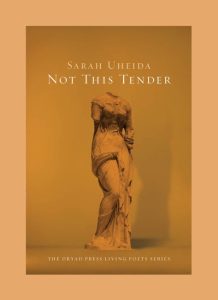
Sarah Uheida
Not This Tender
Dryad Press, 2025
If Waiting Is a Bargain You Make with the Gone
A father’s job is not to teach his children
to swim but to pull their bodies from the water
each time they are drunk by Tripoli’s blue-blue-blue—
and this July heat, honest about its thistle and thirst.
He leaves them ashore, shoals where salt
clogs noses and is instantly forgiven,
their bones already memorising the stride
and stray of swaying water, for the dark hours—
when they will close their eyes
and still feel the sea’s insistence
on the beauty of dreamless sleep.
Their dad plunges ahead, his body
softens the fall, and he smiles to himself,
weightless in Mediterranean melancholia.
He dives, drifting past the two orange flags
hung up by fishermen who know
rip current, bait, moon and tide—
men who can tell patience from waiting,
and know which one comes first.
(If waiting is a bargain you make with the gone
—hollowed with hope porous with promise selfish as
sacrifice and more brittle—then patience is how the sea will
say, sorry for your loss.)
But he looks back. He always looks back.
Neck straining for the yellow and pink
of their smallness, their shrill inland laughter
a deserted lighthouse that, unneeded
by men and unloved by water, sits brilliant
and blinking at itself, luminous for no one.
He never taught his daughters to swim,
though it was not a broken-winged bird thing,
was not a tyrant father thing; just sweet, blue-lipped
delirium, that he could always swim back in time
or if too far, unearth them later, undrown them,
these gilled girls of his: he keeps
forgetting to waterproof their lungs.
On that same searing morning,
blue-irised sky bored and light-blind,
one daughter learns waiting,
the other not-returning.
It isn’t even 8 a.m.,
and the sun is starting to sing,
peeling dark shoulders, less scornful
more paled with pretty plight.
And July, like so much unfinished business,
comes up for air again and again.
But of course, he always swims back,
back just in time, of course
he saves them, loves them—
and the sea is spared, every sky
charcoaled and moonlit,
the cantaloup starred open,
sweetness soaking sleeves.
So much summer inertia,
a good night’s sleep,
on beds he built
from sturdy teakwood;
and his children, who, full of safe landings,
forget all his leaving—unlearn patience—
until the next morning,
when they’ll follow him back into the sea.
*
- Sarah Uheida is a Libyan-born poet and essayist, living and working in Cape Town. She holds an MA in English Studies specialising in poetry from Stellenbosch University, with distinction. In 2021, Uheida was the recipient of the internationally renowned Miles Morland Foundation Writing Scholarship. She is also the recipient of the 2020 Dan Veach Prize for Young Poets. Her writing been published in anthologies like We Call to the Eye & the Night and Relations: An Anthology of African and diaspora Voices, and in journals such as New Contrast, The Atlanta Review, HarperCollins, the other side of hope, The Shore, fresh.ink, Plume, Every Day Fiction, and elsewhere. She is a regular contributor at readings by poetry groups such as Off the Wall and The Red Wheelbarrow. Not This Tender is her debut collection.
~~~
Publisher information
‘A conjuring voice and a poetry of longing.’—Gabeba Baderoon
Sarah Uheida’s poetry collection Not This Tender is a profound exploration of memory, navigating the landscape of the war-torn North Africa she was forced to flee as a child. It is a mythical yet deeply personal examination of longing and belonging, estrangement, loss and the influence of family and language, presented through immersive portraits and the lens of a fractured landscape.
Here, poetry is wielded as both refuge and rupture in an excavation of the past—not to preserve it, but to make sense of the future. Through its vivid, evocative imagery, the collection offers a powerful journey through the restless search for home, and the fragile yet unrelenting hope of return.