The JRB presents an excerpt from The Devil Made Me Do It: Understanding Occult Crime in South Africa by Nicky Falkof.
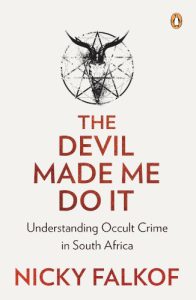
The Devil Made Me Do It: Understanding Occult Crime in South Africa
Nicky Falkof
Penguin Random House SA, 2025
Does South Africa have a problem with occult crime, or does it have a problem with belief in the occult? In an anxiety-provoking landscape such as this one, where threat and violence are often only a city block or a security fence away, the way that we feel about danger can have almost as much impact on our daily lives as its reality. Fear-laden emotional states are not just personal; they also have significant consequences for society.
When people’s fears are explicitly about occult or supernatural threats, and these fears are echoed in newspapers, on social media, and in the pronouncements of police and government figures, the idea of occult danger becomes legitimised. This has bleak consequences for the way many of us view and experience the world that we live in. It hardens the idea that we live alongside inhuman evil and makes our pedestrian modes of survival seem futile. Believing that the occult poses a genuine threat to our wellbeing, and transmitting these worries through talk, rumour, posting, forwarding and texting, impacts on how individuals behave in response to a feeling of unsafety and on how society reacts to threats, crimes and danger, both actual and potential.
Whether we blame demonic attacks or mental illness, dispossession or heredity, the fact remains that appalling violence is appallingly common in our society, and that the perpetrators of these acts are themselves a product and a part of society. Something has gone terribly wrong in South Africa, and prayer will not help us to right it. Rather than offering solutions to the problems that we face, our fascination with occult crime distracts us from and papers over many of the harsh realities we need to face.
When human violence and venality are overlooked in favour of a turn to the spiritual or supernatural, the possibility of real action moves even further away. Our collective imagination remains locked in a fabulist narrative about good and evil, God and Satan, rather than shining a light on the fact that the traumas we face as individuals and as a society come most often from inside: from our flawed, dangerous and all too human selves, rather than from mythical others.
Beliefs in the occult, and in the prevalence and threat of occult violence, perform several social functions that can help to explain their persistence. Firstly, occult explanations can allow us to make sense of an otherwise senseless world. When terrible things happen to people who don’t seem to deserve them, when families, communities and even nations experience wave after wave of tragedy, loss or trauma, we may find ourselves desperately looking about for explanations, whether reasonable or not.
Placing the blame on demonic possession, a local witch or a satanic cult can, perversely, offer a form of comfort, in which the world makes sense, and one can at least feel victimised by something purposeful rather than feeling that suffering is random. Occult beliefs give us something or someone to blame, and this supports a cosmology in which the universe has logic and order, albeit a logic and order that may revolve around terrifying supernatural powers and the perpetual presence of evil.
Much like how religion can operate as an organising principle for society, occult beliefs tell us that things happen for a reason and that our little lives have some meaning. In a world that can be increasingly difficult to understand, subject to vast global forces of technology and capitalism that we may struggle to comprehend, it is not so surprising that many of us turn to spiritual or supernatural explanations, especially when such explanations make sense in terms of the cultures we’ve been raised in.
Secondly, occult explanations can offer a feeling of power and agency. Daily life in this era of uncertainty, especially in an unequal country like South Africa, can be distressing. From genuine misfortune and failure to an overwhelming sense of precarity and anxiety, everyday existence can make people feel horribly powerless, with no capacity to resist bad luck, state incompetence, ill health, corruption, lack of opportunities or any of the other challenges that we face here. However, if a witch, demon or satanist is responsible for the terrible things that are happening around us, at least we can turn to prayer, muti, exorcism or rituals to try to mitigate the dark forces pervading our world. If we give money to a prophet or follow the teachings of makeshift churches, perhaps our luck will turn; perhaps we can take control of our situation. In providing a target for our ire, a focus for our anger and frustration, beliefs in the occult make us feel that we can act to address complicated problems, that we are not helpless.
Thirdly, occult beliefs have a powerful conforming effect. From teenagers who wear black clothes and listen to the ‘wrong’ kind of music to business owners who do suspiciously well and older women who are too independent and outspoken, standing out from the crowd can be a lightning rod for accusations of occult involvement. Such accusations then serve as a disciplinary mechanism, keeping us in line, deterring us from breaking social taboos or taking risks. This disciplining can constrain both individuals and society, making us wary of doing anything out of the ordinary or against the norm.
The push towards conformity can also be seen in how rumours of occult involvement spread, where people invest emotionally in these kinds of claims, passing them around with terror or glee, as a way of demonstrating that they personally are not tainted or involved. Occult accusations become a way of ostracising anyone who is seen to be different or other, so that ‘we’, the normal ones, the ones who do things ‘right’, can cohere as a group. Staying within the bounds of society means being like everyone else, following majority opinion and behaviour, not daring to argue that the emperor has no clothes.
Fourthly, occult beliefs and rumours can operate as a means of broad social control. A terrified population is often docile, at least in the sense that it’s too busy persecuting witches or monitoring for cult activity to turn on the economic and political elites who are responsible for much of the country’s daily misery. It serves the interests of the powerful for the masses to have supernatural subjects to blame for any misfortune, and South Africans’ emphasis on the problem of the occult has long been a useful distraction from discomforting realities. Tenderpreneurs, state capture, gangster capitalism and cadre deployment pose more of a threat to social mobility and economic wellbeing than sorcery does, but mobilisation against the latter can often stand in for effective collective action against the former. We see these same tendencies elsewhere. In the US, conspiratorial beliefs about an elite cabal of vampiric paedophiles supported the rise to power of a group of unaccountable billionaires whose blood-sucking tendencies may be metaphorical rather than literal, but who are nonetheless causing immense harm to ordinary people.
As we have seen throughout this book, muti murders, ritual killings and other apparently occult crimes remain disturbingly common. Intermittent panics about the supernatural or cultic motivations behind such acts do nothing to lessen their frequency, or to provide a practical toolkit for forestalling or responding to them. They don’t help us to increase critical thinking, foster media literacy, or support people in developing the skills they need to avoid religious scams and evaluate supernatural claims. They don’t help us increase our capacity to deal with and forestall gender-based harm, or to develop strategies to minimise the social drivers of inequality and violence.
Fantastic narratives about the causes and sources of crime may help individual people to make sense of them, or even to feel slightly less at risk, but they are of no use when it comes to actively trying to improve our crime rates. Bontle Mashiyane, Jerobejin van Wyk, Keamogetswe Sefularo and the other victims named in this book were killed in ways that would be no less brutal if we did not call them occult. Blaming supernatural forces for what happened to them does not help us stop such horrible, self-serving violence from happening again.
When influential players like police, journalists, civil servants and clergy uncritically repeat the idea that the Devil is to blame for violence and social decay, they add further impetus to the damaging idea that our problems can be understood and solved with supernatural rather than empirical approaches. Police and press in particular need to be significantly more cautious about how they approach supposedly occult crime. Rather than repeating or amplifying the features of an ongoing moral panic, in many cases because it dovetails with their own personal beliefs, these parties need to think more carefully about what they are justifying or explaining, what they are avoiding, and what effect this might have on the kind of society we want to build. Those who have the power to set the national agenda, to impact on our collective imagination and political discourse, bear a major responsibility when it comes to the language they use and the mythologies they invest in.
~~~
- Nicky Falkof is a writer and academic based in Johannesburg. She is a professor of Media Studies at Wits University and currently heads up the Wits Centre for Diversity Studies. Her research is primarily concerned with race and anxiety in South Africa, with a specific interest in the forms, mythologies and consequences of white fear. She has secondary interests in gender, popular media and culture, moral panic and the social geography of global south cities. Nicky has a PhD in Interdisciplinary Humanities and Cultural Studies from the London Consortium, part of Birkbeck College, University of London. This is her fourth book. For more information, visit nickyfalkof.com.
~~~
Publisher information
South Africa can sometimes appear to be awash with occult crime. From satanist conspiracies and witchcraft accusations to muti murders and demonic possession, a trawl through our national news suggests a society at war with the forces of evil.
Why does the occult have such a grasp on our collective imagination? In this vastly unequal country, with its crises of gender-based violence, child abuse, poverty and unemployment, there are more than enough obvious dangers to our social stability. Why, then, are South Africans so quick to blame the supernatural for violence and misfortune? How do beliefs in occult crime intersect with problems of gender, race and class? And is there any truth to these supernatural tales?
The Devil Made Me Do It examines these and other thorny questions by probing the stories, beliefs and rumours behind the so-called occult crimes that have entranced South Africa’s fractured psyche. They include the murder of a child mistaken for a tokoloshe in the 1920s, the satanic panic that gripped the nation in the 1980s and 1990s, the Krugersdorp cult killings of 2012–16, and the muti murder of a six-year-old girl in 2022. What can these crimes, and the way they are represented by media, police and other institutions, tell us about South Africa today?